Kapaya Nayaka
Musunuri chief (fl. c. 1336–1368), cousin and successor of Prolaya Nayaka. He took Warangal from the Delhi governors and ruled as 'lord of the Andhra country'. He is identified with the Kanya Naik of Barani and the Krishna Naik of Ferishta. He helped the founders of the Bahmani kingdom, then lost Kaulas and Golconda to them. He was overthrown by the Recherla Velamas in about 1368.
Kapaya Nayaka was a Musunuri chief whose capital was Warangal, according to his own grant of 1346.1 An inscription of 1357 calls him “the Lord of the Andhra country”.2 Yashoda Devi writes that the Recherla chief Anapota Nayaka defeated and killed him in about 1368.34 See the Musunuri Nayakas.
Family
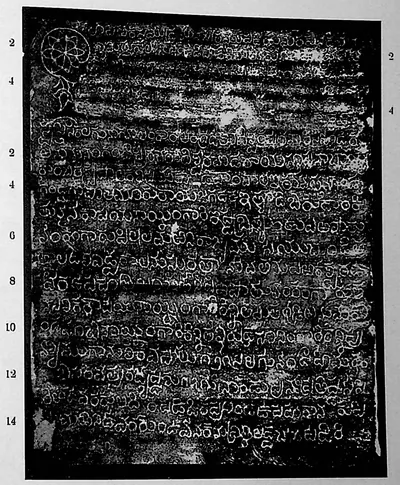
Kapaya Nayaka, or Kapa, is known from his own copper-plate grant of 1346, found at Guraja in the old Krishna (then Kistna) district.51 It grants the village of Prolavaram for the merit of his “predecessor” Prolaya-nayaka.51 The grant gives the donor’s pedigree for three generations: Pota, the first of the line, had four sons, Pocha, Deva, Kama and Raja.1 Pocha’s sons were Prola and Erapota, Deva’s were Kapa and Mummadisa, Kama’s were Immadisa and Deva, and Raja’s son was Anavota, lord of Toyyeru.1
Kapaya was therefore the son of Deva and a first cousin of Prolaya Nayaka.67 But Prolaya’s own Vilasa grant calls Kapaya one of his younger brothers.67
According to the Akkalapundi grant of 1368, Kapaya-nayaka, “the famous Suratrana” (sultan) of the Andhra country, gave his sister’s daughter in marriage to Mummadi-nayaka of Korukonda.8 The editor of that grant thought Mummadi-nayaka was the first of his family to rise to importance.910 He wrote that this was “perhaps by virtue of his close connection with Kapaya-nayaka, the Sultan of the Andhra country”.910
Titles
The Guraja grant calls him Prataparudra-pratima-prabhava, equal in power to Prataparudra.1 It puts his capital at Ekasilanagari, Warangal.1
In the Pillalamarri inscription of 1357 he is “the Lord of the Andhra country” and lord of the excellent city of Anumanamgallu.2 It gives him titles such as “the master who established the Coda king” and “the protector of the security of Kanci”.2
An inscription at Ganapesvaram is dated Saka 1268 (1346–47; Saka is an Indian way of counting years), and it was published only in Telugu, in South-Indian Inscriptions IV.1112 It records a gift for his merit by one of his servants.1112 It gives him the same title of lord of the city of Anumanamgallu.1112 In the Akkalapundi grant he is Andhra-suratrana, the Sultan of the Andhra country.8
Warangal
Under Prolaya, the Vilasa grant says, Kapaya was one of the brothers to whom the government was entrusted.7 He succeeded his cousin and took Warangal from the Delhi Sultanate. The epigraphist who reported the Guraja grant in 1934–35 inferred that Kapaya came to rule the Telugu country some time after Prataparudra’s death.1 He argued that Kapaya can have recaptured Warangal only after about 1335, since Muslim troops held it until then.1 He also noted that Kapaya had been identified with the Kanya-Nayaka or Krishna-Nayak of the Muslim historians.1
Barani says that “Kanya Naik had gathered strength in the country”.13 He says the governor Malik Makbul fled to Delhi, and that “the Hindus took possession of Arangal, which was thus entirely lost”.13 Ferishta dates the rising of “Krishn Naig, the son of Luddur Dew” to AH 744 (1343–44; AH is the Islamic way of counting years).14 He makes it a joint enterprise with “Bilal Dew, Raja of the Carnatic”, whose troops helped him to take Warangal.14 Robert Sewell names the Hoysala Ballala princes as Krishna’s allies in this rising.15
V. Yashoda Devi and the editors of the Vilasa grant place the capture of Warangal in about 1336–37.1617 See Warangal and the Delhi Sultanate in the Telugu country.
Yashoda Devi describes Kapaya as ruling both Telangana and the coast through relatives and allies.1819 In her account his cousin Anavota held Toyyeru on the coast, and the Manchikonda chief Kunaya Nayaka held Korukonda.1819 Prolaya Vema Reddi held the country south of the Krishna from Addanki.1819
The editors of the Vilasa grant summarise the Kaluvacheru grant of 1423.20 It names the Reddi founder Vema among the seventy-five nayakas (military chiefs) who served Kapaya.20
The Bahmanis
Kapaya backed the officers of the Deccan who rose against Muhammad bin Tughluq. Ferishta says that their leader, Zafar Khan, was joined before the battle at Bidar by “fifteen thousand infantry, sent by the Raja of Tulingana”.21 Haig, writing in 1928, names this raja “Kanhayya Naik of Warangal”.22
After the Bahmani kingdom was founded, the Burhan-i Ma’asir says, Sikandar Khan wrote to “Kanabayand, who was wali of Telingana”, for elephants.2324 Kanabayand submitted and sent presents.2324
Ferishta says that Bahman Shah took Kaulas from the Raja of Warangal and made an alliance with him.2526 In return for the raja’s help, Ferishta says, he let him off lightly, and the raja agreed to pay the tribute he had paid to Delhi.2526 Haig too says that Kanhayya was forced to cede Kaulas and pay tribute.27
The next sultan, Muhammad Shah I, fought him for years. In Ferishta’s account:28293031
- the Raja of Telingana sent his son Vinaik Dew to recover Kaulas, and he was defeated28
- the sultan later surprised Vinaik Dew at Velumputtun and had him thrown from a catapult into a fire29
- in a final campaign of nearly two years the raja gave up three hundred elephants, two hundred horses and thirty-three lakhs of rupees, and ceded the hill fort of Golconda30
- the raja presented the jewelled throne that the sultan named the Takht-i-Feroza31
Haig dates the seizure of the horses to 1362.32 He dates the sultan’s first sitting on the throne to 21 March 1365.33 Ferishta also says that the raja, “enraged at the death of his son”, offered to become a vassal of Firuz Tughluq of Delhi if he would send an army south.34 But Firuz was too busy at home to help.30 See Golconda and Kaulas.
The end
Yashoda Devi describes Kapaya’s last years as a struggle with the Recherla Velamas.34 In her account their chief Anapota Nayaka defeated and killed him in a battle at Bhimavaram in about 1368.34 When Anapota made his grant at Inavolu in July 1369, he was ruling Orugallu, Tribhuvanagiri, Rajukonda and the rest of the Telugu country.35 See the Recherla Velamas and the Inavolu inscription.
Evidence and disagreements
- Prolaya. Kapaya’s cousin (Guraja grant) or younger brother (Vilasa grant); K. Rama Sastri, following H. Krishna Sastri, called Kapaya “the son of Prolaya” in 1916.1710
- The Persian names. Kanya Naik (Barani), Krishn Naig “son of Luddur Dew” (Ferishta), Kanabayand or Kabanand (Burhan-i Ma’asir), Krishna or Kanhayya Naik “apparently a scion of the Kakatiyas” (Haig). M. Somasekhara Sarma argued in 1931 that the Burhan-i Ma’asir’s Kabanayand stood for Kapaya-nayaka.1314233637
- The capture of Warangal. About 1336–37, after 1335, or 1343–44 (Ferishta).1617114
- Anumanamgallu. The Ganapesvaram and Pillalamarri records name Kapaya’s city as Arumanamganti and Anumanamgallu; Somasekhara Sarma took them for one place, a village about ten miles from Pillalamarri in the Suryapet taluk.122
Footnotes
-
Annual Report on South-Indian Epigraphy for 1934–35 (1938), p. 74 (archive.org (opens in a new tab)). Paraphrased. ↩ ↩2 ↩3 ↩4 ↩5 ↩6 ↩7 ↩8 ↩9 ↩10 ↩11 ↩12
-
P. Sreenivasachar (ed.), A Corpus of Inscriptions in the Telingana Districts, Part II (1940), p. 114, No. 40, translation (archive.org (opens in a new tab)). Paraphrased. ↩ ↩2 ↩3 ↩4
-
Yashoda Devi, After the Kakatiyas (1975), pp. 63–64. Cite-only; paraphrased. ↩ ↩2 ↩3
-
Yashoda Devi, After the Kakatiyas (1975), p. 65. Cite-only; paraphrased. ↩ ↩2 ↩3
-
Annual Report on South-Indian Epigraphy for the Year ending 31st March 1935 (1938), p. 73, para. 52 (archive.org (opens in a new tab)). Paraphrased. ↩ ↩2
-
Venkataramanayya and Somasekhara Sarma, “Vilasa Grant” (1957–58), p. 250 (archive.org (opens in a new tab)). Paraphrased. ↩ ↩2
-
N. Venkataramanayya and M. Somasekhara Sarma, “Vilasa Grant of Prolaya-nayaka”, Epigraphia Indica XXXII (1957–58), p. 242 (archive.org (opens in a new tab)). Paraphrased. ↩ ↩2 ↩3 ↩4
-
Rama Sastri, “Akkalapundi Grant” (1916), p. 272, translation, verse 25 (archive.org (opens in a new tab)). ↩ ↩2
-
K. Rama Sastri, “Akkalapundi Grant of Singaya-nayaka; Saka-Samvat 1290”, Epigraphia Indica XIII (1915–16), p. 260 (archive.org (opens in a new tab)). ↩ ↩2
-
K. Rama Sastri, “Akkalapundi Grant of Singaya-nayaka; Saka-Samvat 1290”, Epigraphia Indica XIII (1915–16), p. 261 (archive.org (opens in a new tab)). ↩ ↩2 ↩3
-
H. Krishna Sastri (ed.), South-Indian Inscriptions (Texts), Vol. IV (1923), p. 312, No. 950, Ganapesvaram (A.R. No. 133 of 1893) (archive.org (opens in a new tab)). Telugu text. ↩ ↩2 ↩3
-
M. Somasekhara Sarma, “Kapaya Nayaka”, Journal of the Andhra Historical Research Society V (1931), pp. 218–219 (archive.org (opens in a new tab)). Cite-only; paraphrased. ↩ ↩2 ↩3 ↩4
-
H. M. Elliot and John Dowson, The History of India as Told by Its Own Historians, Vol. III (1871), p. 245 (archive.org (opens in a new tab)). ↩ ↩2 ↩3
-
Muhammad Qasim Ferishta, tr. John Briggs, History of the Rise of the Mahomedan Power in India, Vol. I (1829), p. 427 (archive.org (opens in a new tab)). ↩ ↩2 ↩3 ↩4
-
Robert Sewell, A Forgotten Empire (Vijayanagar) (1900), p. 26 (archive.org (opens in a new tab)). ↩
-
Venkataramanayya and Somasekhara Sarma, “Vilasa Grant” (1957–58), p. 256 (archive.org (opens in a new tab)). Paraphrased. ↩ ↩2
-
V. Yashoda Devi, After the Kakatiyas (1975), p. 49. Cite-only; paraphrased. ↩ ↩2
-
Yashoda Devi, After the Kakatiyas (1975), p. 50. Cite-only; paraphrased. ↩ ↩2 ↩3
-
Yashoda Devi, After the Kakatiyas (1975), p. 51. Cite-only; paraphrased. ↩ ↩2 ↩3
-
Venkataramanayya and Somasekhara Sarma, “Vilasa Grant” (1957–58), p. 254 (archive.org (opens in a new tab)). Paraphrased. ↩ ↩2
-
Ferishta, tr. Briggs, Rise of the Mahomedan Power, Vol. II (1829), p. 289 (archive.org (opens in a new tab)). ↩
-
Haig, Cambridge History of India, Vol. III (1928), p. 170 (archive.org (opens in a new tab)). ↩
-
J. S. King, The History of the Bahmani Dynasty, founded on the Burhan-i Ma’asir (1900), p. 9 and notes 15–17 (archive.org (opens in a new tab)). ↩ ↩2 ↩3
-
King, History of the Bahmani Dynasty (1900), p. 10 (archive.org (opens in a new tab)). ↩ ↩2
-
Ferishta, tr. Briggs, Vol. II (1829), p. 293 (archive.org (opens in a new tab)). ↩ ↩2
-
Ferishta, tr. Briggs, Vol. II (1829), p. 294 (archive.org (opens in a new tab)). ↩ ↩2
-
Haig, Cambridge History of India, Vol. III (1928), p. 373 (archive.org (opens in a new tab)). ↩
-
Ferishta, tr. Briggs, Vol. II (1829), p. 301 (archive.org (opens in a new tab)). ↩ ↩2
-
Ferishta, tr. Briggs, Vol. II (1829), p. 303 (archive.org (opens in a new tab)). ↩ ↩2
-
Ferishta, tr. Briggs, Vol. II (1829), p. 305 (archive.org (opens in a new tab)). ↩ ↩2 ↩3
-
Ferishta, tr. Briggs, Vol. II (1829), p. 307 (archive.org (opens in a new tab)). ↩ ↩2
-
Haig, Cambridge History of India, Vol. III (1928), p. 379 (archive.org (opens in a new tab)). ↩
-
Haig, Cambridge History of India, Vol. III (1928), p. 380 (archive.org (opens in a new tab)). ↩
-
Ferishta, tr. Briggs, Vol. II (1829), p. 304 (archive.org (opens in a new tab)). ↩
-
P. Sreenivasachar (ed.), A Corpus of Inscriptions in the Telingana Districts of Andhra Pradesh, Part III (1956), p. 119, No. Wg. 1 (archive.org (opens in a new tab)). Paraphrased. ↩
-
Wolseley Haig (ed.), The Cambridge History of India, Vol. III (1928), p. 169 (archive.org (opens in a new tab)). ↩
-
Somasekhara Sarma, “Kapaya Nayaka” (1931), pp. 230–232 (archive.org (opens in a new tab)). Cite-only; paraphrased. ↩
Photos
References
Notes (0)
Sources (14)
Spotted an error on this page? Tell us
Last updated: