Raghudevapuram and Dorapalem grants of Raghudeva (1455–56)
Two copper-plate charters of Raghudeva, nephew of the Gajapati Kapilendra and his governor at Rajahmundry. D. C. Sircar edited them in Epigraphia Indica XXXIII (1959–60): one from a set in the collection of the Andhra Historical Research Society at Rajahmundry, and one from a single plate in private hands. The Raghudevapura grant of June 1456 founded an agrahara (Brahmin village) on the Godavari for forty shares of Brahmins, and it gives the first family tree of Kapilendra's family. The broken Dorapalem grant of 1455–56 gave a village on the Godavari to a Brahmin.
Raghudeva was a nephew of the Gajapati king Kapilendra.12 He governed the province of Rajahmundry at least from 1455–56 to 1460.3 These two copper-plate charters record his gifts of villages on the Godavari to Brahmins.45
Discovery
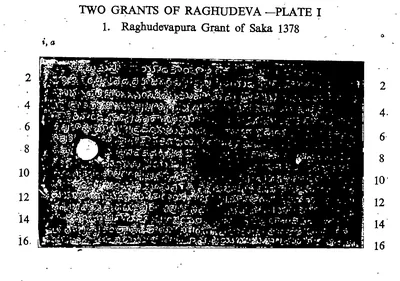
D. C. Sircar found the two charters at Rajahmundry in January 1956.6 One was a set of plates in the collection of the Andhra Historical Research Society, whose secretary was preparing to publish it.6 The other was a single plate, written on both sides, which belonged to a resident of the town.6 It turned out to be the middle part of a second charter of the same donor.6 Sircar published both in Epigraphia Indica XXXIII, the volume for 1959–60, with photographs of the plates.67
The Raghudevapura grant
The set has six plates, and five of them are written on both sides.8 Together they carry 149 lines of writing.8 The ring passes through a seal that shows a standing elephant in decorated trappings.8 The script is Telugu and the language Sanskrit, almost all in verse.8
At the end of the record is a line drawing, of the kind found on other Suryavamsi Gajapati charters.8 Sircar took it to show a sword or dagger, standing for the donor’s signature.8 The date is the twelfth day of the bright half of the month Suchi, in the year Dhatri, Saka 1378 (Saka is an Indian way of counting years).8 Sircar equated it with 18 June 1456.8
The first section opens with verses to Vishnu as the Boar, to Ganesa, to the Earth and to Vishnu.12 It then introduces the donor’s family:12
- A Nayaka named Kapilesvara, one of many rulers of the solar and lunar races, had a son Jagesvara, rich in elephants.12
- Jagesvara and his eldest son Balarama died in battle.12
- The next son, Kapilesvara, named after his grandfather, won the throne of the Gajapati by his bravery.12
- His younger brother Parasurama married Malliki, and their son Raghudeva is the donor.12
The grant says that Raghudeva had his seat at Rajamahendranagara (Rajahmundry).2 He ruled a province that stretched from Simhachalam to a place called Giripraja.2 Sircar suggested that Giripraja was a Sanskrit form of the name Kondavidu.2 See Kapilendra.
The closing verses tell how the grant came about.9 Raghudeva visited Kataka (Cuttack) in the service of his uncle.9 On the road he met a large number of Brahmins with their wives, and he heard their case.9 He then decided to found an agrahara (a village given to Brahmins) for them in his province.9
The grant divides the village into forty shares, though it names 42 donees.9 Most of them were Yajurveda Brahmins.9 Sircar noted that their names show that they came from the Andhra country.9
The gift village was once called Kriddevi, and it was renamed Raghudevapura.4 It lay on the Godavari, here called the Gautami, between its greater and lesser streams.4 Its boundaries mention the road to Muggullu, which Sircar placed about a mile south of the present Raghudevapuram.4 He placed it about 13 miles north-west of Rajahmundry.4 See Rajahmundry.
The Dorapalem grant
The single plate is the second of a set.5 It carries the central part of another charter of Raghudeva, in the same script and language.5 It is dated on a lunar eclipse in Saka 1376, the year Yuvan, which Sircar took to be 1455–56.5
It records a gift of the village of Dorapalem, on the bank of the Kaunteya-ganga, a stream of the Godavari.5 The gift went to a Brahmin named Timmaya or Tirumalu-bhatta of the Kausika gotra (clan).5 He was a reciter of the Puranas, and his grandfather had lived at Bhimavaram.5 The grant’s family tree adds a younger brother of Parasurama, Rama, who is missing from the Raghudevapura grant.5
Raghudeva
Sircar gathered the other records of Raghudeva.6 One is a pillar inscription of 1458 at the Sringararaya temple at Tirupati in the Peddapuram taluk (sub-district).6 It says that a temple officer restored the temple’s lands while Raghudeva-narendra-mahapatra was ruling at Rajahmundry under Kapilesvara.6 The other is the inscription of 2 February 1460 in the fort of Warangal.6
V. Rangacharya’s list of the Tirupati inscriptions also records an undated grant.1011 It was made by “Raghudeva Mahendramahadeva of Rajahmundry (then under the rule of Kapilesvara Maharaya)”.1011
From these records Sircar concluded that Raghudeva governed the province of Rajahmundry at least from 1455–56 to 1460.3 This was soon after Kapilendra had taken it from the Reddis.3 See the Warangal inscriptions, the Gajapatis and the Reddis of Rajahmundry.
Footnotes
-
Sircar, “Two Grants of Raghudeva”, Epigraphia Indica XXXIII (1959–60), p. 4 (archive.org (opens in a new tab)). Paraphrased. ↩ ↩2 ↩3 ↩4 ↩5 ↩6 ↩7
-
Sircar, “Two Grants of Raghudeva”, Epigraphia Indica XXXIII (1959–60), p. 5 (archive.org (opens in a new tab)). Paraphrased. ↩ ↩2 ↩3 ↩4 ↩5 ↩6 ↩7 ↩8 ↩9 ↩10
-
Sircar, “Two Grants of Raghudeva”, Epigraphia Indica XXXIII (1959–60), p. 2 (archive.org (opens in a new tab)). Paraphrased. ↩ ↩2 ↩3
-
Sircar, “Two Grants of Raghudeva”, Epigraphia Indica XXXIII (1959–60), p. 11 (archive.org (opens in a new tab)). Paraphrased. ↩ ↩2 ↩3 ↩4 ↩5
-
Sircar, “Two Grants of Raghudeva”, Epigraphia Indica XXXIII (1959–60), p. 20 (archive.org (opens in a new tab)). Paraphrased. ↩ ↩2 ↩3 ↩4 ↩5 ↩6 ↩7 ↩8
-
D. C. Sircar, “Two Grants of Raghudeva”, Epigraphia Indica XXXIII (1959–60), p. 1 (archive.org (opens in a new tab)). Paraphrased. ↩ ↩2 ↩3 ↩4 ↩5 ↩6 ↩7 ↩8 ↩9
-
Sircar, “Two Grants of Raghudeva”, Epigraphia Indica XXXIII (1959–60), plates I–III, between pp. 12 and 13, 16 and 17, 20 and 21 (archive.org (opens in a new tab)). Paraphrased. ↩
-
Sircar, “Two Grants of Raghudeva”, Epigraphia Indica XXXIII (1959–60), p. 3 (archive.org (opens in a new tab)). Paraphrased. ↩ ↩2 ↩3 ↩4 ↩5 ↩6 ↩7 ↩8
-
Sircar, “Two Grants of Raghudeva”, Epigraphia Indica XXXIII (1959–60), p. 8 (archive.org (opens in a new tab)). Paraphrased. ↩ ↩2 ↩3 ↩4 ↩5 ↩6 ↩7
-
V. Rangacharya, A Topographical List of the Inscriptions of the Madras Presidency, Vol. II (1919), p. 718, Godavari No. 58 (archive.org (opens in a new tab)). ↩ ↩2
-
Rangacharya, Topographical List, Vol. II (1919), p. 719, Godavari No. 62 (archive.org (opens in a new tab)). ↩ ↩2
Photos
References
Notes (0)
Sources (2)
Spotted an error on this page? Tell us
Last updated: