Kondavidu plates of Ganadeva (1455)
Three copper plates, sent to E. Hultzsch from the Kistna district and edited by him in 1891. They record a gift of the village of Chavali in the Repalle taluk to a number of Brahmins by Ganadeva, called Rautaraya, governor of Kondavidu. The gift was made on the day of a lunar eclipse in Saka 1377. The grant praises 'king Kapila' of the Solar race, the Gajapati of Orissa, whose capital was Cuttack. A pillar inscription of the same Ganadeva at Chintapallipadu is a year older, of April 1454.
Ganadeva, called Rautaraya, ruled from Kondavidu, and by this copper-plate grant he gave the village of Chavali to a number of Brahmins.1 The grant is dated in Saka 1377 (Saka is an Indian way of counting years).1 It praises king Kapila, whose capital was Cuttack.1 Hultzsch thought that Ganadeva “appears to have been a tributary” of Kapila, the Gajapati king of Orissa.1
The plates
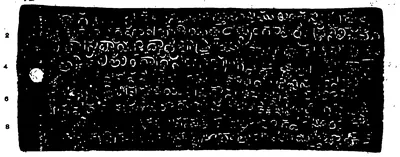
E. Hultzsch edited this grant in the Indian Antiquary of 1891, from the original plates.1 The original “was kindly sent to me for examination by Mr. W. H. Michael, M.C.S., Assistant Collector of the Kistna District”.1 It has three copper plates, numbered 1 to 3 in Telugu figures on their second sides.1 In his words, “both the ring with the seal, and the fourth plate together with any other plate that may have followed it, are lost”.1
The alphabet is Telugu and the language Sanskrit.1 Lines 1 to 32 are in verse, and lines 32 to 58 are in prose.1 Hultzsch found the plates “not very easily read, as they are somewhat worn”.1 He thought the text had been copied from a draft written in a running hand.1
Contents
The grant opens with two verses addressed to Vishnu.12 It then praises king Kapila or Kumbhiraja of the race of the Sun, a worshipper of Jagannatha.12 His capital was “the city called Kataka, on the bank of the Mahanadi”.12
Next it gives the donor’s family line: Chandradeva, his son Guhidevapatra, and Guhideva’s son Ganadeva.1 Ganadeva beat two Turushka (Muslim) princes.1 After this victory he took the surname Rautaraya or Rahuttaraya, “the king of horsemen”.1
Ganadeva’s capital was Kondavidu.1 From there he gave the village of Chavali, in the Repalle taluk (sub-district), to a number of Brahmins.1 He made the gift on the day of a lunar eclipse in the month of Bhadrapada of Saka 1377, the cyclic year Yuvan.1 The rest of the surviving text is a list of the donees.1
Hultzsch noted that the date is irregular.1 The eclipse should have fallen in August–September 1455, but no lunar eclipse fell then.1 The nearest eclipse at the full moon of Bhadrapada was on 3 September 1457.1
He suggested that the two Turushka princes may have been generals of the Bahmani king Ala-ud-din Ahmad Shah II.1 R. D. Banerji thought that one of them was the sultan himself.3 The Archaeological Department of the Nizam’s Dominions found no evidence to identify them.4
Kapila and Ganadeva
The grant calls Kapila the ancestor of Ganadeva’s line.1 But Hultzsch thought it “very probable that Kapila is identical with Kapilesvara-Gajapati”.1 A chronicle of Kondavidu dated Kapilesvara to 1454 to 1461, and Hunter’s Orissa to 1452 to 1479.1
Hultzsch pointed out that the grant names Cuttack as Kapila’s capital and Kondavidu as Ganadeva’s.1 It also speaks of Kapila in the present tense.1 He concluded: “I would accordingly consider Kapila, the Gajapati king of Orissa, as a contemporary of Ganadeva of Kondavidu, who appears to have been a tributary of his.”1
Banerji added that in his day the title Rautaraya was given to the third son of the royal house of Orissa.3 He took Ganadeva to be a distant relative of the king.3 See Kapilendra.
An inscription of the same Ganadeva is on a pillar at Chintapallipadu in the Guntur district.56 It is dated April 1454, and it names the forts of Addanki and Vinukonda in his province.56
H. Luders edited the Mangalagiri pillar inscription of Krishnadeva Raya in 1901.7 He used this grant to show that after the Reddi kings “the country must have been occupied by the Gajapatis”.7 He also used it to show that Ganadeva’s family “was connected with that of the Gajapatis”.7
D. C. Sircar noted that Ganadeva held Kondavidu as another of Kapilendra’s viceroys, at the time when Raghudeva governed Rajahmundry.6 See the Gajapatis, Kondavidu and Addanki.
Place
V. Rangacharya lists the plates under Kondavidu.8 He calls them “the Kondavidu plates of Rauta Raya or Ganadeva, the son of Guhideva and the grandson of Chandradeva, a descendant of Kapila Gajapati of Cataka (Cuttack)”.8 He records that they give Chavali to Brahmins.8 Hultzsch’s paper reproduced the plates in a photo-lithograph.9
Footnotes
-
E. Hultzsch, “Copper-plate Grant of Ganadeva of Kondavidu, dated Saka-Samvat 1377”, Indian Antiquary XX (1891), p. 390 (archive.org (opens in a new tab)). ↩ ↩2 ↩3 ↩4 ↩5 ↩6 ↩7 ↩8 ↩9 ↩10 ↩11 ↩12 ↩13 ↩14 ↩15 ↩16 ↩17 ↩18 ↩19 ↩20 ↩21 ↩22 ↩23 ↩24 ↩25 ↩26 ↩27 ↩28 ↩29 ↩30 ↩31 ↩32
-
Hultzsch, “Copper-plate Grant of Ganadeva”, Indian Antiquary XX (1891), p. 392, translation, verses 4–7 (archive.org (opens in a new tab)). ↩ ↩2 ↩3
-
Banerji, History of Orissa, Vol. I (1930), p. 298 (archive.org (opens in a new tab)). ↩ ↩2 ↩3
-
Annual Report of the Archaeological Department of His Exalted Highness the Nizam’s Dominions, 1344 F. (1934-35) (1938), p. 31 (archive.org (opens in a new tab)). Paraphrased. ↩
-
R. D. Banerji, History of Orissa from the Earliest Times to the British Period, Vol. I (1930), p. 297 (archive.org (opens in a new tab)). ↩ ↩2
-
D. C. Sircar, “Two Grants of Raghudeva”, Epigraphia Indica XXXIII (1959–60), p. 5 and note 3 (archive.org (opens in a new tab)). Paraphrased. ↩ ↩2 ↩3
-
H. Luders, “Two Pillar Inscriptions of the time of Krishnaraya of Vijayanagara”, Epigraphia Indica VI (1900–01), p. 110 (archive.org (opens in a new tab)). ↩ ↩2 ↩3
-
V. Rangacharya, A Topographical List of the Inscriptions of the Madras Presidency, Vol. II (1919), p. 771, Guntur No. 215 (archive.org (opens in a new tab)). ↩ ↩2 ↩3
-
Hultzsch, “Copper-plate Grant of Ganadeva”, Indian Antiquary XX (1891), plate “Plates of Ganadeva of Kondavidu.—Saka-Samvat 1377” (archive.org (opens in a new tab)). ↩
Photos
References
Notes (0)
Sources (6)
Spotted an error on this page? Tell us
Last updated: