Kapilendra (Kapilesvara)
Founder of the Suryavamsi Gajapati dynasty of Orissa, who took the throne of the last Eastern Ganga king in 1434–35 and reigned until about 1470. He conquered the Reddi kingdoms of Rajahmundry and Kondavidu, and governed them through his nephew Raghudeva and his kinsman Ganadeva. He relieved Devarakonda from the Bahmanis in 1459, and his son Hamvira and Raghudeva took Warangal in 1460. His records credit him with conquests down the coast to the Kaveri.
Kapilendra, also called Kapilesvara, founded the Suryavamsi or Solar dynasty of the Gajapatis of Orissa. He took the Reddi kingdom of Rajahmundry between 1444 and 1448, and then Kondavidu.12 R. D. Banerji followed Monmohan Chakravarti’s reckoning of the regnal (anka) years.3 He wrote that Kapilendra was “originally a Mahapatra” (a high officer) and “obtained the throne in 1435-36 A.D.”, and that the actual date of his accession was 1435.3
The Godavari gazetteer of 1907 gives 1434, and calls him “the minister of the last Ganga king of that country”.4 The Vizagapatam gazetteer says that he took the throne in 1434–35 “under the title of Pratapa Kapilesvara”.5 See the Gajapatis and the Eastern Gangas.
Family
The grants of his nephew Raghudeva, edited by D. C. Sircar in 1963, give the earliest account of the family. According to the Raghudevapura grant of 1456, Kapilendra’s grandfather, also called Kapilesvara, was a Nayaka (chief).6 His father was Jagesvara, a hero who owned many elephants.6 The same grant names Balarama as the eldest son of Jagesvara.6 It says that Balarama died in battle together with his father.6
The grant makes Parasurama a younger brother of Kapilendra and the father of Raghudeva, whose mother was Malliki.67 The Dorapalem grant of Raghudeva adds a younger brother of Parasurama named Rama.8 Rama is missing from the longer genealogy of the Raghudevapura grant.8 See the grants of Raghudeva.
The Veligalani grant of 1458 names the three parts of the gift village after Kapilendra’s father Jagesvara, his mother Vellamamba and himself.910 Sircar noted that the Oriya part of the grant calls the mother Velama.11 He wondered whether Kapilendra had Andhra blood, perhaps from the Velama community of the Telugu country.11
Of Kapilendra’s sons the inscriptions name two: Purushottama, whose mother was Parvati, and Hamvira.12 The temple chronicle, as Chakravarti summarised it, says that Kapilendra had many sons and that Purushottama was not the eldest.13 See Purushottama and Hamvira.
Coming to the throne
The temple chronicle of Puri, in W. W. Hunter’s version, makes Kapilendra “originally a common herd-boy, tending the flocks of his Brahman master, but afterwards raised to the throne”.14 It dates his reign 1452–1479.14
Sircar, citing another Oriya work, gave the version in which he was a minister who seized the throne while the Ganga king was away on campaign.15 Sircar preferred this version.15 Chakravarti read the chronicle to say that he won the throne with the help of the Bahmani sultan.13 The Godavari gazetteer also says that he obtained Bahmani help in establishing himself.4
V. Rangacharya used an inscription at Srikurmam dated in Saka 1382 (Saka is an Indian way of counting years) and Kapilendra’s thirty-second year.16 From it he concluded that Kapilendra had been crowned about 1429–30.16
The Telugu country
Kapilendra took the Reddi kingdom of Rajahmundry between 1444 and 1448, and then Kondavidu.12 By 1454, the Godavari gazetteer says, he “was recognized as suzerain as far south as Kondavid” (accepted as overlord).4 It adds that “a minister of his was ruling at Rajahmundry in 1458”.4
The grant of 1455 of his kinsman Ganadeva, governor of Kondavidu, praises “king Kapila-Kumbhiraja” of the race of the Sun.17 It says that his “powerful race was descended from the Sun”.17 It calls him a worshipper of Jagannatha, whose capital was “the city called Kataka, on the bank of the Mahanadi”.17
In April 1458, camping on the Godavari, he made the Veligalani grant to 120 Brahmins.9 See the Kondavidu plates of Ganadeva, the Veligalani grant, the Reddis of Rajahmundry and the Reddis of Kondavidu.
In 1459, according to Ferishta, the defenders of Devarakonda were besieged by the Bahmani army.1819 They “applied for assistance to the Ray of Orissa”, who sent troops and war-elephants and routed the besiegers.1819 The Burhan-i Ma’asir calls him “at that time … chief of the infidels of that country”.20 Banerji credited Kapilendra himself with the march.21
On 2 February 1460 his son Hamvira and his nephew Raghudeva recorded the capture of the fort of Warangal.2223 In Raghudeva’s inscription, Kapilendra is a maharajadhiraja (great king of kings) of the Solar race.2223 He is the hero Gajapati, lord of Gauda and of the Karnata of nine crores that he had conquered.2223 See Devarakonda and the Warangal inscriptions.
Titles and conquests
The Veligalani grant, as Sircar read it, claims that the noise of Kapilendra’s war-drums shook Hampi, Dhara, Gulbarga and Delhi.910 It gives him for the first time the titles Gajapati, Gaudesvara and Navakoti-Karnata-Kalavaragesvara.910
Banerji took the last title as a fair claim for a king who had conquered the coast as far as Thanjavur (then Tanjore) and Tiruchirappalli (then Trichinopoly).24 But he doubted that Kapilendra had ever taken Gulbarga.24
According to the Gopinathapura inscription, Banerji wrote, Kapilendra “possessed Udayagiri, the seat of a Vijaynagara Viceroyalty, in the Nellore district of Madras”.25 The inscription also names “Conjeeveram in the Chingleput district” (Kanchipuram) among his possessions.25 The extent and duration of these southern conquests are disputed.26 See the Gajapatis.
Death
Kapilendra’s last dated inscription is of December 1466.27 The Burhan-i Ma’asir reports that in AH 875 (1470; AH is the Islamic way of counting years) news reached Bidar that “the Raya of Orisa, who was the principal raya of Telingana, was dead”.2829
The temple chronicle says that he died on the bank of the Krishna.2430 Chakravarti, reckoning from the anka years, placed his death in 1469–70.30 The Kondavidu chronicle summarised by Robert Sewell gives him a reign of 27 years, but dates it from 1454 to 1461.31
Evidence and disagreements
- Accession. 1434–35 (Chakravarti and the Vizagapatam gazetteer), 1435 (Banerji), 1434 (the Godavari gazetteer), 1452 (the temple chronicle) or about 1429–30 (Rangacharya).305341416
- Origin. A herd-boy (the chronicle), a minister who seized the throne (Sircar’s preferred tradition and the Vizagapatam gazetteer), or the son and grandson of chiefs (the Raghudeva grants).141556
- Death. About 1469–70 (Chakravarti, and Banerji from the Burhan-i Ma’asir) or 1479 (the chronicle).302714
Footnotes
-
D. C. Sircar, “Two Grants of Raghudeva”, Epigraphia Indica XXXIII (1959–60), p. 2 (archive.org (opens in a new tab)). Paraphrased. ↩ ↩2
-
Sircar and Sarma, “Veligalani Grant of Kapilesvara”, Epigraphia Indica XXXIII (1959–60), p. 279 (archive.org (opens in a new tab)). Paraphrased. ↩ ↩2
-
R. D. Banerji, History of Orissa from the Earliest Times to the British Period, Vol. I (1930), p. 289 (archive.org (opens in a new tab)). ↩ ↩2 ↩3
-
F. R. Hemingway, Madras District Gazetteers: Godavari, Vol. I (1907), p. 26 (archive.org (opens in a new tab)). ↩ ↩2 ↩3 ↩4 ↩5
-
W. Francis, Madras District Gazetteers: Vizagapatam, Vol. I (1907), p. 28 (archive.org (opens in a new tab)). ↩ ↩2 ↩3
-
Sircar, “Two Grants of Raghudeva”, Epigraphia Indica XXXIII (1959–60), p. 4 (archive.org (opens in a new tab)). Paraphrased. ↩ ↩2 ↩3 ↩4 ↩5 ↩6
-
Sircar, “Two Grants of Raghudeva”, Epigraphia Indica XXXIII (1959–60), p. 5 (archive.org (opens in a new tab)). Paraphrased. ↩
-
Sircar, “Two Grants of Raghudeva”, Epigraphia Indica XXXIII (1959–60), p. 20, the Dorapalem grant (archive.org (opens in a new tab)). Paraphrased. ↩ ↩2
-
D. C. Sircar and K. H. V. Sarma, “Veligalani Grant of Kapilesvara, Saka 1380”, Epigraphia Indica XXXIII (1959–60), p. 277 (archive.org (opens in a new tab)). Paraphrased. ↩ ↩2 ↩3 ↩4
-
Sircar and Sarma, “Veligalani Grant of Kapilesvara”, Epigraphia Indica XXXIII (1959–60), p. 278 (archive.org (opens in a new tab)). Paraphrased. ↩ ↩2 ↩3
-
Sircar, “Two Grants of Raghudeva”, Epigraphia Indica XXXIII (1959–60), p. 7 (archive.org (opens in a new tab)). Paraphrased. ↩ ↩2
-
D. C. Sircar and K. H. V. Sarma, “Chiruvroli Grant of Hambira, Saka 1383”, Epigraphia Indica XXXIV (1961–62), p. 181 (archive.org (opens in a new tab)). Paraphrased. ↩
-
Chakravarti, “The last Hindu Kings of Orissa”, JASB LXIX, Part I (1900), p. 182 (archive.org (opens in a new tab)). ↩ ↩2
-
W. W. Hunter, Orissa, Vol. II (1872), Appendix VII, p. 188 (archive.org (opens in a new tab)). ↩ ↩2 ↩3 ↩4 ↩5
-
Sircar, “Two Grants of Raghudeva”, Epigraphia Indica XXXIII (1959–60), p. 6 (archive.org (opens in a new tab)). Paraphrased. ↩ ↩2 ↩3
-
V. Rangacharya, A Topographical List of the Inscriptions of the Madras Presidency, Vol. I (1919), p. 687, Ganjam No. 162 (archive.org (opens in a new tab)). ↩ ↩2 ↩3
-
E. Hultzsch, “Copper-plate Grant of Ganadeva of Kondavidu, dated Saka-Samvat 1377”, Indian Antiquary XX (1891), p. 392, verses 4–7 (archive.org (opens in a new tab)). ↩ ↩2 ↩3
-
Muhammad Qasim Ferishta, tr. John Briggs, History of the Rise of the Mahomedan Power in India, Vol. II (1829), p. 456 (archive.org (opens in a new tab)). ↩ ↩2
-
Ferishta, tr. Briggs, Vol. II (1829), p. 457 (archive.org (opens in a new tab)). ↩ ↩2
-
J. S. King, The History of the Bahmani Dynasty, founded on the Burhan-i Ma’asir (1900), p. 83 (archive.org (opens in a new tab)). ↩
-
Banerji, History of Orissa, Vol. I (1930), p. 293 (archive.org (opens in a new tab)). ↩
-
D. C. Sircar, “Warangal Inscription of Raghudeva, Kali Year 4561”, Epigraphia Indica XXXIII (1959–60), p. 126 (archive.org (opens in a new tab)). Paraphrased. ↩ ↩2 ↩3
-
Sircar, “Warangal Inscription of Raghudeva”, Epigraphia Indica XXXIII (1959–60), p. 128 (archive.org (opens in a new tab)). Paraphrased. ↩ ↩2 ↩3
-
Banerji, History of Orissa, Vol. I (1930), p. 302 (archive.org (opens in a new tab)). ↩ ↩2 ↩3
-
Banerji, History of Orissa, Vol. I (1930), p. 304 (archive.org (opens in a new tab)). ↩ ↩2
-
Banerji, History of Orissa, Vol. I (1930), p. 295 (archive.org (opens in a new tab)). ↩
-
Banerji, History of Orissa, Vol. I (1930), p. 303 (archive.org (opens in a new tab)). ↩ ↩2
-
King, History of the Bahmani Dynasty (1900), p. 103 (archive.org (opens in a new tab)). ↩
-
King, History of the Bahmani Dynasty (1900), p. 104 (archive.org (opens in a new tab)). ↩
-
Monmohan Chakravarti, “The last Hindu Kings of Orissa”, appendix to “An Inscription of the time of Kapilendra Deva of Orissa, from Gopinathapura”, Journal of the Asiatic Society of Bengal, Vol. LXIX, Part I (1900), p. 181 (archive.org (opens in a new tab)). ↩ ↩2 ↩3 ↩4
-
Robert Sewell, Lists of Inscriptions, and Sketch of the Dynasties of Southern India (1884), p. 188 (archive.org (opens in a new tab)). ↩
Photos
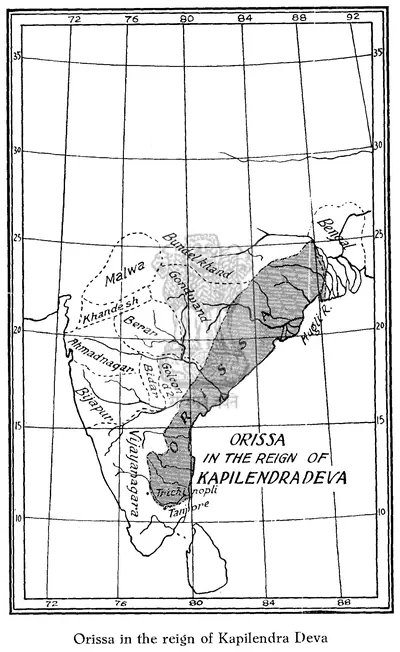 "Orissa in the reign of Kapilendra Deva": map in R. D. Banerji, History of Orissa, Vol. I (1930), facing p. 296Map · 1930
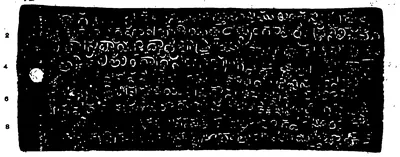 "Plates of Ganadeva of Kondavidu.—Saka-Samvat 1377", first side of the first plate (lines 1-9) (Indian Antiquary XX, plate with p. 390)Inscription rubbing · 1891
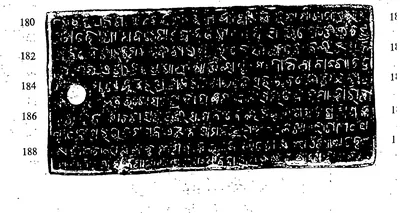 "Veligalani Grant of Kapilesvara, Saka 1380": plate face with lines 180-188, the Oriya summary (Epigraphia Indica XXXIII, plates between pp. 286 and 287)Inscription rubbing · 1963
References
Notes (0)
Sources (12)
Spotted an error on this page? Tell us
Last updated: