Veligalani grant of Kapilesvara (1458)
Ten surviving plates of a copper charter whose first plate is lost, edited by D. C. Sircar and K. H. V. Sarma in 1963. By it the Gajapati Kapilendra (Kapilesvara), camping on the bank of the Godavari on the full moon of Vaisakha, Saka 1380 (27 April 1458), gave the village of Veligalani to 120 Brahmins and renamed it Kapilesvarapura. It is the only known copper-plate grant of the king himself. It has sections in Sanskrit, Telugu and Oriya, names his father and mother, and is the first to give him the titles Gajapati, Gaudesvara and Navakoti-Karnata-Kalavaragesvara.
The Gajapati king Kapilendra (Kapilesvara) gave the village of Veligalani to 120 Brahmins by this copper-plate charter.1 The grant is dated in Saka 1380 (Saka is an Indian way of counting years), which its editors equated with 27 April 1458.1 It is the only known copper-plate charter of Kapilendra himself.2
The plates
D. C. Sircar and K. H. V. Sarma edited the grant in Epigraphia Indica XXXIII.3 They worked from an incomplete set of ten plates.3 They had come about a quarter of a century earlier from an advocate of Bapatla in the Guntur district, who had them from a client.3 The first plate of the set is lost, and the place where the plates were first found is unknown.3
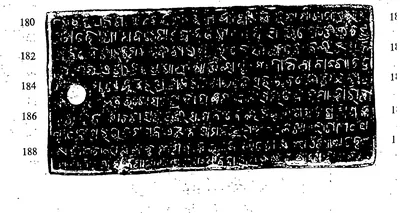
The plates measure about 14 inches by 7 and have raised rims.3 Together they weigh 1367 tolas, and the ring and any seal are lost.3 A faulty edition, without pictures, had appeared earlier in the Journal of the Bombay Historical Society.3
The record is a palimpsest (a text written over an older one).3 It was engraved over an earlier charter, also of Kapilesvara.3 The older text was beaten out, except for its closing Sanskrit verses and some names of donees.3 The plates keep the numbers of their places in the older document.3
On the back of the last plate are these drawings:3
- a dagger, which served as the king’s signature on Suryavamsi Gajapati charters3
- a standing elephant, the emblem of the Gajapatis3
- the sun, the moon and a lotus3
The editors published photographs of the plates.4
Date and grant
The grant is dated on the full moon of Vaisakha in Saka 1380, the year Bahudhanya.1 The Oriya part adds that the day was a Thursday, and the editors equated the date with 27 April 1458.1
The Sanskrit section began on the lost first plate, so its beginning is missing.1 It praises Kapilendra’s strength in war.1 It says that the noise of his war-drums made Hampa tremble and pressed Dhara hard.1 The noise put the horses of Kalubariga (Gulbarga) to flight and filled Dhilli (Delhi) with savage women.1
The section then records that the king, while camping on the bank of the Godavari, gave the village of Veligalani, in a district named in the grant, to 120 Brahmins.1 He named the village after himself and his parents.1 The section also refers to a place called Vijayapratapa-Kapilendra-mahasasana, east of the joined streams of the Krishna and Venna.1
The Telugu section lists the 120 donees, each with an equal share, in six groups of twenty.12 The groups are the northern and southern halves of Jagesvarapura, Vellamambapura and Kapilesvarapura.12 These were the three parts of the village, and they were named after the king’s father, his mother and himself.12
Many of the donees’ family names come from villages such as Vijayawada (then Bezwada), Addada, Kondapalli, Lolla and Rajukonda.5 Others come from branches of learning, and the editors noted that most of these family names are still in use in Andhra.5
The Oriya section summarises the grant, and it is the first to give Kapilesvara the titles Gajapati, Gaudesvara and Navakoti-Karnata-Kalavaragesvara.2 The titles refer to his claims over Bengal, Vijayanagara and the Bahmani sultans.2 His successors and later rulers of Orissa kept these titles.2
R. D. Banerji, writing before the grant was known, explained the last title as the claim to be “the master of ninety millions of people of Karnata”.6
Place
Among the boundary villages, the editors identified Penamakuru, Kanumuru (near the present Kapilesvarapuram) and Mullapudi.7 They placed all of them in the Krishna district.7 The other names could not be traced.7 See the Gajapatis.
Kapilendra’s family and wars
The grant is the only known copper-plate charter of Kapilendra himself.2 Sircar read it together with the grants of Raghudeva, and from them he learnt the name of the king’s father, Jagesvara.2 The king’s mother was Vellamamba in Telugu, or Velama in Oriya.2 Sircar suggested that she may have come from the Telugu country.2
The editors used the grant to work out the story of Kapilendra’s southern wars.8 In their account, he did these things:8
- he subdued the chiefs of Nandapur and Viraghattam8
- he took the Reddi kingdom of Rajahmundry between 1444 and 14488
- with the help of the Rajahmundry Reddis, he took Kondavidu and the other forts of the south8
He then placed his nephew Raghudeva at Rajahmundry and his kinsman Ganadeva at Kondavidu.8 He put his son Hamvira over the Telugu and Tamil conquests.8
The editors also linked the boast about the war-drums with a joint attack on Vijayanagara by the Gajapati and the Bahmani sultan.9 This attack came after the death of Devaraya II.9 They also linked it with the war against Humayun Shah at Devarakonda.9 See Kapilendra, the Raghudeva grants and the Kondavidu plates of Ganadeva.
Footnotes
-
Sircar and Sarma, “Veligalani Grant of Kapilesvara”, Epigraphia Indica XXXIII (1959–60), p. 277 (archive.org (opens in a new tab)). Paraphrased. ↩ ↩2 ↩3 ↩4 ↩5 ↩6 ↩7 ↩8 ↩9 ↩10 ↩11 ↩12 ↩13 ↩14
-
Sircar and Sarma, “Veligalani Grant of Kapilesvara”, Epigraphia Indica XXXIII (1959–60), p. 278 (archive.org (opens in a new tab)). Paraphrased. ↩ ↩2 ↩3 ↩4 ↩5 ↩6 ↩7 ↩8 ↩9 ↩10 ↩11
-
D. C. Sircar and K. H. V. Sarma, “Veligalani Grant of Kapilesvara, Saka 1380”, Epigraphia Indica XXXIII (1959–60), p. 275 (archive.org (opens in a new tab)). Paraphrased. ↩ ↩2 ↩3 ↩4 ↩5 ↩6 ↩7 ↩8 ↩9 ↩10 ↩11 ↩12 ↩13 ↩14 ↩15
-
Sircar and Sarma, “Veligalani Grant of Kapilesvara”, Epigraphia Indica XXXIII (1959–60), plates between pp. 286 and 287 (archive.org (opens in a new tab)). Paraphrased. ↩
-
Sircar and Sarma, “Veligalani Grant of Kapilesvara”, Epigraphia Indica XXXIII (1959–60), p. 281 (archive.org (opens in a new tab)). Paraphrased. ↩ ↩2
-
R. D. Banerji, History of Orissa from the Earliest Times to the British Period, Vol. I (1930), p. 302 (archive.org (opens in a new tab)). ↩
-
Sircar and Sarma, “Veligalani Grant of Kapilesvara”, Epigraphia Indica XXXIII (1959–60), p. 285 (archive.org (opens in a new tab)). Paraphrased. ↩ ↩2 ↩3
-
Sircar and Sarma, “Veligalani Grant of Kapilesvara”, Epigraphia Indica XXXIII (1959–60), p. 279 (archive.org (opens in a new tab)). Paraphrased. ↩ ↩2 ↩3 ↩4 ↩5 ↩6 ↩7
-
Sircar and Sarma, “Veligalani Grant of Kapilesvara”, Epigraphia Indica XXXIII (1959–60), p. 280 (archive.org (opens in a new tab)). Paraphrased. ↩ ↩2 ↩3
Photos
References
Notes (0)
Sources (2)
Spotted an error on this page? Tell us
Last updated: