Satara grant of Vishnuvardhana I
A Sanskrit copper-plate grant of Vishnuvardhana, the founder of the Eastern Chalukya line, issued while he was still only yuvaraja (heir-apparent) under his elder brother Pulakesin II of Badami. It gives a village on the Bhima to three Brahmin brothers and two other men. It is dated in the eighth year of 'the glorious Maharaja', which J. F. Fleet converted to 616 or 617. Found at Satara before 1844 and now in the British Museum, it is the earliest record of the founder.
This is the earliest record of Kubja-Vishnuvardhana, the younger brother of the Chalukya king Pulakesin II and the founder of the Eastern Chalukya dynasty of Vengi.12 It was issued before he had any kingdom of his own.12 He then held only the rank of yuvaraja, heir-apparent, in the western Chalukya country.12
J. F. Fleet re-edited the grant in 1890.3 He used it to correct his own earlier view that the eastern branch had been independent from the beginning of Pulakesin II’s reign.3
Discovery and description
Bal Gangadhar Shastri first published the grant in 1844, with what Fleet called “an indifferent lithograph”.1 The plates were said to have been found at Satara, the chief town of the district of that name in the Bombay Presidency.1 James Bird, Secretary of the Bombay Branch of the Royal Asiatic Society, acquired them.1 Then they were lost sight of for many years.1
About 1884 or 1885, “five or six years” before Fleet wrote, they turned up in a London auction room.1 A. W. Franks bought them and presented them to the British Museum, where Fleet edited them from the originals.1 F. Kielhorn’s list of southern inscriptions of 1903 also records them as in the British Museum.4
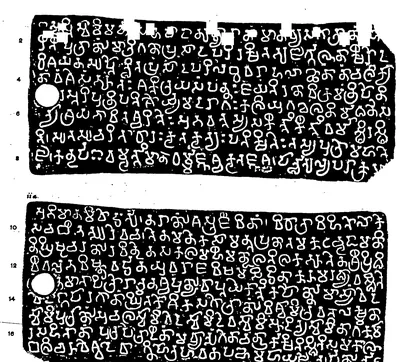
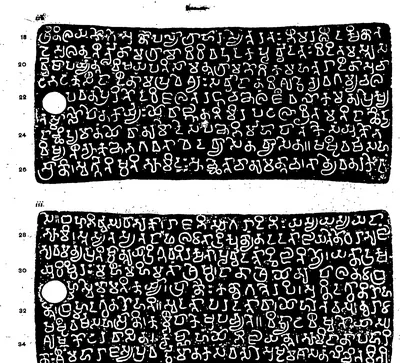
There are three plates, about 7 inches long, smooth and without raised rims.1 The first and last are inscribed on one side only.1 The writing is perfectly preserved except for small pieces broken from the corners of the first plate.1 The oval ring had been cut and rejoined with a bolt.1
The ring’s roughly circular seal shows the moon at the top and a squatting boar at the bottom.1 Across the middle is the legend Sri-Bittarasa, “the illustrious king Bitti or Bitta”.1 Fleet took Bittarasa to be the Prakrit form of the king’s name.56 He thought it was probably the name given to him at birth, turned into the Sanskrit Vishnuvardhana when he was made yuvaraja.56
Script and language
The letters belong to the southern class of alphabets, of the regular type for the period and region.1 Fleet noted one unusual form, a long i made by a vertical line drawn across the circle of the short i.1 He knew no parallel for it in Chalukya grants.1
The language is Sanskrit.1 Verses in lines 4 to 10 give the genealogy.1 Seven of the usual benedictive and imprecatory verses (blessings and curses) follow in lines 25 to 35.1
Content
The grant opens with the Chalukya family.7 They meditate on the feet of the god Svami-Mahasena, belong to the Manavya gotra and are Haritiputras (sons of Hariti).7 They are protected by the Mothers, and bear the crest of a boar given by Vishnu.7
It names Pulakesin I by his titles Ranavikrama and Satyashraya, and then his son Kirtivarman I.7 It goes straight on to Kirtivarman’s son, “the Yuvaraja Vishnuvardhana”, also called Vishamasiddhi.7 Fleet noticed that the reigning king, Pulakesin II, is passed over in the genealogy and appears only in the dating clause.2
Vishnuvardhana was staying at Kurumarathi (or Kurumarathya).78 There, on the full-moon tithi (lunar day) of Karttika, he gave the village of Alandatirtha in the Srinilaya bhoga (district).78 The village lay north of the agrahara (village granted to Brahmins) of Anopalya, on the south bank of the river Bhimarathi.78
The donees were the sons of Lakshmanasvamin of the Ghritakausika gotra, Achalasvamin, Vedasvamin and Devasvamin, with Adityasvamin and Nagakumara.78 The gift was to maintain the five great sacrifices.78
The neighbouring district officers, samantas (subordinate chiefs), village headmen and elders were told that regular and irregular troops and money-lenders were not to enter the village.8 The charter ends: “(This) charter has been written in the augmenting eighth year of the glorious Maharaja.”8
The village and the place of issue
Fleet identified Alandatirtha with “Alundah” on the Indian Atlas sheet.2 It is about five miles north-east of Bhor and some thirty-five miles north of Satara.2 It is not on the Bhima itself but on the Sivaganga, which flows through the Nira into the Bhima.2 He took Bhimarathi to cover any tributary of the Bhima.2
Bal Gangadhar Shastri had proposed Alandi in Poona district, about twelve miles north of Poona.2 Fleet rejected that identification because Alandi lies on the north bank of the Indrayani, not the south.2 He could not identify Anopalya, the Srinilaya bhoga or Kurumarathi.2
Either way, he argued, a village on the south bank of the Bhima shows that Vishnuvardhana was then acting within the western Chalukya dominions, far from the east coast.9
Date
According to Fleet, the “glorious Maharaja” of the dating clause “can be no one but” Pulakesin II.2 The date is the full moon of Karttika in the eighth year of his reign.2 Fleet equated it with Saka 539 (Saka is an Indian way of counting years) or 540 current, that is A.D. 616 or 617.2 Kielhorn’s list likewise takes the year as Pulakesin II’s eighth.4
For Fleet the record proved that, up to that date, “there had been no actual separation of the two kingdoms”.3 In his view, Pulakesin II still reigned over the whole Chalukya family, and Vishnuvardhana assisted him in a subordinate capacity.3
Fleet thought Vishnuvardhana had been made yuvaraja in 615, to represent his brother at home while Pulakesin II campaigned in the east.10 He thought Vishnuvardhana still held the post in 616 or 617.10
The epigraphical report for 1907–08 read the date differently.11 It described the Satara grant as “dated in the 8th year”, without naming Pulakesin II.11 It suggested that this corresponded “apparently to A.D. 622–23”.11 It placed the Timmapuram plates, in which Vishnuvardhana is called Maharaja, after that year.11
That conversion seems to count the eighth year from 615, the start of Vishnuvardhana’s own regnal years.109 It seems not to count from Pulakesin II’s accession in 609 or 610.109
Titles
Fleet used the grant to show how slowly the formal titles of sovereignty developed in the south.512 In the Satara grant Pulakesin II, a paramount king, is called only Maharaja.512 Vishnuvardhana himself takes only the subordinate title Yuvaraja.512 Fleet noted that he later called himself Maharaja in the Chipurupalle grant, once he ruled Vengi as an independent kingdom.512
Edition
J. F. Fleet, “Sanskrit and Old-Canarese Inscriptions, No. 191: Satara Copper-Plate Grant of Vishnuvardhana I”, Indian Antiquary XIX (1890), pp. 303–311, with text, translation and a photo-lithograph. First edited by Bal Gangadhar Shastri in the Journal of the Bombay Branch of the Royal Asiatic Society, Vol. II (1844), p. 1 ff.1
Footnotes
-
J. F. Fleet, “Sanskrit and Old-Canarese Inscriptions, No. 191: Satara Copper-Plate Grant of Vishnuvardhana I”, Indian Antiquary XIX (1890), p. 303 (archive.org (opens in a new tab)). ↩ ↩2 ↩3 ↩4 ↩5 ↩6 ↩7 ↩8 ↩9 ↩10 ↩11 ↩12 ↩13 ↩14 ↩15 ↩16 ↩17 ↩18 ↩19 ↩20 ↩21 ↩22
-
Fleet, “Satara Copper-Plate Grant of Vishnuvardhana I” (1890), p. 304 (archive.org (opens in a new tab)). ↩ ↩2 ↩3 ↩4 ↩5 ↩6 ↩7 ↩8 ↩9 ↩10 ↩11 ↩12 ↩13 ↩14
-
J. F. Fleet, “The Chronology of the Eastern Chalukya Kings”, Indian Antiquary XX (1891), p. 3 (archive.org (opens in a new tab)). ↩ ↩2 ↩3 ↩4
-
F. Kielhorn, “A List of Inscriptions of Southern India”, appendix to Epigraphia Indica VII (1902–03), p. 92, No. 547 (archive.org (opens in a new tab)). ↩ ↩2
-
Fleet, “Satara Copper-Plate Grant of Vishnuvardhana I” (1890), p. 305 (archive.org (opens in a new tab)). ↩ ↩2 ↩3 ↩4 ↩5 ↩6
-
Fleet, “Chronology of the Eastern Chalukya Kings” (1891), p. 95 (archive.org (opens in a new tab)). ↩ ↩2
-
Fleet, “Satara Copper-Plate Grant of Vishnuvardhana I” (1890), p. 310, translation (archive.org (opens in a new tab)). ↩ ↩2 ↩3 ↩4 ↩5 ↩6 ↩7 ↩8 ↩9 ↩10
-
Fleet, “Satara Copper-Plate Grant of Vishnuvardhana I” (1890), p. 311, translation (archive.org (opens in a new tab)). ↩ ↩2 ↩3 ↩4 ↩5 ↩6 ↩7
-
Fleet, “Chronology of the Eastern Chalukya Kings” (1891), p. 96 (archive.org (opens in a new tab)). ↩ ↩2 ↩3
-
Fleet, “Chronology of the Eastern Chalukya Kings” (1891), p. 94 (archive.org (opens in a new tab)). ↩ ↩2 ↩3 ↩4
-
Annual Report on Epigraphy, Southern Circle, for 1907–08 (G.O. No. 574, Public, 17 July 1908), Part II, para. 11, p. 49 (archive.org (opens in a new tab)). ↩ ↩2 ↩3 ↩4
-
Fleet, “Satara Copper-Plate Grant of Vishnuvardhana I” (1890), p. 307 (archive.org (opens in a new tab)). ↩ ↩2 ↩3 ↩4
Photos
References
Notes (0)
Sources (4)
Spotted an error on this page? Tell us
Last updated: