Simhachalam inscription of Kulottunga I
Damaged Tamil inscription of the Chola king Kulottunga I on a slab in the mandapa of the Varaha-Narasimha temple at Simhachalam, near Visakhapatnam, dated Saka 1021 (1099). V. Rangacharya and W. Francis took it as confirmation of Kulottunga's conquest of Kalinga celebrated in the Tamil poem Kalingattupparani; Robert Sewell was more cautious.
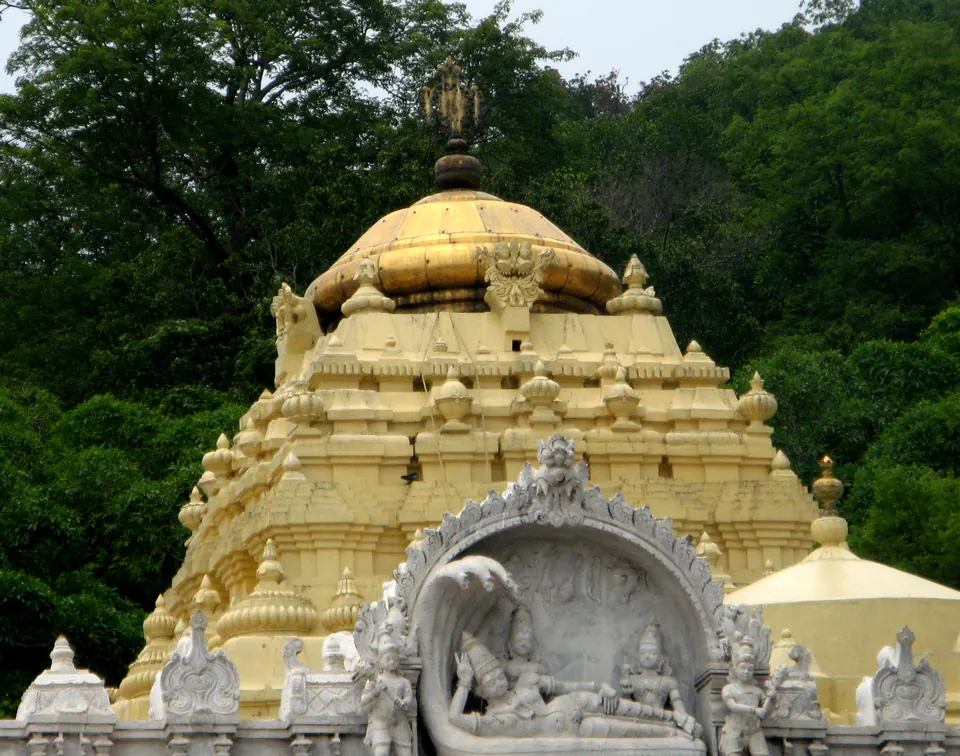
This damaged Tamil inscription at Simhachalam belongs to the reign of the Chola king Kulottunga I.1 V. Rangacharya read its date as Saka 1021 (Saka is an Indian way of counting years), which is 1099.1 Some scholars saw in it proof of Kulottunga’s war in Kalinga.12
The record
The inscription, No. 363 of 1899, is on a slab in the mandapa (pillared hall) of the Varaha-Narasimha temple at Simhachalam, in the old Visakhapatnam (then Vizagapatam) district.1 Rangacharya described it in 1919 as “a damaged record of the Chola king Kulottunga I, dated S. 1021”.1 It names a minister of peace and war (sandhivigrahin), Madurantaka Brahmamarayar.1 Its text was printed in South-Indian Inscriptions VI in 1928.3 See the Simhachalam temple.
The Kalinga conquest
Rangacharya thought the record proved “that the literary traditions of Kulottunga’s Kalinga conquest as given in the Kalingattupparani are true”.1 The Vizagapatam District Gazetteer (1907) wrote that the Cholas “seem twice to have invaded the south of Trikalinga”.2 It thought this Tamil record confirmed the first of these invasions.2 Robert Sewell was more careful.4 He called the date uncertain and thought the record no firm proof of a conquest of Kalinga.4 See Karunakara Tondaiman.
Where the sources disagree
The date has been read in several ways.12564
- Saka 1021, that is 1099 (Rangacharya).1
- 1089 in one place of the Vizagapatam gazetteer, and 1098–99 in another.25
- Lost (Hultzsch, 1903) or uncertain (Sewell).64
Footnotes
-
V. Rangacharya, A Topographical List of the Inscriptions of the Madras Presidency, Vol. III (1919), p. 1686, Vizagapatam No. 191 (archive.org (opens in a new tab)). ↩ ↩2 ↩3 ↩4 ↩5 ↩6 ↩7 ↩8 ↩9
-
W. Francis, Madras District Gazetteers: Vizagapatam, Vol. I (1907), p. 27 (archive.org (opens in a new tab)). ↩ ↩2 ↩3 ↩4 ↩5
-
K. V. Subrahmanya Aiyer (ed.), South-Indian Inscriptions (Texts), Vol. VI (1928), pp. 462–464, No. 1144 (archive.org (opens in a new tab)). ↩
-
Robert Sewell and S. Krishnaswami Aiyangar, The Historical Inscriptions of Southern India (1932), p. 91 (archive.org (opens in a new tab)). Paraphrased. ↩ ↩2 ↩3 ↩4
-
Francis, Vizagapatam (1907), p. 324 (archive.org (opens in a new tab)). ↩ ↩2
-
E. Hultzsch, South-Indian Inscriptions, Vol. III, pt. II (1903), p. 126 (archive.org (opens in a new tab)). ↩ ↩2
Photos
References
Notes (0)
Sources (5)
Spotted an error on this page? Tell us
Last updated: