Draksharama inscription of Kulottunga I (1103)
Sanskrit inscription in Telugu characters on the south wall of the Bhimesvara temple at Draksharama, dated in the 33rd year of the Chola king Kulottunga I (1103). It records the deeds of his general Vanduvaraja, also called Pallavaraja, who burnt the Kalinga country, defeated the Ganga king and Devendravarman and set up a pillar of victory on the borders of the Odra country, and his gifts in the Vengi country, including a pavilion at Draksharama. K. V. Subrahmanya Aiyer identified him with Karunakara Tondaiman, the hero of the Kalingattupparani.
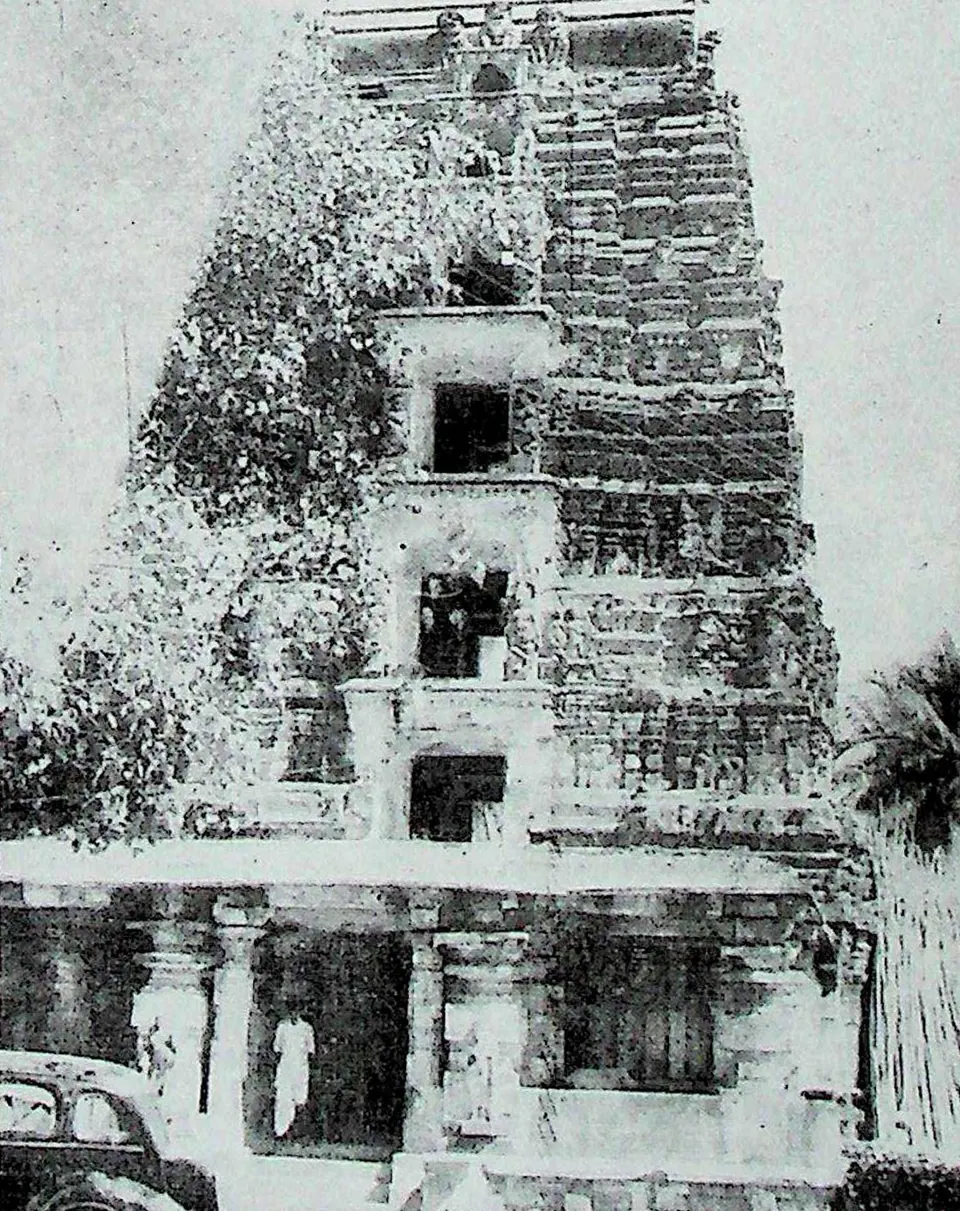
This Sanskrit inscription at Draksharama records the deeds of a general of the Chola king Kulottunga I.12 It tells how he burnt Kalinga and made gifts in the Vengi country.3 Its editor thought the general was Karunakara, the hero of a famous Tamil war poem.4
The record
The inscription is on a slab in the south wall of the Bhimesvara temple at Draksharama.5 It was copied in 1893 and printed in South-Indian Inscriptions IV in 1923.56 K. V. Subrahmanya Aiyer edited it again in Epigraphia Indica XXII.5 The language is Sanskrit, the letters are Telugu, and the stone is not well preserved.1
It is dated in the 33rd year of Kulottunga I, which Subrahmanya Aiyer equated with 1103.1 It gives the king titles such as Rajarajendra and Rajakesarivarman.1 See the Bhimesvara temple.
What it says
In Subrahmanya Aiyer’s translation, the record praises a chief called Vanduvaraja, Pallavaraja and Tiruvaranga.2 He was the son of Sirilango of Mandalanjeri, in the Chola country.2 At the king’s command he burnt the whole Kalinga country and defeated the Ganga king.23 With the forces of Kosala he destroyed Devendravarman and other chiefs.3 He set up a pillar of victory on the borders of the Odra country (Orissa).3
He also made gifts.3 He built a Vishnu temple of black granite at a Brahmin village called Alaveli.3 He gave land for offerings to the god Panchavati-Hari on the bank of the Godavari “in Vengi-mandala”.3 He built a pavilion at Draksharama.3 Subrahmanya Aiyer could not identify Alaveli.7
Karunakara and the Kalinga war
Subrahmanya Aiyer compared the record with the Tamil poem Kalingattupparani.1 The poem tells how Karunakara led Kulottunga’s army north from Kanchi against the king of northern Kalinga, crossing the Godavari.8 Both the poem and the inscription say the chief burnt Kalinga at the king’s command and set up a pillar of victory.4 So Subrahmanya Aiyer took Vanduvaraja to be Karunakara.4 See Karunakara Tondaiman.
He identified the defeated Devendravarman with the Eastern Ganga king Rajaraja I (1070–1078).9 So he dated the war of the poem before 1078, probably about 1076–77.9 He set it apart from a later Kalinga war of about 1111, led by Kulottunga himself.10
Footnotes
-
Subrahmanya Aiyer, “Draksharama Inscription”, Epigraphia Indica XXII, p. 139 (archive.org (opens in a new tab)). Paraphrased. ↩ ↩2 ↩3 ↩4 ↩5
-
Subrahmanya Aiyer, “Draksharama Inscription”, Epigraphia Indica XXII, p. 144, translation (archive.org (opens in a new tab)). Paraphrased. ↩ ↩2 ↩3 ↩4
-
Subrahmanya Aiyer, “Draksharama Inscription”, Epigraphia Indica XXII, p. 145, translation (archive.org (opens in a new tab)). Paraphrased except for a phrase quoted from the inscription. ↩ ↩2 ↩3 ↩4 ↩5 ↩6 ↩7 ↩8
-
Subrahmanya Aiyer, “Draksharama Inscription”, Epigraphia Indica XXII, p. 140 (archive.org (opens in a new tab)). Paraphrased. ↩ ↩2 ↩3
-
K. V. Subrahmanya Aiyer, “Draksharama Inscription of Kulottunga I.: 33rd Year”, Epigraphia Indica XXII (1933–34, publ. 1938), p. 138 (archive.org (opens in a new tab)). Paraphrased. ↩ ↩2 ↩3
-
H. Krishna Sastri (ed.), South-Indian Inscriptions (Texts), Vol. IV (1923), pp. 428–429, No. 1239 (archive.org (opens in a new tab)). ↩
-
Subrahmanya Aiyer, “Draksharama Inscription”, Epigraphia Indica XXII, p. 143 (archive.org (opens in a new tab)). Paraphrased. ↩
-
V. Kanakasabhai Pillai, “The Kalingattu Parani”, Indian Antiquary XIX (1890), p. 334 (archive.org (opens in a new tab)). ↩
-
Subrahmanya Aiyer, “Draksharama Inscription”, Epigraphia Indica XXII, p. 141 (archive.org (opens in a new tab)). Paraphrased. ↩ ↩2
-
Subrahmanya Aiyer, “Draksharama Inscription”, Epigraphia Indica XXII, p. 142 (archive.org (opens in a new tab)). Paraphrased. ↩
Photos
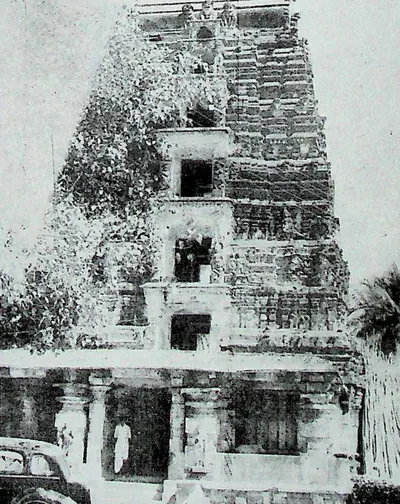 "22. West Gōpuram - Bhīmēśvara Temple - Drākshārāma" (M. Rama Rao, Eastern Calukyan Temples of Andhra Desa, 1964, Fig. 22 (PDF p. 77))Historic photograph · 1964
 "31. Vimāna - Bhīmēśvara Temple - Drākshārāma" (M. Rama Rao, Eastern Calukyan Temples of Andhra Desa, 1964, Fig. 31 (PDF p. 93))Historic photograph · 1964
References
Notes (0)
Sources (3)
Spotted an error on this page? Tell us
Last updated: