Simhachalam temple
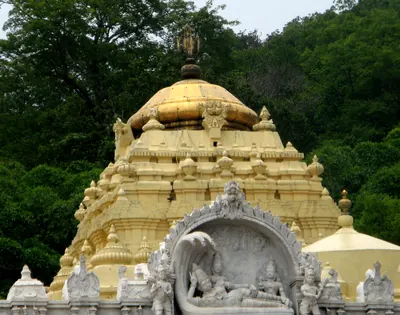
Temple of Narasimha on the Simhachalam hill north of Visakhapatnam, described in 1907 as the most famous, richest and best carved shrine of the district. Its walls hold more than five hundred inscriptions, many of Eastern Ganga kings. The district gazetteer credits the Ganga king Narasimha I with building its central shrine, halls and enclosing verandah in black stone in 1267–68. Its records include a Tamil inscription of Kulottunga I, gifts of Reddi and Matsya chiefs, and the inscriptions of Krishnadeva Raya of Vijayanagara.
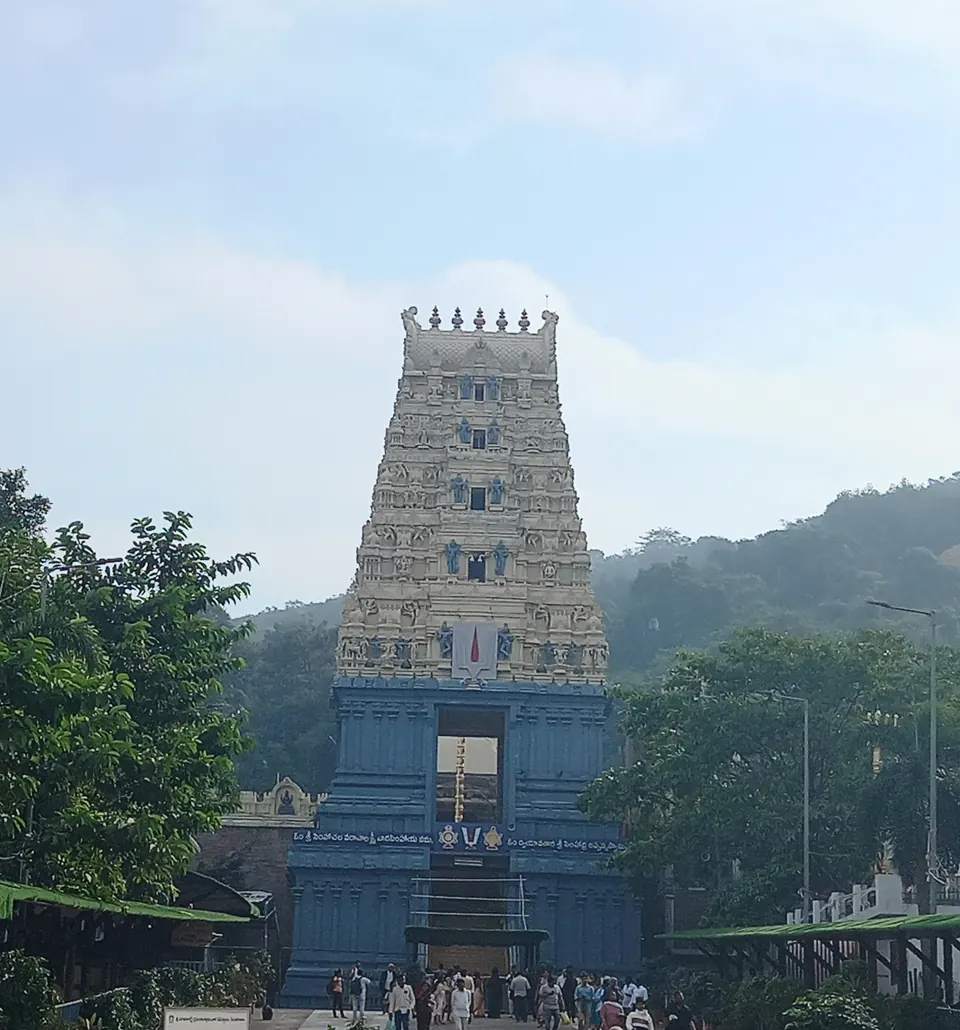
The temple on the hill
The Vizagapatam district gazetteer (1907) describes Simhachalam, “the lion hill”, as rising about 800 feet just north of Visakhapatnam (then Vizagapatam). Near the top of its north side, in a wooded hollow, “is the temple to Narasimha, the man-lion incarnation of Vishnu, which gives the hill its name”.1 The gazetteer calls it “the most famous, richest, and best sculptured shrine in Vizagapatam”.1 The Rajas of Vizianagram had been its wardens for over two centuries.1 They had endowed it with land worth some Rs. 30,000 a year.1
Pilgrims climbed from a rose garden at the foot of the hill by a flight of more than a thousand stone steps.12 They passed through a portal called Hanuman’s gate, once part of the temple’s fortifications.12 They bathed in two pools fed by a stream before reaching the temple, which stands on a terrace partly cut out of the hillside.12 See Simhachalam.
Building
The gazetteer says: “The exact age of the temple is not known”.2 But it contains an inscription “dated as far back as 1098-99 A.D., of the Chola king Kulottunga I who conquered the Kalinga territories”.2 Another inscription “shows that a queen of the Velanandu chief Gonka III (1137-56) covered the image with gold”.2 A third “says that the Eastern Ganga king Narasimha I built the central shrine, the mukhamandapam, the natyamandapam, and the enclosing verandah in black stone in 1267-68”.2
Europeans were not admitted to the central enclosure.23 It was said to contain a square shrine with a high tower, a portico, a sixteen-pillared hall and an enclosing verandah.23 All were “made of dark granite richly and delicately carved with conventional and floral ornament and scenes from the Vaishnavite puranas”.3 “These are doubtless the work of the Narasimha I referred to above.”3 Much of the carving had been damaged or covered with plaster.3
Outside the inner enclosure the gazetteer singled out the hall on the north side, where the god’s marriage is performed.3 It rests on ninety-six pillars of black stone, “more delicately carved than any others in the temple”.3 This hall is also attributed to Narasimha I.3 See Narasimha I.
The image of the god “is small and is kept covered with an unctuous preparation of sandal paste” (an oily sandal paste).3 The paste is removed once a year, in May, at the festival called Chandanayatra.3
The inscriptions
The Government Epigraphist’s lists for 1899, the gazetteer noted, gave “no less than 125” inscriptions on the temple walls.2 This made the temple “a regular repository of the history of the district” (store of history).2 Their texts and many more were printed in South-Indian Inscriptions VI (1928).4 There Simhachalam “alone furnishes as many as 525 inscriptions”, with “a large number of epigraphs belonging to the reigns of many an Eastern Ganga sovereign”.4 V. Rangacharya’s summaries of 1919 include:
- a damaged Tamil record of Kulottunga I of Saka 1021 (Saka is an Indian way of counting years), naming a minister, which Rangacharya thought proved the truth of the poem Kalingattupparani on Kulottunga’s conquest of Kalinga5
- a Sanskrit prasasti (praise poem) of an Eastern Ganga king Narasimha, of Saka 1184, composed by Chitsukharya6
- records of later Ganga kings and their queens, from Bhanudeva I in the 1270s to a Narasimha who came to the throne in 1376, and of the queens and chiefs of the Matsya family of Oddavadi78
- a gift of Saka 1308 by the Reddi king Katamareddi-Vemireddi of Rajahmundry8
- a record of the Gajapati king Kapilesvara, and records of the Vijayanagara king Krishnaraya, one of them of jewels given by the king and his two queens in Saka 143868
The dates of the Kulottunga record differ.925 The gazetteer gives 1089 on one page and 1098–99 on another.92 Rangacharya’s Saka 1021 corresponds to 1099–1100.5 See Kulottunga I.
Later history
The gazetteer says that the Reddi kings of Kondavidu “penetrated to Simhachalam (where stands an inscription of one of them dated 1385-86)”.1011 It adds that the temple “still contains inscriptions recounting” the successes of Krishnadeva Raya of Vijayanagara, who halted at Simhadri in 1515.1011 They relate “how he and his queens presented the god with a necklace of 991 pearls and other costly gifts”.1011 The Godavari district gazetteer records the inscription of Kataya Vema of Rajahmundry in the temple.12 See the Reddis of Kondavidu.
Footnotes
-
Francis, Vizagapatam (1907), p. 323 (archive.org (opens in a new tab)). ↩ ↩2 ↩3 ↩4 ↩5 ↩6 ↩7
-
Francis, Vizagapatam (1907), p. 324 (archive.org (opens in a new tab)). ↩ ↩2 ↩3 ↩4 ↩5 ↩6 ↩7 ↩8 ↩9 ↩10 ↩11 ↩12 ↩13
-
Francis, Vizagapatam (1907), p. 325 (archive.org (opens in a new tab)). ↩ ↩2 ↩3 ↩4 ↩5 ↩6 ↩7 ↩8 ↩9 ↩10
-
K. V. Subrahmanya Aiyer (ed.), South-Indian Inscriptions (Texts), Vol. VI (1928), Preface (archive.org (opens in a new tab)). ↩ ↩2
-
Rangacharya, Topographical List, Vol. III (1919), p. 1686, Vizagapatam No. 191 (archive.org (opens in a new tab)). ↩ ↩2 ↩3
-
V. Rangacharya, A Topographical List of the Inscriptions of the Madras Presidency, Vol. III (1919), p. 1675, Vizagapatam Nos. 69–76 (archive.org (opens in a new tab)). ↩ ↩2
-
Rangacharya, Topographical List, Vol. III (1919), p. 1676, Vizagapatam Nos. 77–88 (archive.org (opens in a new tab)). ↩
-
Rangacharya, Topographical List, Vol. III (1919), p. 1678, Vizagapatam Nos. 100–112 (archive.org (opens in a new tab)). ↩ ↩2 ↩3
-
W. Francis, Madras District Gazetteers: Vizagapatam, Vol. I (1907), p. 27 (archive.org (opens in a new tab)). ↩ ↩2
-
Francis, Vizagapatam (1907), p. 28 (archive.org (opens in a new tab)). ↩ ↩2 ↩3
-
Francis, Vizagapatam (1907), p. 29 (archive.org (opens in a new tab)). ↩ ↩2 ↩3
-
F. R. Hemingway, Madras District Gazetteers: Godavari, Vol. I (1907), p. 26 (archive.org (opens in a new tab)). ↩
Photos
Related
Inscriptions
Simhachalam inscription of Kulottunga I
1099 CE
Damaged Tamil inscription of the Chola king Kulottunga I on a slab in the mandapa of the Varaha-Narasimha temple at Simhachalam, near Visakhapatnam, dated Saka 1021 (1099). V. Rangacharya and W. Francis took it as confirmation of Kulottunga's conquest of Kalinga celebrated in the Tamil poem Kalingattupparani; Robert Sewell was more cautious.
Simhachalam inscriptions of Krishnadeva Raya (1516–1519)
1516–1519 CE
Three Telugu inscriptions of Krishnadeva Raya in the Varaha-Narasimha temple at Simhachalam near Visakhapatnam. They are on the base of the asthana-mandapa (audience hall) and on a round pillar of the verandah round the central shrine. They are dated Saka 1438 (1516) and 1441 (1519). They record that the king, after subduing Udayagiri, Kondavidu, Kondapalli and Rajahmundry on his 'first campaign', came to Simhadri. For the merit of his parents he gave the god a necklace of 991 pearls and other jewels. His queens Chinnadevi and Tirumaladevi also made gifts, and later the king gave several villages.
References
Notes (0)
Sources (4)
Spotted an error on this page? Tell us
Last updated: