Srikurmam
Village and place of pilgrimage near Srikakulam, with the temple of Vishnu as the tortoise (Kurma). The temple's black stone pillars carry more than a hundred inscriptions. Many of them are of the Eastern Ganga kings, their ministers and feudatories (subordinate chiefs), and of the Gajapatis.
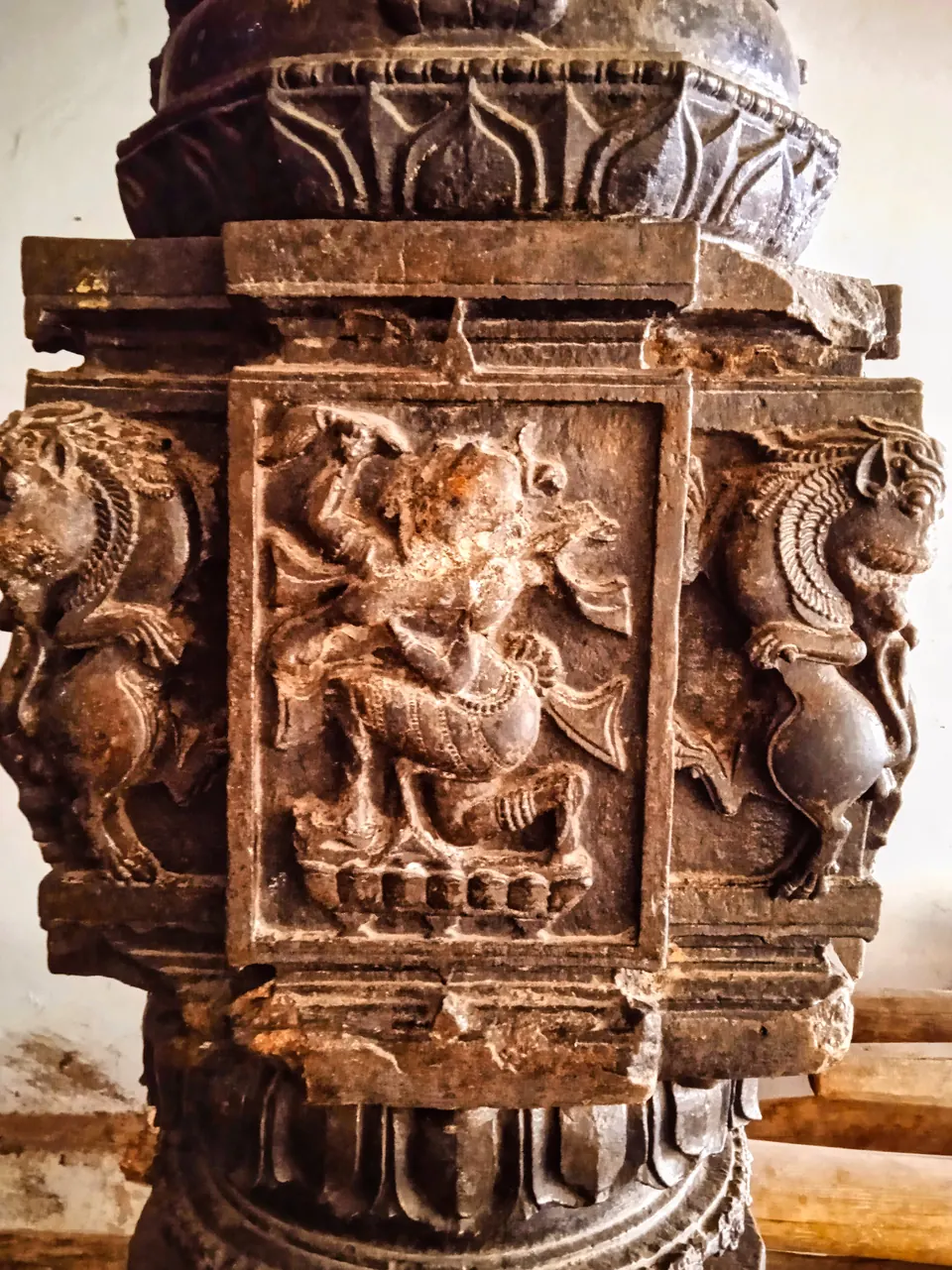
The Imperial Gazetteer (1908) places Srikurmam (“holy tortoise”) in the Srikakulam (then Chicacole) taluk of the Ganjam district, “9 miles south-east of Chicacole”, with a population in 1901 of 6,510.1 Its temple “is dedicated to the tortoise incarnation of Vishnu”.1
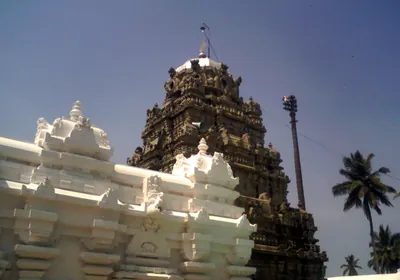
According to the gazetteer, the temple’s inscriptions are in Telugu and Devanagari characters and cover eight centuries from the eleventh.1 They “afford unique material regarding the history of various early dynasties, such as the Gangas, Matsyas, Silas, and Chalukyas”.1 The Ganjam district manual of 1882 called it “the only place of pilgrimage for Telugus in the district”.2 See the Srikurmam temple.
V. Rangacharya, quoting E. Hultzsch, noted that most of the Srikurmam inscriptions concern the successors of Anantavarman Chodaganga.34 He noted too that the departmental list held more than a hundred of them.34 Two groups have been edited in full: the inscriptions of the Chalukya chiefs and the inscription of Naraharitirtha. See the Eastern Gangas.
Footnotes
-
Imperial Gazetteer of India, Provincial Series: Madras, Vol. I (1908), p. 230 (archive.org (opens in a new tab)). ↩ ↩2 ↩3 ↩4
-
T. J. Maltby, The Ganjam District Manual (1882), p. 62 (archive.org (opens in a new tab)). ↩
-
V. Rangacharya, A Topographical List of the Inscriptions of the Madras Presidency, Vol. I (1919), p. 685 (archive.org (opens in a new tab)). ↩ ↩2
-
Rangacharya, Topographical List, Vol. I (1919), p. 686 (archive.org (opens in a new tab)). ↩ ↩2
Photos
Related
People
Anantavarman Chodaganga
c. 1078–1146 CE
Eastern Ganga king of Kalinga, crowned in 1078 and still reigning in his 72nd regnal year (1146–47). He was a son of the Ganga king Rajaraja and of Rajasundari, a daughter of Kulottunga I, so he was a grandson of the Chola-Chalukya emperor whose armies invaded Kalinga in his reign. Dozens of his Telugu and Sanskrit inscriptions survive at Mukhalingam, Srikurmam, Simhachalam, Draksharama and other places in the north of the Telugu country. His grants trace the Ganga family back to Brahma.
Narasimha I (Eastern Ganga)
c. 1250–1268 CE
Eastern Ganga king of Kalinga and Orissa in the mid-13th century, son of Anangabhima. The Vizagapatam gazetteer credits him with building the central shrine, the halls and the enclosing verandah of the Simhachalam temple in black stone in 1267–68. His feudatories and ministers left records at Srikurmam. The Orissa temple chronicle remembers him as Languliya Narsinh, builder of the Sun temple at Konarak. His dates differ widely between the sources.
Kapilendra (Kapilesvara)
c. 1434–1470 CE
Founder of the Suryavamsi Gajapati dynasty of Orissa, who took the throne of the last Eastern Ganga king in 1434–35 and reigned until about 1470. He conquered the Reddi kingdoms of Rajahmundry and Kondavidu, and governed them through his nephew Raghudeva and his kinsman Ganadeva. He relieved Devarakonda from the Bahmanis in 1459, and his son Hamvira and Raghudeva took Warangal in 1460. His records credit him with conquests down the coast to the Kaveri.
Purushottama (Gajapati)
c. 1470–1497 CE
Gajapati king of Orissa from 1469–70 to 1496–97, son of Kapilendra. Early in his reign the Bahmanis took Rajahmundry and Kondapalli or Kondavidu, after a disputed succession in which he may have bought their help. His attempt to recover the Godavari country in the 1470s ended with Muhammad Shah III's invasion of Orissa. But by 1489 his grants and inscriptions reach the Krishna and the Ongole country again. Orissan tradition credits him with an expedition to Kanchi and a romantic marriage.
Prataparudra (Gajapati)
c. 1497–1540 CE
Gajapati king of Orissa from 1496–97 to about 1540, son of Purushottama, and the last great king of the Suryavamsi line. At his accession his empire reached from Bengal to the Guntur and Nellore country. In 1512–19 the Vijayanagara king Krishnadeva Raya took Udayagiri, Kondavidu and Kondapalli, captured his son Virabhadra, marched to Simhachalam and married his daughter. The Qutb Shahi sultan of Golconda then took the Godavari–Krishna country. The legal digest Sarasvativilasa bears his name. He was a disciple of Chaitanya.
Monuments
Inscriptions
Srikurmam inscriptions of the Chalukya chiefs
1273 CE
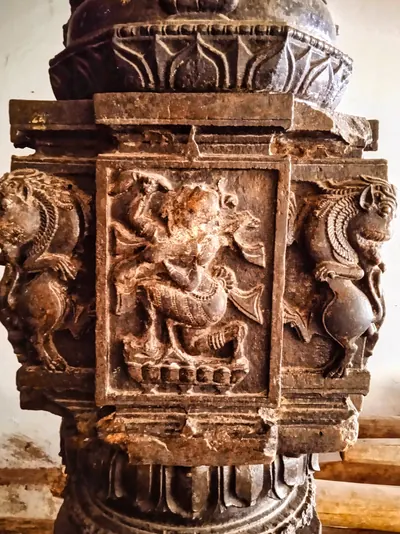
Four inscriptions of 1273 to 1318 on pillars of the Kurmesvara temple at Srikurmam. They were left by chiefs who claimed descent from the Eastern Chalukya kings Vimaladitya and Rajaraja Narendra, and who served the Eastern Ganga kings. The earliest calls the chief's father a minister of Narasimha I. It also says that Rajaraja Narendra, with scholars, translated the history of the Bharata race into Telugu. E. Hultzsch took this as a confirmation, from an inscription, of the tradition of Nannaya's Telugu Mahabharata.
Srikurmam inscription of Naraharitirtha
1281 CE
A Sanskrit inscription in Telugu letters on a black granite pillar of the Kurmesvara temple at Srikurmam, dated Saka 1203 (1281). It names the Madhva teachers Purushottama, Anandatirtha and Naraharitirtha. It says that Naraharitirtha defended Srikurmam against the Savaras and built a shrine of Yogananda-Narasimha there. It suggests that he governed the Kalinga country under the Eastern Ganga kings. H. Krishna Sastri used it and Naraharitirtha's other records to date the philosopher Madhva.
Gajapati inscriptions at Srikurmam (1452–1503)
1452–1503 CE
Short Telugu records on the black stone pillars of the Srikurmam temple. They are dated in the reigns of the Gajapati kings Kapilendra (1452, 1455, 1460), Purushottama (1470–1495) and Prataparudra (1503), and record gifts of land, lamps, images and silver vessels. They were copied in 1896 and printed in South-Indian Inscriptions V (1925). Monmohan Chakravarti and R. D. Banerji used them to fix the regnal years of the kings, and V. Rangacharya used them to argue that the kings came to the throne earlier.
References
Notes (0)
Sources (3)
Spotted an error on this page? Tell us
Last updated: