Srikurmam temple
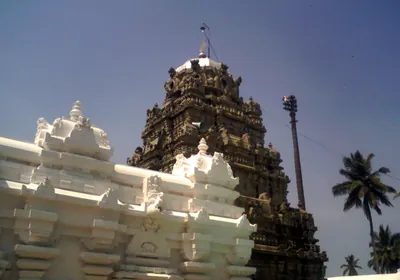
Temple of Vishnu in his tortoise incarnation at Srikurmam, near Srikakulam. Its granite verandas and black stone pillars carry more than a hundred inscriptions. Most of them belong to the Eastern Ganga kings who came after Anantavarman Chodaganga, to their ministers and feudatories, and later to the Gajapatis. An inscription of 1283 credits a Brahmin contemporary of a king Anangabhima with building an enclosure of black stone for the temple.
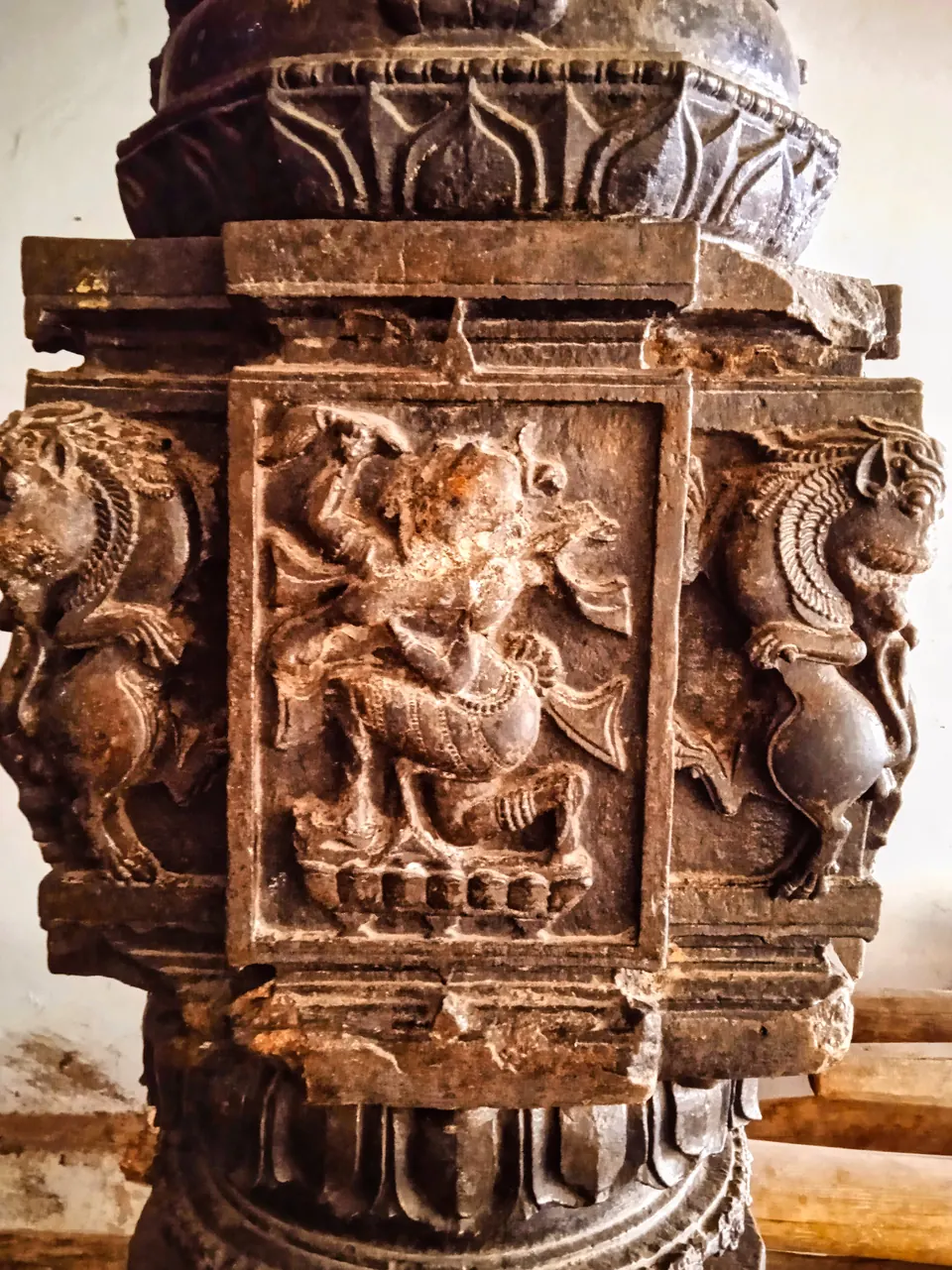
The temple at Srikurmam, near Srikakulam (then Chicacole), is dedicated to the tortoise incarnation of Vishnu.1 Its stone pillars carry more than a hundred inscriptions.2 Most of them concern the Eastern Ganga kings who came after Anantavarman Chodaganga.3
The temple
The Imperial Gazetteer (1908) describes Srikurmam (“holy tortoise”) as a “famous place of pilgrimage”, nine miles south-east of Srikakulam.1 It says: “The temple is dedicated to the tortoise incarnation of Vishnu.”1 “It was formerly a Saiva shrine, but is said to have been changed into a Vaishnava place of worship by the celebrated Hindu reformer Ramanujacharya.”1 It adds that “The gateways and pillars of the granite verandas round the temple are of great architectural beauty”.1 The chief festival, the Dolotsavam, was held every March and drew about 20,000 pilgrims.1
The Ganjam district manual of 1882 called it “the only place of pilgrimage for Telugus in the district”.4 It called the temple “a fine one decorated with the usual carving from which obscenity is not absent”.4 See Srikurmam.
The inscriptions
The gazetteer says that the temple “contains many old inscriptions in Telugu and Devanagari characters”.1 They “cover a period of 800 years from the eleventh century”.1 They “afford unique material regarding the history of various early dynasties, such as the Gangas, Matsyas, Silas, and Chalukyas”.1
E. Hultzsch noted that they are carved on “many inscribed pillars of hard black stone, which have successfully withstood the influence of the climate”.5 He found them better preserved than other stone records in the Telugu country.5 The texts were printed in South-Indian Inscriptions V (1925), Nos. 1150 to 1341.6 V. Rangacharya, writing in 1919, counted more than a hundred in the departmental list.2 Robert Sewell’s Lists of Antiquities had only sixteen.2
The kings in the records
Rangacharya quoted Hultzsch’s report of 1896.3 According to it, most of the Srikurmam inscriptions concern the successors of Anantavarman Chodaganga.3 Among them are four kings named Narasimha and four named Bhanudeva.3 The first Narasimha was the son of Anangabhima.3 The second came to the throne about 1275–76 and the third about 1322–23.3 A single record names a king Jagannatha.3
Among the records summarised by Rangacharya are:27
- an inscription of Saka 1172 (1250–51; Saka is an Indian way of counting years) recording a gift of land by a feudatory of Narasimha I, son of Anangabhima7
- gifts by ministers and officers of Narasimha II and his successors, and by queens of the later Narasimhas27
- an inscription of Saka 1393 of the Gajapati king Purushottama, which Rangacharya took to fix his accession in 1464–652
See Narasimha I and the Eastern Gangas.
Records edited in full
Two groups of records have been edited in full.58 The first is the inscriptions of the Chalukya chiefs who served Narasimha I and Bhanudeva II.5 One of them recalls the Telugu Mahabharata of Rajaraja Narendra’s court.5 The second is the inscription of 1281 of the Madhva teacher Naraharitirtha.8 He built a shrine of Yogananda-Narasimha in front of the temple.8 See the Srikurmam inscriptions of the Chalukya chiefs and the inscription of Naraharitirtha.
The black stone enclosure
An inscription of Saka 1205 (1283–84) records a gift of a lamp by the wife of Narasimhabhattopadhyaya.7 According to Rangacharya’s summary, he “was a contemporary of king Anangabhima … and had built an enclosure of black stone for the temple”.7 Rangacharya placed this Anangabhima, following W. W. Hunter, in 1175–1202.7
H. Krishna Sastri described the hall around the temple as supported by black granite pillars.8 The inscription of Naraharitirtha is cut on one of these pillars.8
Footnotes
-
Imperial Gazetteer of India, Provincial Series: Madras, Vol. I (1908), p. 230 (archive.org (opens in a new tab)). ↩ ↩2 ↩3 ↩4 ↩5 ↩6 ↩7 ↩8 ↩9
-
Rangacharya, Topographical List, Vol. I (1919), p. 686, Srikurmam and Ganjam Nos. 150–161 (archive.org (opens in a new tab)). ↩ ↩2 ↩3 ↩4 ↩5 ↩6
-
V. Rangacharya, A Topographical List of the Inscriptions of the Madras Presidency, Vol. I (1919), p. 685, introduction to Srikurmam (archive.org (opens in a new tab)). ↩ ↩2 ↩3 ↩4 ↩5 ↩6 ↩7
-
T. J. Maltby, The Ganjam District Manual (1882), p. 62 (archive.org (opens in a new tab)). ↩ ↩2
-
E. Hultzsch, “Four Pillar Inscriptions of Eastern Chalukya Chiefs at Srikurmam”, Epigraphia Indica V (1898–99), p. 31 (archive.org (opens in a new tab)). ↩ ↩2 ↩3 ↩4 ↩5
-
H. Krishna Sastri (ed.), South-Indian Inscriptions (Texts), Vol. V (1925), Table of Contents, p. v (archive.org (opens in a new tab)). ↩
-
Rangacharya, Topographical List, Vol. I (1919), p. 688, Ganjam Nos. 174–186 (archive.org (opens in a new tab)). ↩ ↩2 ↩3 ↩4 ↩5 ↩6
-
H. Krishna Sastri, “Srikurmam Inscription of Naraharitirtha; Saka-Samvat 1203”, Epigraphia Indica VI (1900–01), p. 260 (archive.org (opens in a new tab)). ↩ ↩2 ↩3 ↩4 ↩5
Photos
Related
Inscriptions
Srikurmam inscriptions of the Chalukya chiefs
1273 CE
Four inscriptions of 1273 to 1318 on pillars of the Kurmesvara temple at Srikurmam. They were left by chiefs who claimed descent from the Eastern Chalukya kings Vimaladitya and Rajaraja Narendra, and who served the Eastern Ganga kings. The earliest calls the chief's father a minister of Narasimha I. It also says that Rajaraja Narendra, with scholars, translated the history of the Bharata race into Telugu. E. Hultzsch took this as a confirmation, from an inscription, of the tradition of Nannaya's Telugu Mahabharata.
Srikurmam inscription of Naraharitirtha
1281 CE
A Sanskrit inscription in Telugu letters on a black granite pillar of the Kurmesvara temple at Srikurmam, dated Saka 1203 (1281). It names the Madhva teachers Purushottama, Anandatirtha and Naraharitirtha. It says that Naraharitirtha defended Srikurmam against the Savaras and built a shrine of Yogananda-Narasimha there. It suggests that he governed the Kalinga country under the Eastern Ganga kings. H. Krishna Sastri used it and Naraharitirtha's other records to date the philosopher Madhva.
Gajapati inscriptions at Srikurmam (1452–1503)
1452–1503 CE
Short Telugu records on the black stone pillars of the Srikurmam temple. They are dated in the reigns of the Gajapati kings Kapilendra (1452, 1455, 1460), Purushottama (1470–1495) and Prataparudra (1503), and record gifts of land, lamps, images and silver vessels. They were copied in 1896 and printed in South-Indian Inscriptions V (1925). Monmohan Chakravarti and R. D. Banerji used them to fix the regnal years of the kings, and V. Rangacharya used them to argue that the kings came to the throne earlier.
References
Notes (0)
Sources (6)
Spotted an error on this page? Tell us
Last updated: