Chendalur plates of Sarvalokasraya (Mangi-yuvaraja)
Five Sanskrit copper plates of the Eastern Chalukya king Sarvalokasraya Vijayasiddhi, the Mangi-yuvaraja of later grants. They were dug up at Chendalur in the old Ongole taluk with a Pallava grant of the same village. They are dated on a lunar eclipse in the second year of his reign, which F. Kielhorn fixed as 6 May 673, and give the village of Chendarura in Kamma-rashtra to six Brahmins. E. Hultzsch edited them in 1906.
These plates are a grant of the fifth Eastern Chalukya king.1 His own record calls him the Maharaja Sarvalokasraya, and later grants call him Mangi-yuvaraja.1 They were found at Chendalur, the same village whose name appears in a Pallava grant of Kumaravishnu II.23 The two sets record gifts of land in one village under two dynasties.23
Discovery and description
E. Hultzsch quoted the report on how the plates were found.21 Like the Chendalur plates of Kumaravishnu II, these “were found buried in a pot full of paddy husk”.21 A ryot (farmer) of Chendalur, then in the Ongole taluka of the Nellore district, found them while digging his house-site for a foundation.21 “This was some forty years ago.”21
The plates passed from the ryot to the village accountant (karnam) and then to N. Suryanarayana Rao, a vakil (lawyer) of Nellore.21 He sent them, through A. Butterworth, to V. Venkayya, and they were returned to him after study.21 They were registered as No. II of Appendix A in the epigraphical report for 1906.4
Hultzsch printed Venkayya’s description.1 It says that the five plates have no rims and that the first and last are inscribed on the inner side only.1 They are a little over 9 inches broad, narrower at the top and bottom edges than in the middle.1 The oval ring, which Venkayya cut for the first time, is fixed in an almost round seal.1
The seal bears in relief the legend Sri-Vijayasiddhi, with a seven-petalled lotus below.1 Above are the crescent moon and two symbols “which may be taken to be daggers pointing upwards”.1 The first plate carries the numeral “1” on its left margin, and the others are unnumbered.1
Script and language
Hultzsch found the inscription “carefully engraved and on the whole well preserved”.1 Its alphabet resembles that of the two published grants of Vishnuvardhana II, Sarvalokasraya’s father.1 The language is Sanskrit prose with two quoted verses, and the rules of sandhi (joining of sounds) are often ignored.1
For five of the six donees the text uses the Telugu word boya, which Hultzsch thought had the same sense as the Sanskrit vastavya, “residing in”.3 Twenty years later, editing the Penukaparu grant of the king’s son Jayasimha II, Hultzsch compared its alphabet with that of these plates.5
Content
The grant gives the family line:1
- Sarvalokasraya1
- his father Vishnuvardhana (II)1
- his grandfather Indrabhattarakavarman1
- his great-grandfather Vishnuvardhana (I), “who adorned the family of the Chalukyas”1
Hultzsch noted that some of the praises of Indrabhattarakavarman and of Vishnuvardhana II “were evidently copied from inscriptions or office records of the Pallavas”.1 The Pallavas, he added, “had been supplanted by the Eastern Chalukyas”.1 Indrabhattarakavarman seems to have had the surname Simhavikrama, and Vishnuvardhana II that of Makaradhvaja.1
Two long compounds praising the king’s valour fill five lines.1 But, Hultzsch wrote, they “contain nothing of any historical interest”.1 The king’s surname Vijayasiddhi, on the seal, is explained in the text.1 He is “he who has obtained the accomplishment of victory (vijaya-siddhi) by crushing the daring (of enemies) in many battles”.1
The king addresses “the villagers in the village of Chendarura in (the district named) Kamma-rashtra”.3 He also addresses “all officers (naiyogika) and favourites gone to this (district)”.3 He tells them that he has granted the village to six Brahmins, students of the Samaveda, each receiving two shares.3 Five were of the Kaundinya gotra (clan) and one of the Kalabava gotra.3
“Curiously enough”, Hultzsch wrote, their names are not given.3 Only their native villages are named: Katura, Vangra, Kollipuro (?), Pidena, Kuriyida and Kodinki.3 The executor (ajnapti) was “the glorious A[na]ghavarman”, praised as the sun crowning the eastern mountain of the family of Ayyana.3 Pumbeya Sarvottama Atharvana wrote the edict.3
Date
The grant ends with the date.13 The plates were given “on the occasion of an eclipse on the full-moon tithi of Vaisakha in the second year of the reign of increasing victory.”13
On J. F. Fleet’s chronology this second year fell in 673.3 But Robert Sewell’s tables recorded no lunar eclipse in Vaisakha between 665 and 683, only a total eclipse in Jyeshtha, on Friday, 6 May 673.3
Hultzsch put the difficulty to F. Kielhorn.6 In a postscript Kielhorn showed that a month was intercalated (added) that year.6 By an older rule of Brahmagupta’s, such a month took its name from the month before it, Vaisakha, not from the month after it, Jyeshtha.6 The full-moon day of 6 May 673 “would thus have been correctly described as the full-moon day of Vaisakha (or, more fully of the second Vaisakha)”.6
Hultzsch concluded that the date was 6 May 673.3 He called it “a result which corroborates the correctness of Dr. Fleet’s chronology of the Eastern Chalukya dynasty”.3
The village and the district
Hultzsch held that Chendarura “must be the same as the present Chendalur, at which the copper-plates were discovered”.3 The district Kamma-rashtra appears as Karma-rashtra in two other grants, of Vishnuvardhana II and Mangi-yuvaraja.3 In the Pallava plates of Kumaravishnu II the same village and district are named Chendalura and Karmma[n]ka- or Kamma[n]ka-rashtra.3
Fleet had edited the other grant of Mangi-yuvaraja in 1891.78 It gave fields in a village of the Karmarashtra country in the king’s twentieth year, and he did not know where it had been found.78
Disagreements
The sources place Chendalur in different districts. Hultzsch, in 1906, gave it as in the Ongole taluk of the Nellore district.2 Sewell’s chronology of 1932 entered the grant under the Ongole taluk of Guntur district.9 V. Rangacharya explained the difference in 1919: “at the time when Hultzsch wrote the village was in Nellore district, but now in Guntur.”10
Sewell took the grant as showing Mangi-yuvaraja ruling that country, and dated his accession to 672.9 Fleet’s list gives his reign as twenty-five years, 672 to 696.11
Footnotes
-
Hultzsch, “Chendalur Plates of Sarvalokasraya” (1906), p. 237 (archive.org (opens in a new tab)). ↩ ↩2 ↩3 ↩4 ↩5 ↩6 ↩7 ↩8 ↩9 ↩10 ↩11 ↩12 ↩13 ↩14 ↩15 ↩16 ↩17 ↩18 ↩19 ↩20 ↩21 ↩22 ↩23 ↩24 ↩25 ↩26 ↩27 ↩28 ↩29 ↩30 ↩31 ↩32
-
E. Hultzsch, “Chendalur Plates of Sarvalokasraya; A.D. 673”, Epigraphia Indica VIII (1905–06), p. 236 (archive.org (opens in a new tab)). ↩ ↩2 ↩3 ↩4 ↩5 ↩6 ↩7 ↩8 ↩9
-
Hultzsch, “Chendalur Plates of Sarvalokasraya” (1906), p. 238 (archive.org (opens in a new tab)). ↩ ↩2 ↩3 ↩4 ↩5 ↩6 ↩7 ↩8 ↩9 ↩10 ↩11 ↩12 ↩13 ↩14 ↩15 ↩16 ↩17 ↩18 ↩19 ↩20
-
Rangacharya, Topographical List, Vol. II (1919), p. 785, No. 346 (archive.org (opens in a new tab)). ↩
-
E. Hultzsch, “Penukaparu Grant of Jayasimha II”, Epigraphia Indica XVIII (1925–26), p. 314 (archive.org (opens in a new tab)). ↩
-
F. Kielhorn, postscript to Hultzsch, “Chendalur Plates of Sarvalokasraya”, Epigraphia Indica VIII (1905–06), pp. 240–241 (archive.org (opens in a new tab)). ↩ ↩2 ↩3 ↩4
-
J. F. Fleet, “Madras Museum Copper-plate Grant of Mangi-Yuvaraja”, Indian Antiquary XX (1891), p. 104 (archive.org (opens in a new tab)). ↩ ↩2
-
Fleet, “Madras Museum Copper-plate Grant of Mangi-Yuvaraja” (1891), p. 105 (archive.org (opens in a new tab)). ↩ ↩2
-
Robert Sewell and S. Krishnaswami Aiyangar, The Historical Inscriptions of Southern India (1932), p. 26 (archive.org (opens in a new tab)). ↩ ↩2
-
V. Rangacharya, A Topographical List of the Inscriptions of the Madras Presidency, Vol. II (1919), p. 784, Ongole taluk, No. 345 (archive.org (opens in a new tab)). ↩
-
J. F. Fleet, “The Chronology of the Eastern Chalukya Kings”, Indian Antiquary XX (1891), p. 98 (archive.org (opens in a new tab)). ↩
Photos
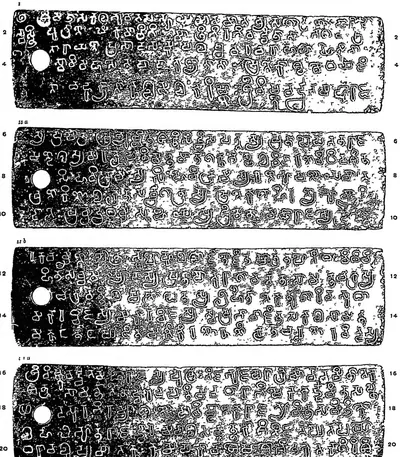 "Chendalur plates of Sarvalokasraya.—A.D. 673", plates i, ii a, ii b and iii a (Epigraphia Indica VIII, plate between pp. 238 and 239 (PDF p. 301))Inscription rubbing · 1906
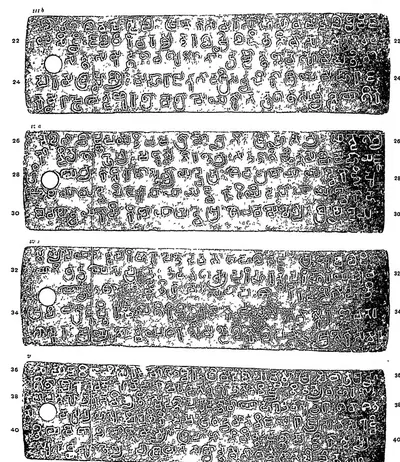 "Chendalur plates of Sarvalokasraya.—A.D. 673", plates iii b, iv a, iv b and v (Epigraphia Indica VIII, plate between pp. 238 and 239 (PDF p. 302))Inscription rubbing · 1906
References
Notes (0)
Sources (5)
Spotted an error on this page? Tell us
Last updated: