Pedapalakaluru plates of Anavema (1378)
Four copper plates of 4 December 1378, found at Pedapalakaluru near Guntur in 1954 and now in the Andhra Pradesh State Museum, Hyderabad. They record Anavema Reddi's gift of the village to the scholar Ahobala Pandita and eight other Brahmans. Half of the 212 lines describe the village boundaries in Telugu. The family history in the grant credits Prolaya Vema with flights of steps at Srisailam and Ahobilam.
Discovery and the plates
N. Ramesan found these plates in 1954 at Pedapalakaluru, about eight miles from Guntur, while he was Collector of Guntur.1 After the formation of Andhra Pradesh they were shown for some years at the Raj Bhavan in Hyderabad.1 Then they were given to the Government Archaeological Museum in the Public Gardens.1
There are four plates, about 28.4 cm by 15.5 cm, with well raised rims.1 They hang on a ring sealed with a Nandi, the emblem of the Kondavidu kings.1 The plates weigh 5,055 g and the ring 1,875 g.1 Unusually, all eight sides are inscribed, with 212 lines in all.1
Language and style
The script is medieval Telugu, and the text is Sanskrit, except for the boundaries of the village.2 These take up 108 of the 212 lines and are written in Telugu, which the grant calls the language of the country.2
Ramesan judged the 26 verses stiff and artificial compared with the Puvvada grant.2 He took them as a sign of the decline of classical poetry at the time.2
Contents
The grant opens with invocations of Vishnu as the boar, of Siva, the Goddess, Ganapati, Lakshmi and the sun and moon.34 It then describes the fourth caste.34 In the Panta Reddi lineage, it names king Prola, who married Annambika, daughter of king Dodda.34 Their sons were Macha, Vema, Dodda, Anna and Malla.4
Vema gave villages on the banks of the Tungabhadra, the Krishna and the Godavari.5 He built two flights of steps, at Srigiri (Srisailam) and at Ahobilagiri.5 The grant calls these steps permanent pillars of victory, better than the perishable pillars set up by other kings.5
Vema’s two sons, Pota (Anavota) and Anavema, are compared to Indra and Vishnu.56 Anavema, the donor, is praised as Jaganobbaganda and as a Rudra to his enemies.56
In Saka 1300 (Saka is an Indian way of counting years), the cyclic year Kalayukti, on a Saturday at an eclipse of the moon in Margasira, Anavema granted Pedapalakaluru to the scholar Ahobala Pandita.67 He thought that the scholar lived there as Narasimha lives at Ahobilam.67 The village is described as lying north-east of Srikundinipattana (Kondavidu) and south-west of Mangaladri (Mangalagiri).67 The description also places it on the south bank of the Krishna.67
Ahobala Pandita, of the Harita gotra (clan), was the main donee.7 The grant names eight other Brahmans, and each of them received one share.7 With each of these shares, Ahobala Pandita was also given one share, so he received eight shares in all.7 Ramesan concluded from this that the village was divided into sixteen shares.7 As the largest donee, Ahobala Pandita probably managed the village, in his view.7
Date and place
Ramesan worked out the date as Saturday, 4 December 1378, the full moon of Margasira, when there was a lunar eclipse.8 The village of Pedapalakaluru, where the plates were found, matches the description.79 Ramesan drew a plan of its boundaries from the grant.79 See Kondavidu.
Ramesan’s notes
Ramesan pointed to the phrase “Panta Reddi” in the grant.10 Following M. Somasekhara Sarma, he used it to argue that the family came from a Panta country around Gudur in the Nellore district.10
He explained Anavema’s title Appaya-Gopaya-disapatta as taken over from the Hoysala generals Appaya and Gopaya.10 According to him, the family’s ancestors had fought these generals in the service of the Telugu Choda Tikka.10 Unlike other Reddi grants, this one does not name Vema, the founder of the line, before Prola.8
Footnotes
-
N. Ramesan, Copper Plate Inscriptions of Andhra Pradesh Government Museum, Hyderabad, Vol. I (1962), p. 185 (archive.org (opens in a new tab)). ↩ ↩2 ↩3 ↩4 ↩5 ↩6 ↩7
-
Ramesan, Copper Plate Inscriptions, Vol. I (1962), p. 186 (archive.org (opens in a new tab)). ↩ ↩2 ↩3 ↩4
-
Ramesan, Copper Plate Inscriptions, Vol. I (1962), p. 187 (archive.org (opens in a new tab)). ↩ ↩2 ↩3
-
Ramesan, Copper Plate Inscriptions, Vol. I (1962), p. 188 (archive.org (opens in a new tab)). ↩ ↩2 ↩3 ↩4
-
Ramesan, Copper Plate Inscriptions, Vol. I (1962), p. 189 (archive.org (opens in a new tab)). ↩ ↩2 ↩3 ↩4 ↩5
-
Ramesan, Copper Plate Inscriptions, Vol. I (1962), p. 190 (archive.org (opens in a new tab)). ↩ ↩2 ↩3 ↩4 ↩5 ↩6
-
Ramesan, Copper Plate Inscriptions, Vol. I (1962), p. 193 (archive.org (opens in a new tab)). ↩ ↩2 ↩3 ↩4 ↩5 ↩6 ↩7 ↩8 ↩9 ↩10 ↩11
-
Ramesan, Copper Plate Inscriptions, Vol. I (1962), p. 191 (archive.org (opens in a new tab)). ↩ ↩2
-
Ramesan, Copper Plate Inscriptions, Vol. I (1962), pp. 197–198 and text figure (archive.org (opens in a new tab)). ↩ ↩2
-
Ramesan, Copper Plate Inscriptions, Vol. I (1962), p. 192 (archive.org (opens in a new tab)). ↩ ↩2 ↩3 ↩4
Photos
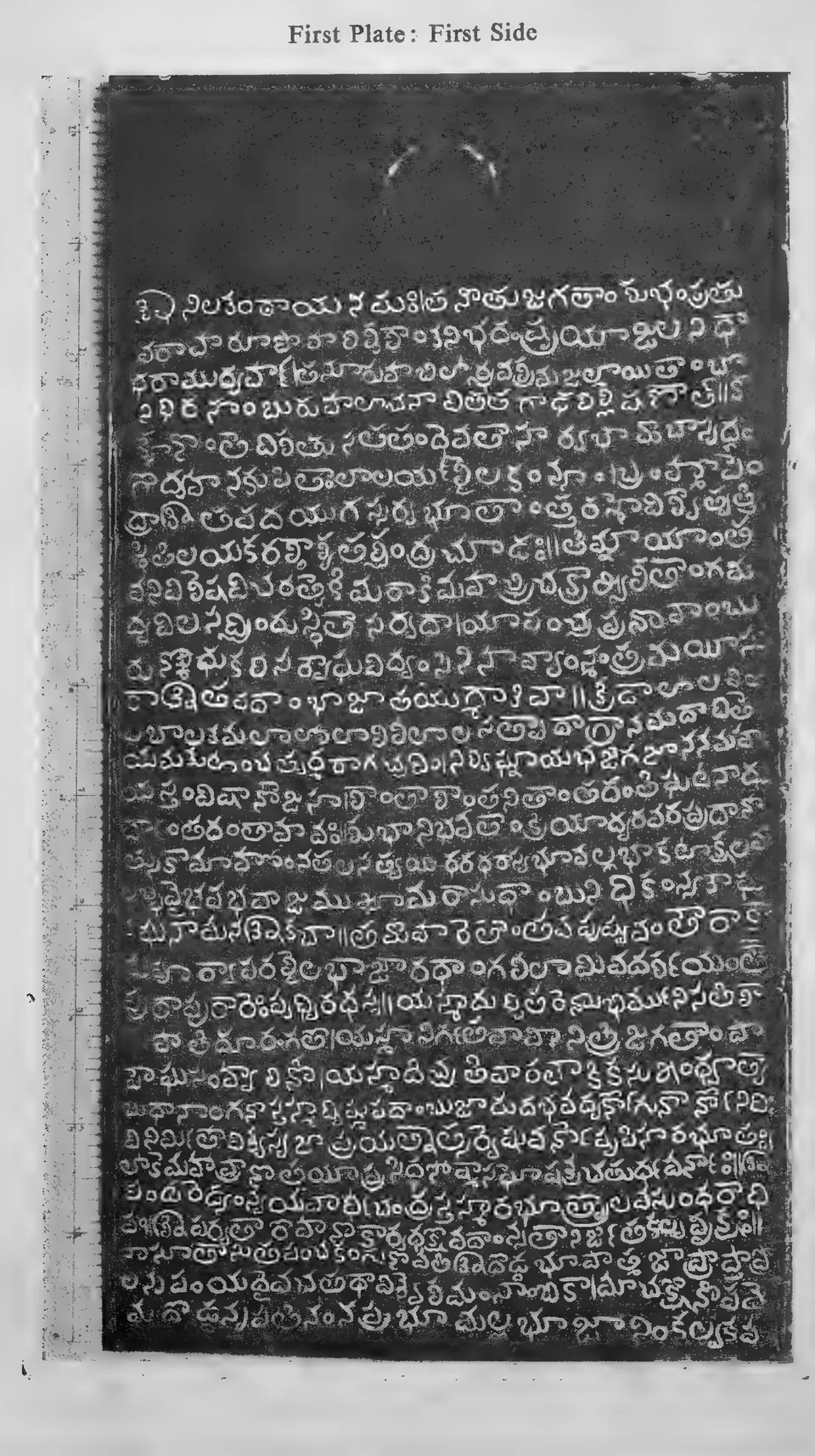
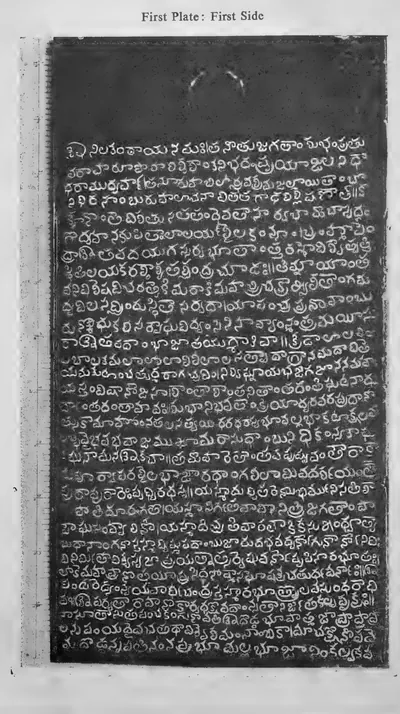 Pedapalakaluru plates of Anavema Reddi, Saka 1300 (A.D. 1378): photograph of the first plate, first side (lines 1-31) (Ramesan 1962, Plate XII (a), PDF p. 249)Photograph · 1962
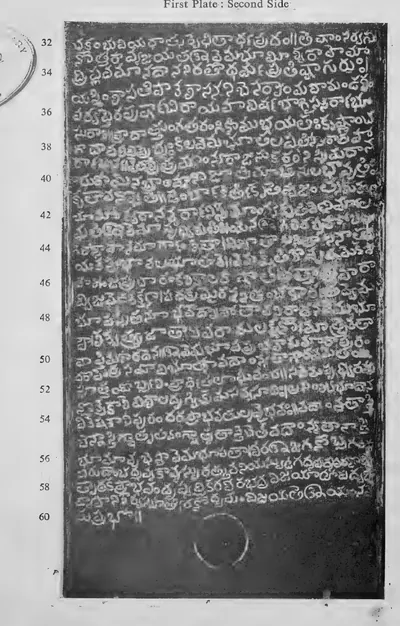 Pedapalakaluru plates of Anavema Reddi, Saka 1300 (A.D. 1378): photograph of the first plate, second side (lines 32-60) (Ramesan 1962, Plate XII (b), PDF p. 250)Photograph · 1962
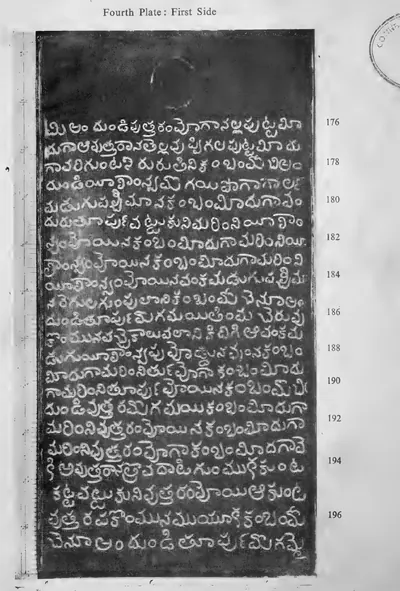 Pedapalakaluru plates of Anavema Reddi, Saka 1300 (A.D. 1378): photograph of the fourth plate, first side (lines 176-197) (Ramesan 1962, Plate XII (g), PDF p. 261)Photograph · 1962
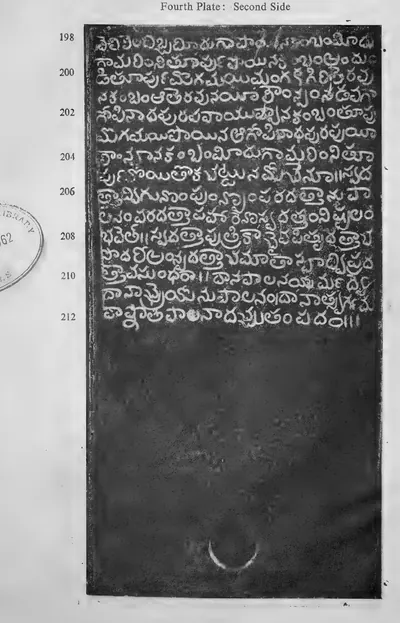 Pedapalakaluru plates of Anavema Reddi, Saka 1300 (A.D. 1378): photograph of the fourth plate, second side (lines 198-212) (Ramesan 1962, Plate XII (h), PDF p. 262)Photograph · 1962
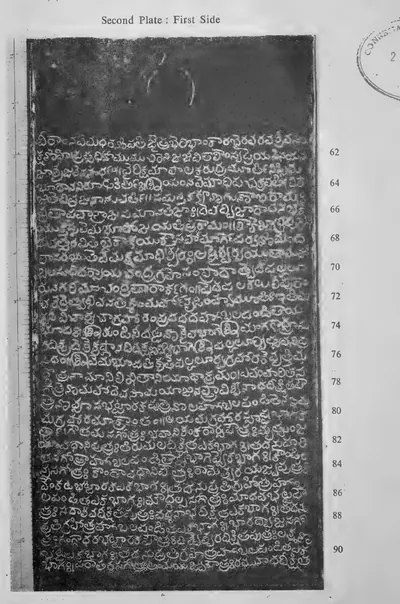 Pedapalakaluru plates of Anavema Reddi, Saka 1300 (A.D. 1378): photograph of the second plate, first side (lines 61-91) (Ramesan 1962, Plate XII (c), PDF p. 253)Photograph · 1962
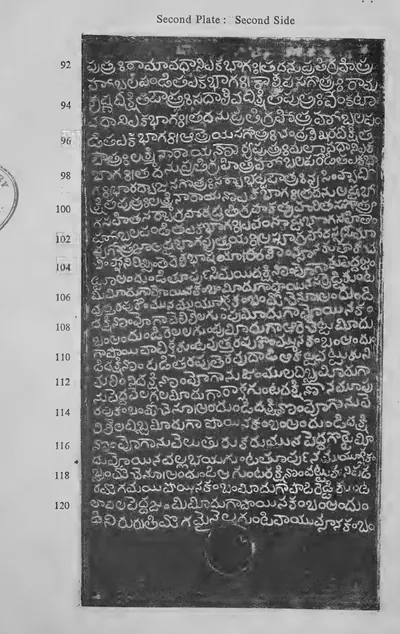 Pedapalakaluru plates of Anavema Reddi, Saka 1300 (A.D. 1378): photograph of the second plate, second side (lines 92-121) (Ramesan 1962, Plate XII (d), PDF p. 254)Photograph · 1962
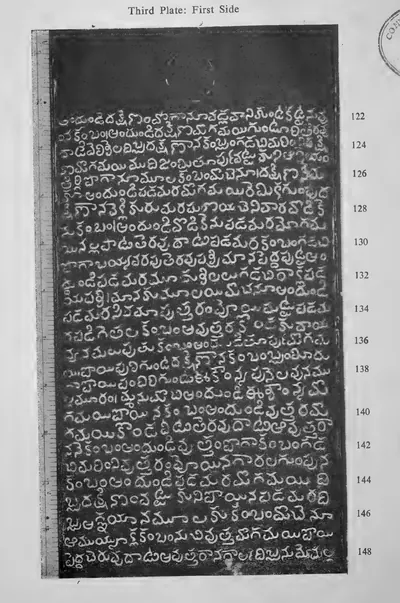 Pedapalakaluru plates of Anavema Reddi, Saka 1300 (A.D. 1378): photograph of the third plate, first side (lines 122-148) (Ramesan 1962, Plate XII (e), PDF p. 257)Photograph · 1962
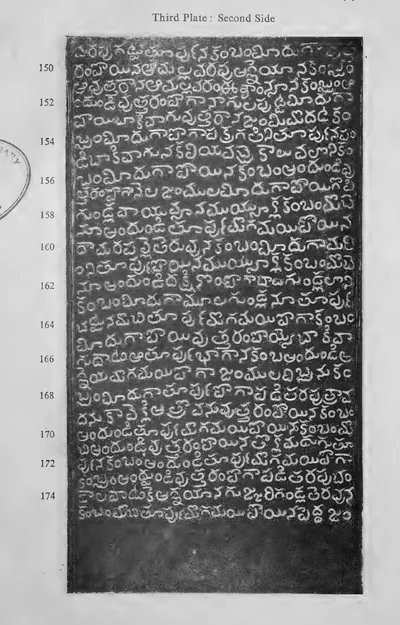 Pedapalakaluru plates of Anavema Reddi, Saka 1300 (A.D. 1378): photograph of the third plate, second side (lines 149-175) (Ramesan 1962, Plate XII (f), PDF p. 258)Photograph · 1962
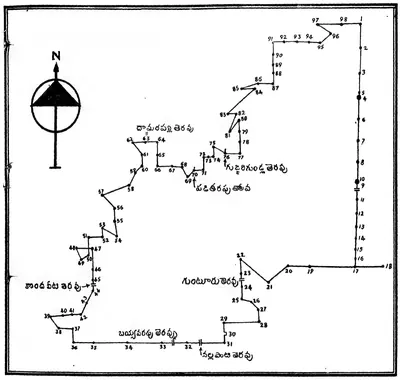 Plan of Pedapalakaluru village drawn by the editor from the boundaries given in the grant of Anavema Reddi (Ramesan 1962, Text Figure I, PDF p. 246)Map · 1962
References
Notes (0)
Sources (1)
Spotted an error on this page? Tell us
Last updated: