Prolaya Nayaka
Musunuri chief (fl. c. 1325–1336). According to his Vilasa grant, he rose after Prataparudra's death and drove the Delhi garrisons out of the Telugu coast. He ruled from Rekapalli on the Godavari and gave back to the Brahmins the villages that the conquerors had seized.
Family
Prolaya Nayaka, or Prola, belonged to the Musunuri family, which his Vilasa grant places in the fourth caste.1 Prolaya’s father was Pochaya-nayaka, who is named in the Pentapadu grant of the Telugu Choda chief Bhaktiraja.23
His cousin Kapaya’s Guraja grant of 1346 gives a pedigree of the family.4 It makes Pocha the eldest of the four sons of Pota, and gives Prola a brother, Erapota.4
The Vilasa grant calls Kapaya-nayaka one of Prolaya’s younger brothers.5 Its editors, N. Venkataramanayya and M. Somasekhara Sarma, thought “younger brothers” meant cousins, because the Guraja pedigree makes Kapaya the son of Pocha’s brother Deva.6 See Kapaya Nayaka and the Musunuri Nayakas.
The liberation of the coast
The Vilasa grant describes the Telugu country after the death of Prataparudra. It says the land was left without a protector and laid waste by the Yavanas (foreigners), and Prolaya was the leader who rose against them.15 In its account the Yavanas left their forts and fled.15 The people who had suffered under them turned on them and killed them.15
Prolaya then gave back to the Brahmins their old villages and revived the Vedic sacrifices, and he set about repairing the damage.5 The cultivators willingly paid him a sixth of their produce.5 The editors called this the first national movement in Indian history, and this is their interpretation of the grant.7
From other records they named Prolaya’s associates. In the Pentapadu grant Prolaya and a chief called Venga leave the Vengi country for a forest fort among the hills.23 Together they win back the Andhra country and destroy the Turushka (Turkish) horsemen in battle.23 After Venga’s death Prolaya set up Venga’s nephew Bhaktiraja, still a boy, as ruler of his uncle’s lands.23
The editors identified the unnamed forest fort with Prolaya’s capital Rekapalli.3 In their reconstruction the coast had been recovered by 1325–26.82
Rekapalli and the Vilasa grant
Prolaya established himself at Rekapalli, on the Godavari at the foot of the Malyavanta hill.5 He gave the work of government to his younger brothers, among them Kapaya, while he gave himself to charity.5 The editors identified the place with Rekapalli in the Bhadrachalam taluk of the old East Godavari district.9
On the day of a lunar eclipse he gave the village of Vilasa, in the Kona country on the Godavari, to the Brahmin scholar Vennaya.5 Vennaya divided it into 108 shares among learned Brahmins and renamed it Prolavaram after the king.5
The grant is undated, and the editors placed it between 1325 and about 1336, probably about 1330.9 See Rekapalli, Vilasa and the Vilasa grant.
Death
No record gives the date of Prolaya’s death. Kapaya made a grant in February 1346 for the merit of his “predecessor” Prolaya-nayaka, so Prolaya was dead by then.10
The editors of the Vilasa grant thought he had died before Kapaya took Warangal, about 1336–37.911 Their reason was that the Persian histories name only Kapaya as the leader of the rising there.911 V. Yashoda Devi dates the capture of Warangal to the same years.911
Evidence and disagreements
- Relationship to Kapaya. The Vilasa grant makes Kapaya a younger brother.54612 The Guraja grant makes him a first cousin, and the editors of the Vilasa grant follow it.54612 In 1931 Somasekhara Sarma, writing before either grant had been published, could not decide whether the two chiefs of the Kaluvacheru grant were related at all.54612
- Who freed the country. Three records credit Prolaya with the recovery, as the editors of the Vilasa grant read them: the Vilasa grant, the Pentapadu grant and the Kaluvacheru grant of 1423.1269 The Persian histories know only a leader at Warangal, identified with Kapaya.1269
Footnotes
-
N. Venkataramanayya and M. Somasekhara Sarma, “Vilasa Grant of Prolaya-nayaka”, Epigraphia Indica XXXII (1957–58), p. 241 (archive.org (opens in a new tab)). Paraphrased. ↩ ↩2 ↩3 ↩4 ↩5 ↩6
-
Venkataramanayya and Somasekhara Sarma, “Vilasa Grant” (1957–58), p. 253 (archive.org (opens in a new tab)). Paraphrased. ↩ ↩2 ↩3 ↩4 ↩5 ↩6 ↩7
-
Venkataramanayya and Somasekhara Sarma, “Vilasa Grant” (1957–58), p. 254 (archive.org (opens in a new tab)). Paraphrased. ↩ ↩2 ↩3 ↩4 ↩5
-
Annual Report on South-Indian Epigraphy for 1934–35 (1938), p. 74 (archive.org (opens in a new tab)). Paraphrased. ↩ ↩2 ↩3 ↩4 ↩5
-
Venkataramanayya and Somasekhara Sarma, “Vilasa Grant” (1957–58), p. 242 (archive.org (opens in a new tab)). Paraphrased. ↩ ↩2 ↩3 ↩4 ↩5 ↩6 ↩7 ↩8 ↩9 ↩10 ↩11 ↩12 ↩13
-
Venkataramanayya and Somasekhara Sarma, “Vilasa Grant” (1957–58), p. 250 (archive.org (opens in a new tab)). Paraphrased. ↩ ↩2 ↩3 ↩4 ↩5 ↩6
-
Venkataramanayya and Somasekhara Sarma, “Vilasa Grant” (1957–58), p. 249 (archive.org (opens in a new tab)). Paraphrased. ↩
-
Venkataramanayya and Somasekhara Sarma, “Vilasa Grant” (1957–58), p. 252 (archive.org (opens in a new tab)). Paraphrased. ↩
-
Venkataramanayya and Somasekhara Sarma, “Vilasa Grant” (1957–58), p. 256 (archive.org (opens in a new tab)). Paraphrased. ↩ ↩2 ↩3 ↩4 ↩5 ↩6 ↩7
-
Annual Report on South-Indian Epigraphy for the Year ending 31st March 1935 (1938), p. 73, para. 52 (archive.org (opens in a new tab)). Paraphrased. ↩
-
V. Yashoda Devi, After the Kakatiyas (1975), p. 49. Cite-only; paraphrased. ↩ ↩2 ↩3
-
M. Somasekhara Sarma, “Kapaya Nayaka”, Journal of the Andhra Historical Research Society V (1931), pp. 226–227 (archive.org (opens in a new tab)). Cite-only; paraphrased. ↩ ↩2 ↩3
Photos
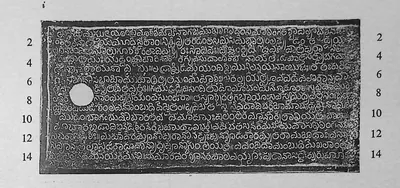 "Vilasa Grant of Prolaya-nayaka", plate i (Epigraphia Indica XXXII, plate between pp. 260 and 261, PDF p. 363 of the archive.org scan kmm-0149-epigraphia-indica-1962)Inscription rubbing · 1959
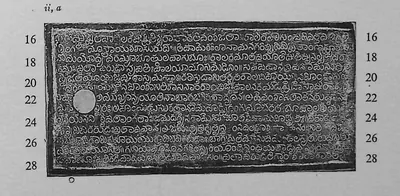 "Vilasa Grant of Prolaya-nayaka", plate ii, a (Epigraphia Indica XXXII, plate between pp. 260 and 261, PDF p. 363)Inscription rubbing · 1959
References
Notes (0)
Sources (4)
Spotted an error on this page? Tell us
Last updated: