Narasimha temples, Ahobilam
The temples of Narasimha at Lower (Diguva) and Upper Ahobilam, in the Nallamalai hills of the Kurnool district. Lower Ahobilam has a large unfinished mandapa (pillared hall). Fergusson's revisers compared its plan with the Vitthala temple at Vijayanagara but its style with Nayak work, and rejected a local tradition that gave it to Prataparudra about 1300. Inscriptions of Achyuta Raya, Sadasiva, Sriranga I and Venkatapati record halls, a pillar of victory and a Garuda pillar. They also record how the temple was recovered after the Golconda king had occupied it for seven years.
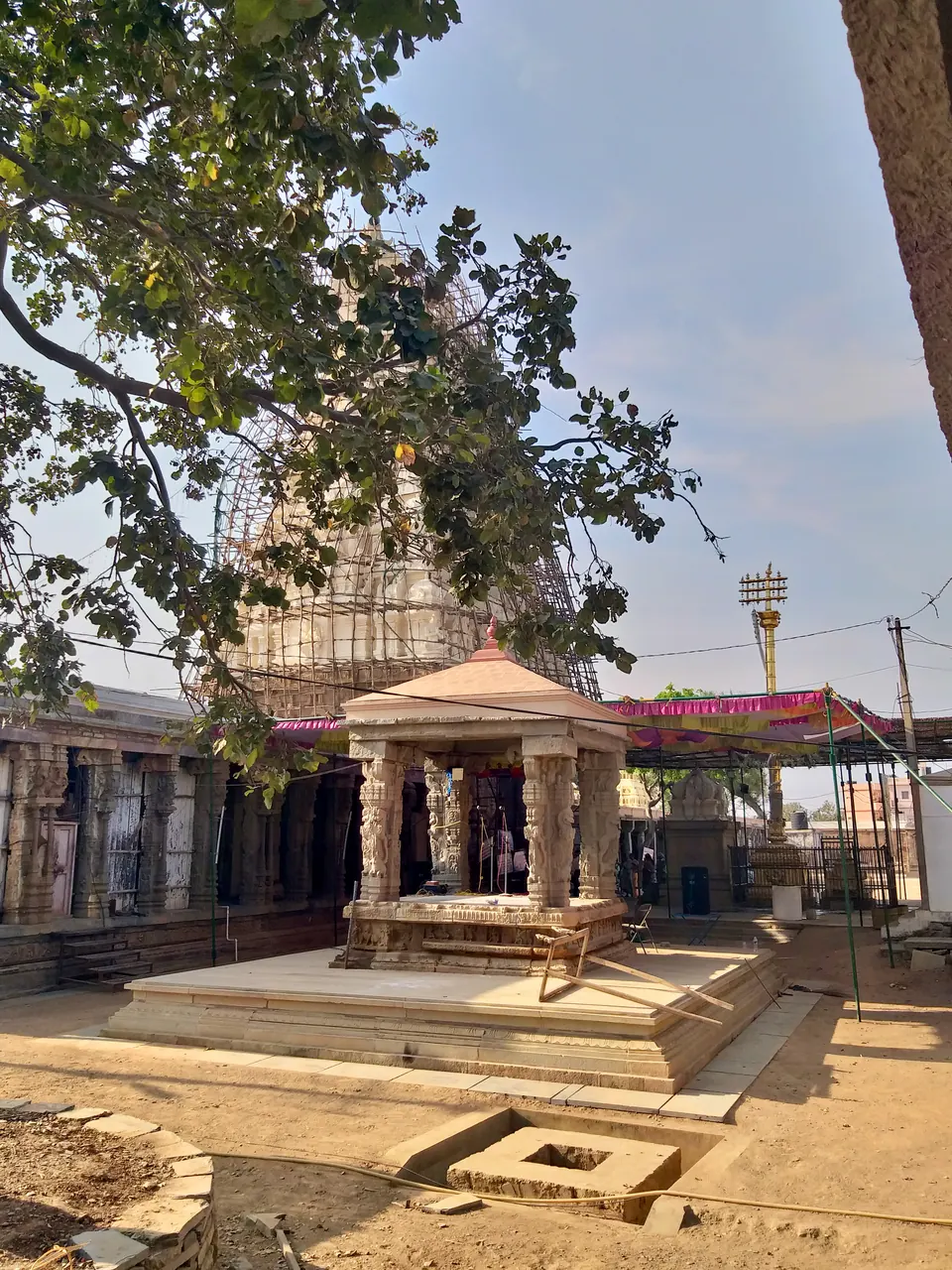
The Imperial Gazetteer of 1908 describes the temple of Ahobilam as “the most sacred Vaishnava shrine in the District”.1 It has three parts:1
- the Diguva (lower) Ahobilam temple at the foot of the hills1
- Yeguva (upper) Ahobilam, about four miles higher up1
- a small shrine on the summit1
The unfinished mandapa
James Fergusson’s revisers described the lower temple in 1910.2 They began: “About fifty miles still further east, at a place called Diguva Ahobalam, in Karnul district, there is a large unfinished mantapam”.2 In plan and design it is very like the temple of Vithoba (Vitthala) at Vijayanagar, but “its style and details are much more like those of the Nayyaks”.2
Local tradition gave the hall to Prataparudra (Pratapa Rudra) about 1300.2 The revisers answered that traditions usually refer to the original shrine.2 Judged by its style, they thought it “could hardly have been erected before the destruction of that capital in A.D. 1565”, that is, of Vijayanagara.2
They added that the inscriptions “have not yet been examined, but seem mostly to belong to the latter part of the 16th century”.2 They judged that, “whoever may have built it,” the hall was “a fine bold specimen of architecture”.2 See Vijayanagara.
What the inscriptions record
The inscriptions of Lower Ahobilam were copied in 1915, and V. Rangacharya summarised them.3 They run from the reign of Achyuta Raya.3 A record of Saka 1453 (1531; Saka is an Indian way of counting years) registers land given to the temple of Ahobalesvara, and one of 1536 is cut round the base of the central shrine.3
Several records belong to the reign of Sadasiva:345
- a record of 1547 that provides offerings during a festival345
- one of 1550, cut “round the platform of the huge pillar jayastambha” (pillar of victory) of the temple345
- another recording that a chief “set up the Garudastambha in the street opposite to the temple”345
- others recording halls (mantapas) on the processional ways of Upper Ahobilam345
The Garuda pillar record placed the management in the hands of the temple trustees and of the representative “of the Mahamandalesvara Aliya Ramarajadeva-Maharaja”.345 See Aliya Rama Raya.
The recovery of the temple
Two slabs of 1584 and 1585 belong to Sriranga I and Venkatapati, “ruling at Penugonda”.64 They record that the grandfather of the chief Venkataraja had driven out “the Muhammadan chief Vibhuramu (Ibrahim II of Golconda)”.64 This chief “had occupied the temple of Ahobalam for seven years in alliance with the Handevaru (chiefs)”.64 The family received privileges in the temple for restoring it.64 See the Ahobilam inscription of 1584.
Footnotes
-
Imperial Gazetteer of India: Madras, Vol. I (1908), p. 424 (archive.org (opens in a new tab)). ↩ ↩2 ↩3 ↩4 ↩5
-
James Fergusson, History of Indian and Eastern Architecture, Vol. I, revised by James Burgess (1910), p. 404 (archive.org (opens in a new tab)). ↩ ↩2 ↩3 ↩4 ↩5 ↩6 ↩7 ↩8
-
V. Rangacharya, A Topographical List of the Inscriptions of the Madras Presidency, Vol. II (1919), p. 969, Kurnool Nos. 569–572 (archive.org (opens in a new tab)). ↩ ↩2 ↩3 ↩4 ↩5 ↩6 ↩7 ↩8 ↩9
-
Rangacharya, Topographical List, Vol. II (1919), p. 973, Kurnool Nos. 584–589 (archive.org (opens in a new tab)). ↩ ↩2 ↩3 ↩4 ↩5 ↩6 ↩7 ↩8 ↩9 ↩10
-
Rangacharya, Topographical List, Vol. II (1919), p. 974, Kurnool Nos. 590–594 (archive.org (opens in a new tab)). ↩ ↩2 ↩3 ↩4 ↩5 ↩6
-
Rangacharya, Topographical List, Vol. II (1919), p. 972, Kurnool No. 584 (archive.org (opens in a new tab)). ↩ ↩2 ↩3 ↩4
Photos
References
Notes (0)
Sources (3)
Spotted an error on this page? Tell us
Last updated: