Nagarjunakonda Mahachaitya
The Great Stupa of the Ikshvaku city of Vijayapuri. Its limestone ayaka pillars carry Prakrit inscriptions of the princess Chamtisiri and other royal women, dated in the 6th year of King Virapurushadatta. A small bone relic was found in one of its chambers during the 1928–29 excavations.
The Mahachaitya (“great shrine”) was the main Buddhist monument of Vijayapuri, the city that once filled the valley at Nagarjunakonda on the right bank of the Krishna. A stupa is a solid, dome-shaped monument raised over relics.1 The inscriptions found at the site call this one the Mahachetiya, the Prakrit form of Sanskrit mahachaitya, “great chaitya” or great stupa.1 Its fame rests less on its plain architecture than on its long Prakrit inscriptions.2 Women of the Ikshvaku royal house cut them on its stone pillars in the 3rd century CE.2
Discovery and excavation
The Buddhist remains at Nagarjunakonda came to notice in March 1926.3 A. R. Sarasvati, a Telugu assistant in the Madras epigraphy office, found brick mounds and marble pillars in the valley.3 Three of the pillars were inscribed in Prakrit in Brahmi letters.3 Prakrit means the spoken languages that grew out of Sanskrit, and Brahmi is the ancient Indian script from which the later South Indian scripts grew.3
Longhurst’s own first report put the visit of the epigraphy assistant in 1925.45 His later memoir and Vogel both give March 1926.45 M. Hamid Kuraishi made trial excavations, reported early in 1927.34 They yielded eighteen more inscriptions, fifteen of them on the pillars of this stupa.34
Vogel gives the mound’s local name as Nibagutta.1 Kuraishi called it Site No. 1.6 He wrote that it was “locally known as the Ubagutta (Upagupta ?) or ‘the mound of the owl’”.6
Kuraishi began his work at the Great Stupa, hoping to find reliefs, inscriptions and perhaps relics.7 He found that earlier treasure-seekers had already dug out the whole stupa, chambers and all, and filled it in again.7 They had left only a fragment of the solid centre.7 He dug out the entire structure again, made plans and photographs, and filled it in once more.7 He also covered the inscribed pillars with earth to protect them from careless visitors.7
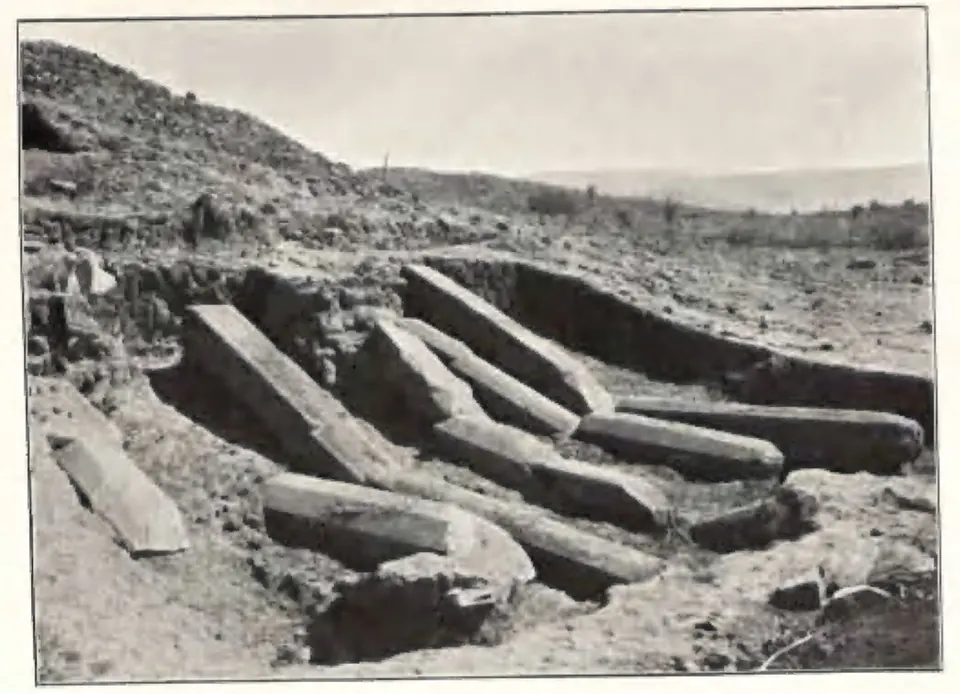
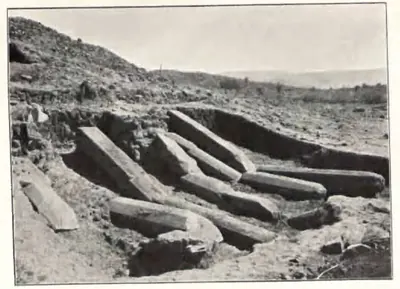
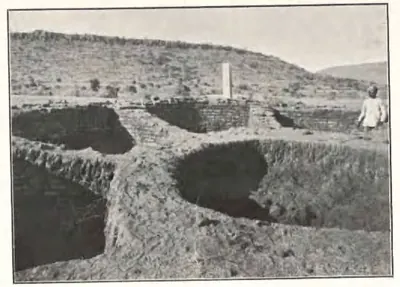
Kuraishi’s photographs show the broken pillars on the west side and the wheel-shaped foundation, as they were before Longhurst’s excavations.8 A. H. Longhurst of the Archaeological Survey cleared the monument in the following seasons. In 1927–28 he cut a trench six feet wide through the stupa, but it found no relics.9 He found that treasure-seekers had already destroyed the upper part of the dome and thrown down most of the pillars.10 Only two of the twenty still stood when work began.10
Form and construction
The stupa was built of large bricks laid in mud mortar and finished with plaster and whitewash. Like other stupas of the lower Krishna valley, it was laid out on a plan like a wheel.1112 It had a central hub, and brick “spokes” ran out from it to an outer ring.1112 The spaces between them were filled with earth before the dome was closed.1112
Longhurst’s 1928–29 report gives the drum (the low round base) as 5 feet high and 102 feet across.1310 He estimated that the complete monument stood at least 60 feet high.1310 His later memoir gives 106 feet for the diameter, including the drum.1310
Kuraishi planned the stupa in 1926–27, and he gave a much smaller diameter: 76 feet.7 He described three retaining walls, one inside the other, not the single outer ring of most large stupas in the Madras Presidency.7 They enclosed three rows of chambers: 8 in the inner row, 16 in the middle and 16 in the outer.7 They surrounded a solid core 18 feet 3 inches across, built of courses of brick laid in thin layers of mud.7 His count of forty chambers agrees with Longhurst’s.14 The sources do not explain the difference between his diameter and Longhurst’s.
A round processional path (pradakshina-patha), 18 feet wide, ran round the base so that worshippers could walk around the shrine. A railing with four gateways, facing north, south, east and west, enclosed it.1310 Only brick foundations survived, and Longhurst concluded that the railing and gateways had been of wood.1310
Kuraishi had found the brick wall of the enclosure, 2½ feet thick, about 18 feet beyond the outermost retaining wall of the stupa.7 It had four entrances 14 feet wide, opposite the groups of pillars.7 No carved casing stones were found on this stupa.1310 The smaller stupas of the valley were richly sculptured, but the Great Stupa was a plain brick and plaster building, decorated only with simple mouldings.1310
The ayaka platforms and pillars
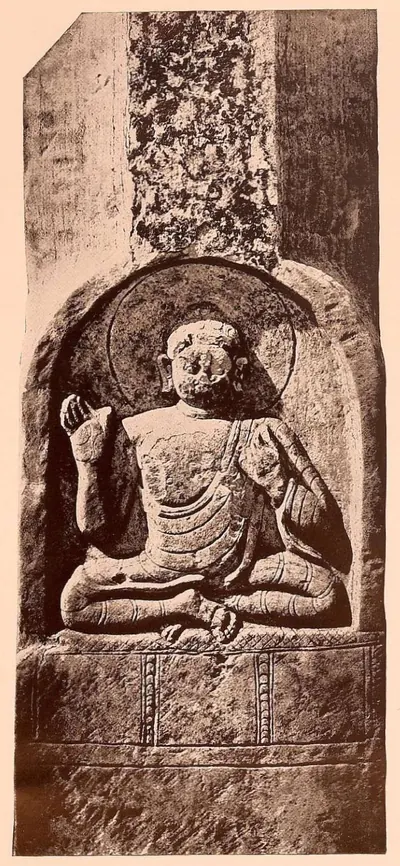
Opposite each of the four gateways a rectangular platform projected from the drum, about 22 feet long and 5 feet wide. On each stood a row of five tall limestone pillars, twenty in all.1210 Vogel noted that the inscriptions call such pillars ayaka-khambha (“ayaka pillars”).15 This arrangement, five pillars facing each entrance, was typical of the stupas of this region and was not known from other parts of India.15
The pillars had no structural function, and they carried Buddhist emblems and inscriptions of gift.151116 Longhurst called the platforms “ayaka platforms” for want of an ancient name.151116 He regarded them as altars for flower offerings and the most important decorative feature of an Andhra stupa.151116
Kuraishi found that all but two of the pillars had fallen and lay buried several feet deep. They were about 1 ft 10 in by 1 ft 6 in at the base, rectangular to a height of 4½ feet and octagonal above.7 They had no capitals or lintels.7 Seventeen of the twenty pillars of the Mahachaitya were recovered, all inscribed, thirteen of them complete or nearly so.1 Vogel was able to work out the original position of each.1
Nine of the inscriptions repeat, with small variations, the same text.217 It records the gift of a pillar by the princess Chamtisiri.217 She was the sister of the Ikshvaku king Chamtamula and the aunt (father’s sister) of his son King Virapurushadatta.217 Other pillars were given by these women:217
- her niece Adavi Chamtisiri, a daughter of King Chamtamula217
- two further nieces, Bapisirinika and Chhathisiri, who were queens of Virapurushadatta217
- a queen named Rudradharabhattarika, whom Vogel thought came from Ujjain217
- other noblewomen217
The pillar texts are dated, almost all alike, in the 6th year of Virapurushadatta, the 6th fortnight of the rainy season, the 10th day.2 Vogel took this to be the date on which the monument was consecrated.2 One pillar adds that the monk Ananda completed the “pious work” of the Mahachaitya and set up the pillars.18 Ananda knew the Digha and Majjhima collections of the Buddha’s teachings by heart.18 He did the work for the benefit of teachers of the Aparamahavinaseliya school.18 The inscriptions are described in more detail on the page for the Chamtisiri inscriptions.
A chaitya-hall stood close to the east side of the Mahachaitya. This was an apsidal shrine, that is, a long hall with one rounded end, housing a small stupa as its object of worship. A long inscription on its floor records that Chamtisiri built it as well, in the 18th year of Virapurushadatta.12
The relic deposit
Kuraishi concluded in 1926–27 that the relics which the inscriptions implied had been placed in the stupa had already disappeared.7 During the 1928–29 season Longhurst decided to empty every chamber between the brick spokes.12 After about a month’s digging the workmen found a broken earthenware pot on the floor of an outer chamber on the north side.12 The pot held a few crystal beads and a small silver casket shaped like a stupa.12 In the casket, with some gold flowers, pearls and garnets, was a tiny round gold box.12 It held a fragment of bone “the size of a pea”.12
In his memoir Longhurst explains why the relic survived.14 It had been placed in an outer chamber, not in the centre, where the treasure-seekers dug.14 The stupa had forty chambers, all of which had to be excavated.14 The silver casket was badly corroded and broken.12
Who built it, and when?
The inscriptions date the pillars but do not say who first built the stupa. Vogel, editing the texts, read one pillar as stating that Chamtisiri put up the Great Chaitya.2 He regarded her as its foundress.2 Longhurst disagreed. He held that the pillars and platforms were later additions to a plain stupa.1419 So he argued that Chamtisiri had added the pillars and rebuilt the outside of an existing monument.1419 In his view the relic had been placed there long before her time, since otherwise so important an event would have been recorded.1419
In his 1927–28 report Longhurst had gone further.4 By comparison with the Bhattiprolu stupa, he suggested that the original stupa might date to about 200 BCE.4 He repeated the suggestion as a possibility in 1928–29.20 No later source in the library tests this idea, and it should be treated as Longhurst’s conjecture.
The wording of the opening formula is itself disputed. Vogel translated the epithet dhatuvara-parigahita, applied to the Buddha, as “absorbed by the best of elements (i.e. by Nirvana)”.18 Hirananda Sastri understood the same words to describe the Mahachaitya as protected by the bodily relics of the Buddha.1921 Longhurst adopted this reading, and he took the bone fragment to be a relic believed to be the Buddha’s own.1921 His 1928–29 report put it more cautiously: whatever its origin, the builders believed the relic to be the Buddha’s.20
The date of the pillars depends on the date of Virapurushadatta. Bühler placed him in the 3rd century CE on grounds of script, and Vogel accepted this.22 Kuraishi wrote before the inscriptions were read.7 He expected them “to shed considerable light on the history of this Buddhist colony of the 2nd century A.D.”7 Longhurst spoke more loosely of the Ikshvakus as rulers of the 2nd and 3rd centuries.23
D. C. Sircar, writing in 1959, placed Virapurushadatta about the middle of the 3rd century.24 Later two Ikshvaku inscriptions dated in the cyclic year Vijaya were read as 273–74 and 333–34.25 Sircar then placed Virapurushadatta’s reign about 255–75 in one reconstruction.25 In another he placed it within about 265–335, together with his two successors.25
The same king’s 20th year is recorded on similar ayaka pillars at the Jaggayyapeta stupa in the Krishna district.2615 James Burgess found them in 1882.2615
Significance
Vogel judged Nagarjunakonda to be, “next to Amaravati, the most important Buddhist site hitherto found in Southern India”.15 The Mahachaitya’s pillars name three generations of the Ikshvaku royal house and many of its women. They praise King Chamtamula as a performer of Vedic sacrifices.227 Yet it was the women of his family who paid for the chief Buddhist shrine of the capital.227 Longhurst later spoke of the whole site as built around this “Great Stupa built by the lady Chamtisiri”.28
Footnotes
-
Vogel, Prakrit Inscriptions from Nagarjunikonda (1933), p. 3 (archive.org (opens in a new tab)). ↩ ↩2 ↩3 ↩4 ↩5 ↩6
-
Vogel, Prakrit Inscriptions from Nagarjunikonda (1933), p. 4 (archive.org (opens in a new tab)). ↩ ↩2 ↩3 ↩4 ↩5 ↩6 ↩7 ↩8 ↩9 ↩10 ↩11 ↩12 ↩13 ↩14 ↩15 ↩16 ↩17
-
J. Ph. Vogel, Prakrit Inscriptions from a Buddhist Site at Nagarjunikonda, Epigraphia Indica XX (1933), p. 1 (archive.org (opens in a new tab)). ↩ ↩2 ↩3 ↩4 ↩5 ↩6
-
A. H. Longhurst, “Excavations at Nagarjunikonda”, Annual Report of the Archaeological Survey of India 1927–28 (1931), p. 115 (archive.org (opens in a new tab)). ↩ ↩2 ↩3 ↩4 ↩5 ↩6
-
A. H. Longhurst, The Buddhist Antiquities of Nagarjunakonda (1938), p. 3 (archive.org (opens in a new tab)). ↩ ↩2
-
M. Hamid Kuraishi, “Trial Excavations at Alluru, Gummadidurru and Nagarjunikonda”, Annual Report of the Archaeological Survey of India 1926–27 (1930), p. 156 (archive.org (opens in a new tab)). ↩ ↩2
-
Kuraishi, “Trial Excavations” (1930), p. 157 (archive.org (opens in a new tab)). ↩ ↩2 ↩3 ↩4 ↩5 ↩6 ↩7 ↩8 ↩9 ↩10 ↩11 ↩12 ↩13 ↩14 ↩15 ↩16
-
Kuraishi, “Trial Excavations” (1930), Plate XXXVII a–b (archive.org (opens in a new tab)). ↩
-
Longhurst, “Excavations at Nagarjunikonda”, ASI Annual Report 1927–28 (1931), p. 120 (archive.org (opens in a new tab)). ↩
-
Longhurst, Buddhist Antiquities of Nagarjunakonda (1938), p. 16 (archive.org (opens in a new tab)). ↩ ↩2 ↩3 ↩4 ↩5 ↩6 ↩7 ↩8 ↩9 ↩10
-
Longhurst, Buddhist Antiquities of Nagarjunakonda (1938), p. 12 (archive.org (opens in a new tab)). ↩ ↩2 ↩3 ↩4 ↩5 ↩6
-
Longhurst, “Excavations at Nagarjunikonda”, ASI Annual Report 1928–29 (1933), p. 101 (archive.org (opens in a new tab)). ↩ ↩2 ↩3 ↩4 ↩5 ↩6 ↩7 ↩8 ↩9 ↩10
-
A. H. Longhurst, “Excavations at Nagarjunikonda”, Annual Report of the Archaeological Survey of India 1928–29 (1933), p. 100 (archive.org (opens in a new tab)). ↩ ↩2 ↩3 ↩4 ↩5 ↩6 ↩7
-
Longhurst, Buddhist Antiquities of Nagarjunakonda (1938), p. 17 (archive.org (opens in a new tab)). ↩ ↩2 ↩3 ↩4 ↩5 ↩6 ↩7
-
Vogel, Prakrit Inscriptions from Nagarjunikonda (1933), p. 2 (archive.org (opens in a new tab)). ↩ ↩2 ↩3 ↩4 ↩5 ↩6 ↩7 ↩8
-
Longhurst, Buddhist Antiquities of Nagarjunakonda (1938), p. 13 (archive.org (opens in a new tab)). ↩ ↩2 ↩3
-
Vogel, Prakrit Inscriptions from Nagarjunikonda (1933), pp. 13–14 (archive.org (opens in a new tab)). ↩ ↩2 ↩3 ↩4 ↩5 ↩6 ↩7 ↩8
-
Vogel, Prakrit Inscriptions from Nagarjunikonda (1933), p. 17 (archive.org (opens in a new tab)). ↩ ↩2 ↩3 ↩4
-
Longhurst, Buddhist Antiquities of Nagarjunakonda (1938), p. 18 (archive.org (opens in a new tab)). ↩ ↩2 ↩3 ↩4 ↩5
-
Longhurst, “Excavations at Nagarjunikonda”, ASI Annual Report 1928–29 (1933), p. 102 (archive.org (opens in a new tab)). ↩ ↩2
-
Longhurst, Buddhist Antiquities of Nagarjunakonda (1938), p. 19 (archive.org (opens in a new tab)). ↩ ↩2
-
Vogel, Prakrit Inscriptions from Nagarjunikonda (1933), p. 6 (archive.org (opens in a new tab)). ↩
-
Longhurst, Buddhist Antiquities of Nagarjunakonda (1938), p. 4 (archive.org (opens in a new tab)). ↩
-
D. C. Sircar, “Two Inscriptions from Guntur District”, Epigraphia Indica XXXII (1959), p. 83 (archive.org (opens in a new tab)). ↩
-
D. C. Sircar, “More Inscriptions from Nagarjunikonda”, Epigraphia Indica XXXV (1963–64), p. 6 (archive.org (opens in a new tab)). ↩ ↩2 ↩3
-
James Burgess, The Buddhist Stupas of Amaravati and Jaggayyapeta (1887), pp. 110–111 (archive.org (opens in a new tab)). ↩ ↩2
-
Longhurst, “Excavations at Nagarjunikonda”, ASI Annual Report 1927–28 (1931), p. 118 (archive.org (opens in a new tab)). ↩ ↩2
-
A. H. Longhurst, “Excavations at Nagarjunikonda”, Annual Report of the Archaeological Survey of India 1929–30 (1935), p. 144 (archive.org (opens in a new tab)). ↩
Photos
 Nagarjunakonda: "Carved ayaka-pillar" (ASI Annual Report 1928-29, Pl. XLVI (a))Book plate · 1933
 Nagarjunakonda: "Nagarjunikonda: Site No. 1, showing broken pillars on west side of stupa" (ASI Annual Report 1926-27, Pl. XXXVII (a))Historic photograph · 1930
 Nagarjunakonda: "Nagarjunikonda: Site No. 1, showing wheel-shaped foundation of stupa" (ASI Annual Report 1926-27, Pl. XXXVII (b))Historic photograph · 1930
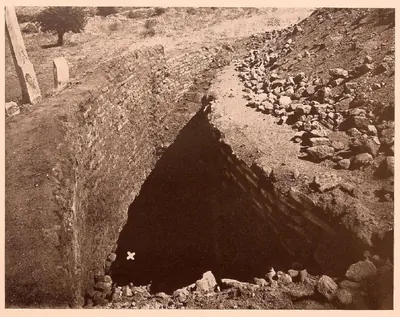 Nagarjunakonda: "Outer wall of the Great Stupa (findspot of relics marked by a cross)" (ASI Annual Report 1928-29, Pl. XLV (b))Plan · 1933
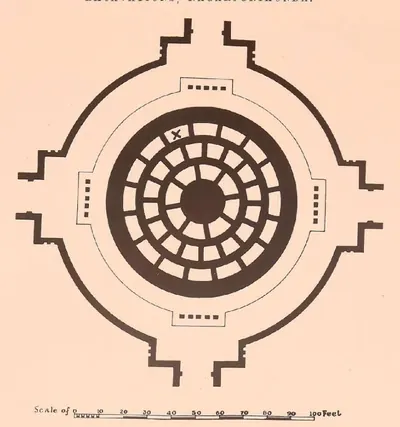 Nagarjunakonda: "Plan of the Great Stupa (findspot of relics marked by a cross)" (ASI Annual Report 1928-29, Pl. XLV (a))Plan · 1933
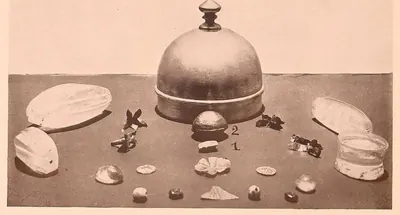 Nagarjunakonda: "The Buddha relics after cleaning and showing (1) the bone relic and (2) the gold box" (ASI Annual Report 1928-29, Pl. XLVI (c))Book plate · 1933
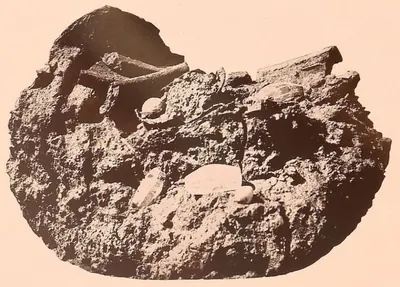 Nagarjunakonda: "The Buddha relics when first discovered" (ASI Annual Report 1928-29, Pl. XLVI (b))Book plate · 1933
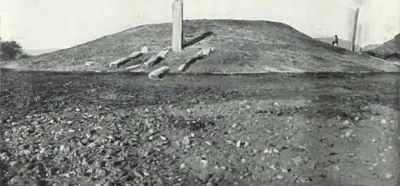 Nagarjunakonda: "The Great Stupa at Nagarjunikonda" (ASI Annual Report 1927-28, Pl. L (a))Book plate · 1931
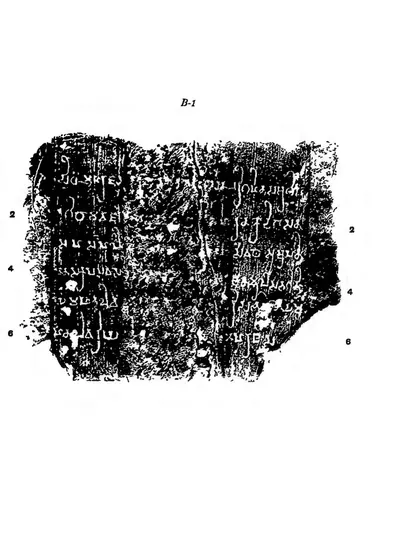 Nagarjunakonda: ayaka-pillar inscription B 1 (south side, first pillar) (Epigraphia Indica XX)Inscription rubbing · 1933
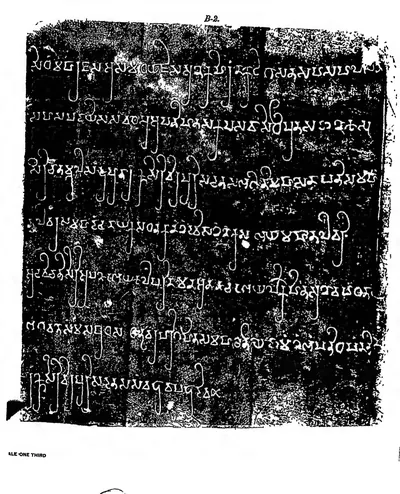 Nagarjunakonda: ayaka-pillar inscription B 2 (south side, second pillar) (Epigraphia Indica XX)Inscription rubbing · 1933
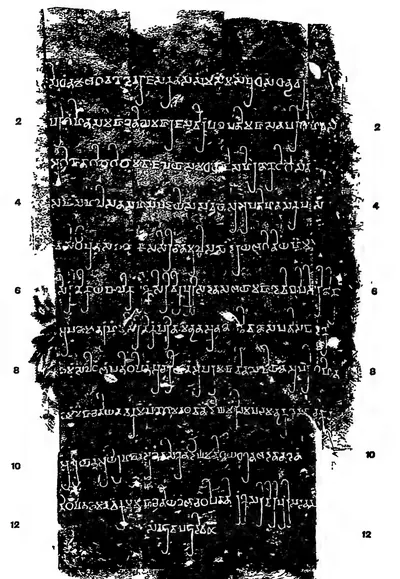 Nagarjunakonda: ayaka-pillar inscription C-2 (west side, second pillar), gift of Mahadevi Bapisirinika, queen of King Siri-Virapurisadata (Epigraphia Indica XX)Inscription rubbing · 1933
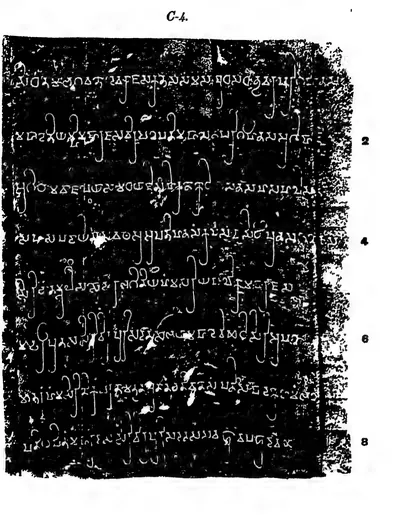 Nagarjunakonda: ayaka-pillar inscription C-4 (west side, fourth pillar), gift of Mahadevi Chhathisiri, queen of King Siri-Virapurisadata (Epigraphia Indica XX)Inscription rubbing · 1933
Related
Inscriptions
References
Notes (0)
Sources (9)
Spotted an error on this page? Tell us
Last updated: