Bhairavakonda cave temples
Group of early rock-cut cave temples at Bhairavakonda in the old Udayagiri taluk of the Nellore district, reported by A. H. Longhurst in 1921. R. Gopalan described them as attributable to the Pallava age and closely resembling the caves of Mahendravarman I; the Madras epigraphy office linked one shrine, named Damodaresvaram in an archaic inscription, with the Ananda king Damodaravarman.
The cave temples of Bhairavakonda, in the old Udayagiri taluk of the Nellore district, are the rock-cut temples of the Telugu country that R. Gopalan attributed to the Pallava age. No inscription found there names the king who had them cut.12
Discovery
The temples were discovered and reported on by A. H. Longhurst of the Archaeological Department, in his annual report for 1921. The Madras epigraphy office visited them in March 1922 and copied seventeen inscriptions in them.32
Description
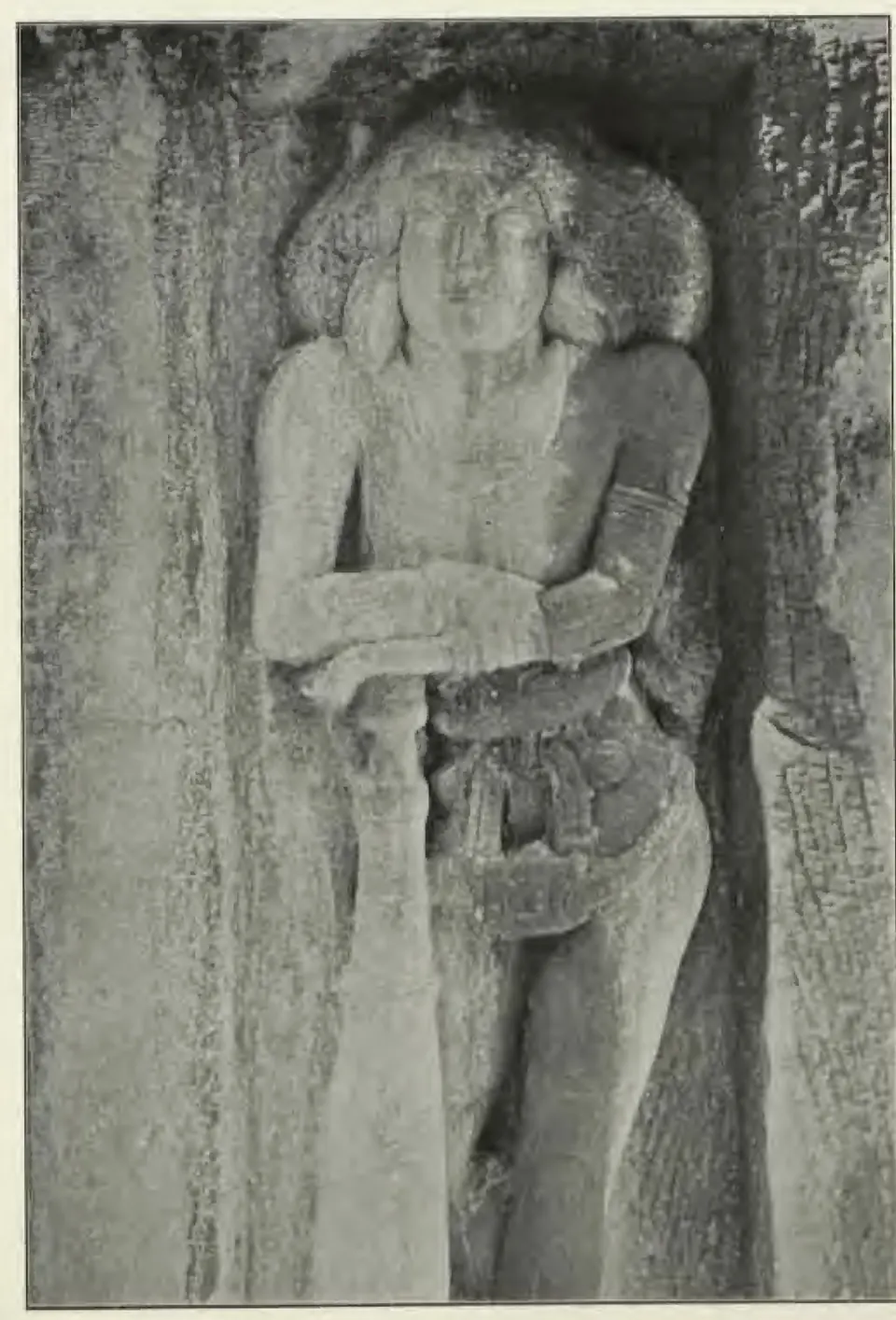
The epigraphy report agreed with most of what Longhurst had said about “these early temples”. It disagreed on one point: not all the door-keepers (dvarapalas) wear horned crowns, as Longhurst had said, but only one figure of a pair. The report suggested that the horned figure was Nandi, Siva’s door-keeper, and the other Bhringi, another attendant of Siva.32 An inscription in archaic letters on a small rock-cut shrine for a linga (stone emblem of Siva) names it Sri Damodaresvaram.2
Who made them?
- The Pallava age. R. Gopalan wrote in 1928 that Longhurst had found at Bhairavakonda “a large group of temples attributable to the Pallava age, all of them cut out of rock and closely resembling the Mahendra caves”.1 Gopalan described the Mahendra style elsewhere: cave temples with square pillars whose upper and lower parts are cubical and whose middle third is octagonal, and door-keepers in a peculiar pose.45
- The Anandas. The epigraphy report suggested that the Damodaresvaram shrine was named after Damodaravarman, a king of the Ananda gotra (clan), whose copper-plate grant had been found in the north of the Nellore district.2
Neither source gives a date for the caves. For the wider debate over early cave temples in the Telugu country, see Pallavas.12
Footnotes
-
R. Gopalan, History of the Pallavas of Kanchi (1928), p. 8 (archive.org (opens in a new tab)). ↩ ↩2 ↩3
-
Annual Report on Epigraphy, Madras, for 1921–22, Part I, p. 4 (archive.org (opens in a new tab)). ↩ ↩2 ↩3 ↩4 ↩5 ↩6
-
Annual Report on Epigraphy, Southern Circle, Madras, for 1921–22, Part I, p. 3, in Annual Reports on Epigraphy for 1920–21 to 1924–25 (1925) (archive.org (opens in a new tab)). ↩ ↩2
-
Gopalan, History of the Pallavas of Kanchi (1928), p. 91 (archive.org (opens in a new tab)). ↩
-
Gopalan, History of the Pallavas (1928), p. 92 (archive.org (opens in a new tab)). ↩
Photos
 "Bhairavakonda temple No. III: detail of doorkeeper" (Longhurst, Pallava Architecture I, 1924, Plate XVII (b) (PDF p. 86))Historic photograph · 1924
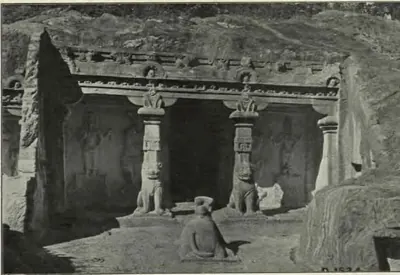 "Bhairavakonda temple No. VII: general view" (Longhurst, Pallava Architecture I, 1924, Plate XX (b) (PDF p. 92))Historic photograph · 1924
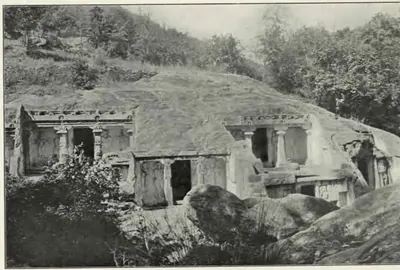 "Bhairavakonda: general view of ten rock-cut temples" (Longhurst, Pallava Architecture I, 1924, Plate XV (a) (PDF p. 82))Historic photograph · 1924
References
Notes (0)
Sources (2)
Spotted an error on this page? Tell us
Last updated: