Bhimesvara temple, Chalukya-Bhimavaram
Two-storeyed Shiva temple at Bhimavaram in Samalkot, one of the five Pancharama shrines. Its inscriptions call it Chalukya-Bhimesvara and the place Kumararama. A Pithapuram inscription of 1202 says the Eastern Chalukya king Chalukya-Bhima founded a temple of that name, and E. Hultzsch (1897) identified it with this one. Its own dated inscriptions begin in the late 11th or 12th century.
The Bhimesvara temple at Bhimavaram, now part of Samalkot, is one of the few surviving temples that a medieval inscription gives by name to an Eastern Chalukya king. Its holiness comes from the legend of the five aramas, or “gardens”, of Shiva.12
The founder named in 1202
The Pithapuram pillar inscription of 1202 lists the Eastern Chalukya kings.1 It says that the fourteenth, Chalukya-Bhima, was victorious in 360 battles and founded a temple of Shiva “called Chalukya-Bhimesvara after his own name”.1
E. Hultzsch edited the inscription in 1897.1 He added: “This temple still exists at Bhimavaram near Cocanada in the Godavari district.”1 He pointed out that three of the temple’s own inscriptions give it this name, while others call the village Chalukya-Bhimesvarapura, Chalukya-Bhimanagari or Chalukya-Bhimapura.1 In his view the village was named after the temple.1 Five inscriptions call Bhimavaram itself Skandarama or Kumararama, “the garden of the War-god”.1 Hultzsch numbered this king Chalukya-Bhima I.1
M. Rama Rao described the temple in 1964.3 He wrote that Chalukya-Bhima built it towards the end of the 9th century and that it was named after him, and that the place was known as Kumararama.3
Where the sources disagree
Robert Sewell, working from local information in 1882, heard a different story.4 In it the temple “is said to have been erected in S.S. 1080 (A.D. 1158) by a Chalukya Maharaja”.4 He added a question mark, and noted that “his fort” was pointed out about 200 yards away.4
The temple’s own dated records do not reach back to the 9th century.53 The Godavari district gazetteer (1907) counted thirty inscriptions in its two temples, of which the oldest was dated 1087.5 Rama Rao listed twenty-seven in the Bhimesvara temple, ranging from 1147 to 1494, although his list also includes a gift of Saka 1045 (1123; Saka is an Indian way of counting years).3
The legend of the five aramas
The gazetteer tells the legend as the local people did.2 The god Subrahmanya killed a demon, Tarakasura, who wore a huge linga (emblem of Shiva) round his neck.2 The linga broke into five pieces, which fell at Bhimavaram, Draksharama, Amaravati (Amararama), Palakollu (Ksheerarama) and “Kumara-rama”, a place the gazetteer could not identify.2
Rama Rao gives a version from the Godavari section of the Skanda Purana.6 In it Shiva cut the linga of the Tripura demons into five.6 Indra set one piece up at Amaravati, Soma one at Somarama and Rama one at Palakollu.6 Kumara set up the fourth “at Bhimavaram, the capital of the Calukyas”, as Kumara-Bhimalinga of Bhimarama, and the fifth was set up at Draksharama.6
Rama Rao identified Kumararama with Chalukya-Bhimavaram.7 The foreword to his monograph calls the five aramas the earliest temples in the coastal Telugu country that can safely be given to the Eastern Chalukya kings.8 See Bhimesvara temple, Draksharama.
The building
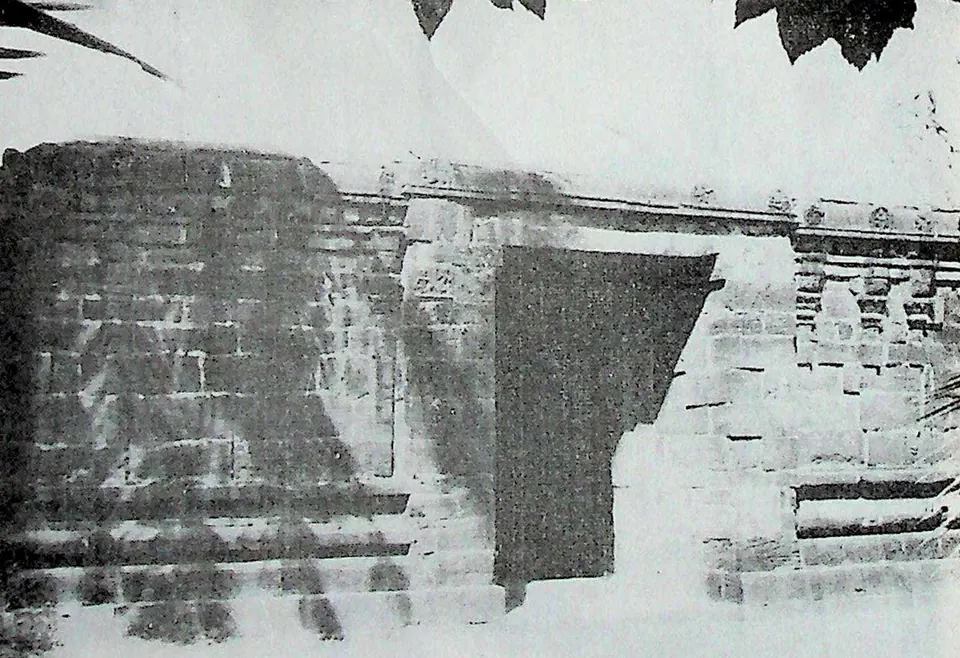
Rama Rao found that the temple “resembles in all respects” the Bhimesvara temple of Draksharama.9 It has a double enclosure wall of large stone blocks, with gateways in the four cardinal directions (north, south, east and west).9 In his time the northern one served as the main entrance.9 The main shrine stands in the centre, with a two-storeyed pillared verandah on all four sides.9
The shrine itself has two storeys.1011 A tall eight-sided linga rises from a pedestal in the ground-floor sanctum.1011 Its top is worshipped in the upper sanctum, which is reached by flights of steps.1011 The tower above is a plain two-storeyed vimana (tower over the shrine) of the Nagara order.1011
Lions with one forepaw raised decorate the base of the north gateway.9 The gazetteer added that a bath in the Bhimagundam tank in front of the temple was believed to confer holiness.2
Later gifts
The inscriptions that Rama Rao summarised record later building work:3
- A minister, Mantripragada Surana, built an eight-pillared mukhamantapa (front hall) in 1422 and the eastern entrance two years later.3
- In 1426 he installed an image of Gauri in the sanctum, in a record that again names the place Kumararama.3
- A stone quarry was given for the compound wall in the time of the Reddi king Kumaragiri of Kondavidu and his governor Allada.3
Footnotes
-
E. Hultzsch, “Pithapuram Pillar Inscription of Mallapadeva”, Epigraphia Indica IV (1896–97), p. 227 and notes 4–6 (archive.org (opens in a new tab)). ↩ ↩2 ↩3 ↩4 ↩5 ↩6 ↩7 ↩8 ↩9
-
F. R. Hemingway, Madras District Gazetteers: Godavari (1907), p. 207 (archive.org (opens in a new tab)). ↩ ↩2 ↩3 ↩4 ↩5
-
Rama Rao, Eastern Calukyan Temples (1964), p. 30 (archive.org (opens in a new tab)). ↩ ↩2 ↩3 ↩4 ↩5 ↩6 ↩7 ↩8
-
Robert Sewell, Lists of the Antiquarian Remains in the Presidency of Madras, Vol. I (1882), p. 24, s.v. Bhimavaram (archive.org (opens in a new tab)). ↩ ↩2 ↩3
-
Hemingway, Godavari (1907), p. 208 (archive.org (opens in a new tab)). ↩ ↩2
-
Rama Rao, Eastern Calukyan Temples (1964), p. 16 (archive.org (opens in a new tab)). ↩ ↩2 ↩3 ↩4
-
M. Rama Rao, Eastern Calukyan Temples of Andhra Desa (1964), preface (unnumbered) (archive.org (opens in a new tab)). ↩
-
M. A. Waheed Khan, foreword to Rama Rao, Eastern Calukyan Temples (1964), p. i (archive.org (opens in a new tab)). ↩
-
Rama Rao, Eastern Calukyan Temples (1964), p. 31 (archive.org (opens in a new tab)). ↩ ↩2 ↩3 ↩4 ↩5
-
Rama Rao, Eastern Calukyan Temples (1964), p. 33 (archive.org (opens in a new tab)). ↩ ↩2 ↩3 ↩4
-
Rama Rao, Eastern Calukyan Temples (1964), p. 34 (archive.org (opens in a new tab)). ↩ ↩2 ↩3 ↩4
Photos
 "32. Northern Entrance to Outer Enclosure - Ch. Bhīmavaram, E. G. Dt." (M. Rama Rao, Eastern Calukyan Temples of Andhra Desa, 1964, Fig. 32 (PDF p. 95))Historic photograph · 1964
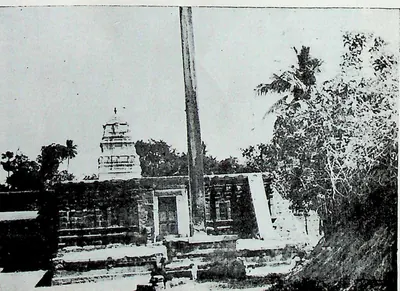 "33. Western Entrance to Outer Enclosure—Ch. Bhīmavaram, E. G. Dt." (M. Rama Rao, Eastern Calukyan Temples of Andhra Desa, 1964, Fig. 33 (PDF p. 97))Historic photograph · 1964
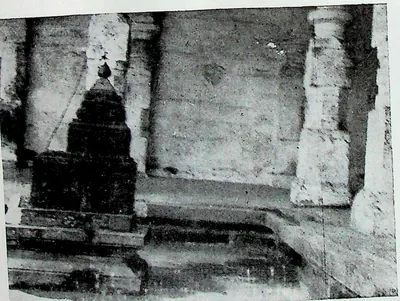 "34. Miniature Temple - Ch. Bhīmēśvaram, E. G. Dt." (M. Rama Rao, Eastern Calukyan Temples of Andhra Desa, 1964, Fig. 34 (PDF p. 99))Historic photograph · 1964
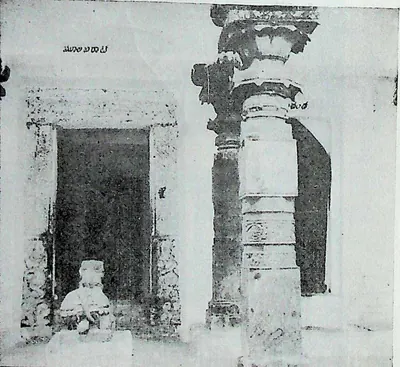 "35. Nandi Maṇṭapa - Ch Bhīmavaram, E. G. Dt." (M. Rama Rao, Eastern Calukyan Temples of Andhra Desa, 1964, Fig. 35 (PDF p. 101))Historic photograph · 1964
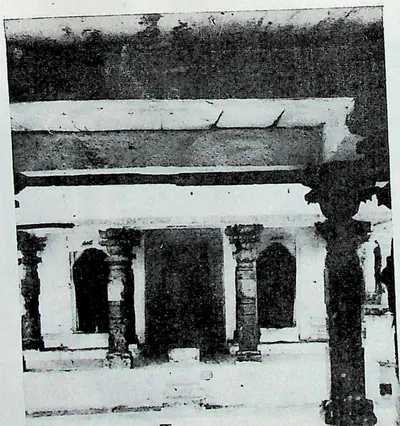 "36. Entrance to Groundfloor—Ch. Bhīmēśvara Temple—Ch. Bhīmavaram, E. G. Dt." (M. Rama Rao, Eastern Calukyan Temples of Andhra Desa, 1964, Fig. 36 (PDF p. 103))Historic photograph · 1964
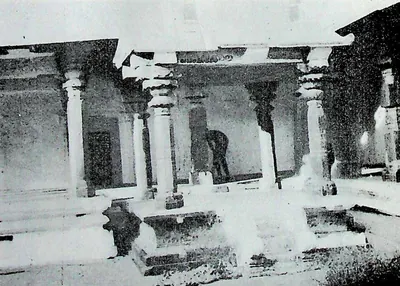 "37. Maṇṭapa in the North-east Corner—Ch. Bhīmavaram, E. G. Dt." (M. Rama Rao, Eastern Calukyan Temples of Andhra Desa, 1964, Fig. 37 (PDF p. 105))Historic photograph · 1964
Related
Inscriptions
References
Notes (0)
Sources (4)
Spotted an error on this page? Tell us
Last updated: