Chula-Dhammagiri monastery
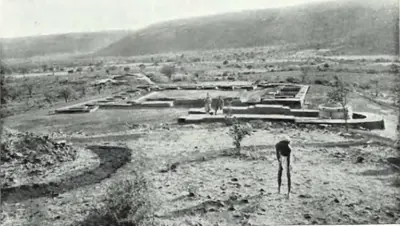
Buddhist monastery buildings on the hill of Naharallabodu at Nagarjunakonda. It is identified with the monastery on the Lesser Dhammagiri east of Vijayapuri. There the lay woman Bodhisiri built an apsidal (round-ended) shrine for monks from Sri Lanka in the 14th year of the Ikshvaku king Virapurushadatta.
The Chula-Dhammagiri (“Lesser Dhammagiri”) monastery stood on a rocky hill about a furlong east of the Great Stupa at Nagarjunakonda.12 The hill is now called Naharallabodu.12 Its excavators thought it the most important group of monastic buildings in the valley.12
Its name comes from the inscription of Bodhisiri on the floor of one of its shrines.3 That record is dated in the 14th year of King Matharīputa (Virapurushadatta) of the Ikshvakus.3 It places her chaitya hall (shrine hall) at the monastery on the Lesser Dhammagiri, on the Sriparvata east of Vijayapuri.3
The hill
Longhurst described Naharallabodu as a long, narrow hill running roughly south to north.2 It was about a quarter of a mile long and less than a hundred yards wide.2 Its southern end was higher and broader.2
M. Hamid Kuraishi first dug there in 1926–27.4 He described two whaleback mounds by the path from the village to the Great Stupa, both locally called Nallarallabodu, “blackstone mound”.4 Each had the remains of a stupa (relic mound) and a monastery on top.4
On the northern mound he cleared an apsidal (round-ended) temple with a long three-line inscription on its floor.56 Beside it stood a monastery about 93 feet square.56 It had six cells on each side of an open court, a central platform and a granary.56 He also traced an ancient road for about 150 feet up the hill’s north-western slope.56
Bodhisiri’s shrine and monastery
Longhurst’s excavations of 1927–29 exposed two monastic groups.2 On the main part of the hill stood two stupas, the apsidal temple with the inscription, and a large brick and plaster monastery with domestic buildings.2 At the northern end were another stupa, a second apsidal brick temple and a small monastery.2 This temple held a limestone Buddha over eight feet high.2
One stupa was built in the usual form of a wheel, with hub, spokes and rim in brick.7 Longhurst identified the stupa and monastery beside the inscribed temple as the chaitya and vihara (monastery) built for the monks from Sri Lanka.7
Monastery 1 and Chaitya 2
In his report for 1928–29 Longhurst gave the plans.89 Monastery 1 had an open court 64 feet square, once paved with stone and probably holding a wooden pillared hall.89 Around it were 24 cells, each about 8 feet square, some used as shrines, store-rooms and kitchens.89
South of it stood the apsidal Chaitya 2, about 41½ by 18½ feet.89 Its object of worship was a small stone stupa 5 feet across.89 Its inscribed floor survived, though the walls stood only a few feet high.89
Monastery 2
Monastery 2, at the lower end, was more compact.9 It had a stone-paved hall 40 feet square and cells and rooms on three sides.9 It also had two small apsidal shrines facing each other, and a yard with a refectory (dining hall), kitchen and store-rooms.9 Lead coins and broken Buddha images were found there.9 Its small Stupa 4 yielded a gold relic casket inside a silver one.9
Finds
In his memoir Longhurst added that the plan of Monastery 1 was somewhat irregular.1011 He took this as a sign that its builders were not very expert.1011 He also found a hoard of lead coins with an earthenware coin die in one of its cells.1011 Among the finds from the hill was a life-size head wearing a draped cap.10 He thought it might be a portrait of a famous teacher of the monastery.10
Identification
Hirananda Sastri made an early summary of the inscription.7 It spoke of monks and nuns from Sri Lanka building a stupa and monastery on a hill called Siripavata.7 It also spoke of buildings on a hillock called Chuladhamagiri.7 Longhurst therefore suggested that the northern end of the hill was regarded as a separate site.7 He even wondered whether its smaller monastery had housed nuns.7 In his memoir he identified Naharallabodu itself as the Lesser Dhammagiri on Sriparvata.12
Vogel came to the same conclusion.1314 He noted that the inscribed shrine encloses a small stupa, has a stone floor and adjoins a monastery on the higher southern end of the hill, all as the inscription describes.1314 So he concluded that the town in the valley was Vijayapuri.1314
A fragmentary inscription found in the 1950s again names the monastery on the Chula-Dhammagiri east of Vijayapuri.15 It says the monastery was given to Buddhist teachers.15 Sircar noted the hill’s identification with Naharallabodu.15
Footnotes
-
J. Ph. Vogel, Prakrit Inscriptions from a Buddhist Site at Nagarjunikonda, Epigraphia Indica XX (1933), p. 3 (archive.org (opens in a new tab)). ↩ ↩2 ↩3
-
A. H. Longhurst, “Excavations at Nagarjunikonda”, Annual Report of the Archaeological Survey of India 1927–28 (1931), p. 116 (archive.org (opens in a new tab)). ↩ ↩2 ↩3 ↩4 ↩5 ↩6 ↩7 ↩8 ↩9 ↩10
-
Vogel, Prakrit Inscriptions from Nagarjunikonda (1933), p. 23, translation of inscription F (archive.org (opens in a new tab)). ↩ ↩2 ↩3
-
M. Hamid Kuraishi, “Trial Excavations at Alluru, Gummadidurru and Nagarjunikonda”, Annual Report of the Archaeological Survey of India 1926–27 (1930), p. 158 (archive.org (opens in a new tab)). ↩ ↩2 ↩3
-
Kuraishi, “Trial Excavations” (1930), p. 159 (archive.org (opens in a new tab)). ↩ ↩2 ↩3 ↩4
-
Kuraishi, “Trial Excavations” (1930), p. 160 (archive.org (opens in a new tab)). ↩ ↩2 ↩3 ↩4
-
Longhurst, “Excavations at Nagarjunikonda”, ASI Annual Report 1927–28 (1931), p. 117 (archive.org (opens in a new tab)). ↩ ↩2 ↩3 ↩4 ↩5 ↩6 ↩7
-
A. H. Longhurst, “Excavations at Nagarjunikonda”, Annual Report of the Archaeological Survey of India 1928–29 (1933), p. 102 (archive.org (opens in a new tab)). ↩ ↩2 ↩3 ↩4 ↩5 ↩6
-
Longhurst, “Excavations at Nagarjunikonda”, ASI Annual Report 1928–29 (1933), p. 103 (archive.org (opens in a new tab)). ↩ ↩2 ↩3 ↩4 ↩5 ↩6 ↩7 ↩8 ↩9 ↩10 ↩11
-
Longhurst, Buddhist Antiquities of Nagarjunakonda (1938), p. 9 (archive.org (opens in a new tab)). ↩ ↩2 ↩3 ↩4 ↩5
-
Longhurst, Buddhist Antiquities of Nagarjunakonda (1938), p. 10 (archive.org (opens in a new tab)). ↩ ↩2 ↩3
-
A. H. Longhurst, The Buddhist Antiquities of Nagarjunakonda (1938), p. 5 (archive.org (opens in a new tab)). ↩
-
J. Ph. Vogel, “Additional Prakrit Inscriptions from Nagarjunikonda”, Epigraphia Indica XXI (1931–32), p. 68 (archive.org (opens in a new tab)). ↩ ↩2 ↩3
-
Vogel, “Additional Prakrit Inscriptions” (1931–32), p. 69 (archive.org (opens in a new tab)). ↩ ↩2 ↩3
-
D. C. Sircar, “Some Brahmi Inscriptions: B. Fragmentary Inscriptions from Nagarjunikonda”, Epigraphia Indica XXXIV (1961–62, publ. 1963), p. 212 (archive.org (opens in a new tab)). ↩ ↩2 ↩3
Photos
References
Notes (0)
Sources (7)
Spotted an error on this page? Tell us
Last updated: