Nagarjunakonda inscription of Bodhisiri
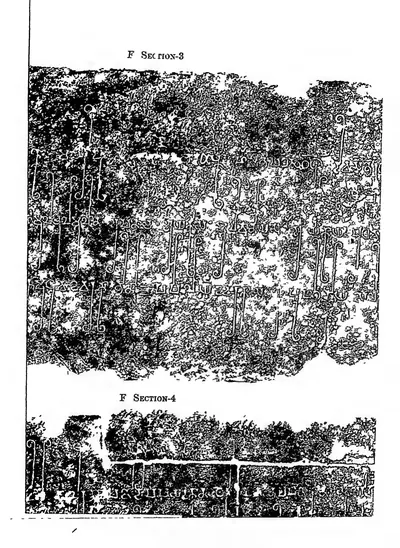
Prakrit inscription on the floor of an apsidal (round-ended) shrine on the Chula-Dhammagiri at Nagarjunakonda, dated in the 14th year of King Mathariputra (Virapurushadatta). It records the gifts of the lay woman Bodhisiri to Buddhist monks from Sri Lanka. It names the city of Vijayapuri, the Sriparvata and the trading town of Kantakasela.
This long Prakrit inscription is labelled F by its editor J. Ph. Vogel.12 It is the fullest record of Buddhist life at Vijayapuri, the Ikshvaku capital in the valley at Nagarjunakonda.12 It is also the only inscription that gives the city its name.12
Where it was found, and what it looks like
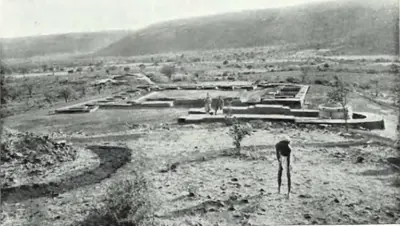
The inscription is cut on the stone floor of an apsidal (round-ended) shrine on the hill now called Naharallabodu.3 The hill is about a furlong east of the Great Stupa, and the shrine stands beside a large monastery.3
M. Hamid Kuraishi cleared the shrine in 1926–27.4 He found it to be about 44 feet long and 18½ feet wide, with brick walls 4 feet thick.4 A small stone-faced stupa (relic mound) stood in its apse (rounded end).4 He recorded three long lines of writing along the west wall and thought the date had flaked away.4 Longhurst’s later plan gives the shrine as about 41½ by 18½ feet, with a stone stupa 5 feet across.5
Vogel describes three lines about 18 to 19 feet long and a fourth short line, fairly well preserved.67 The stone mason, Vidhika, signed the work.8 Vogel found that its execution, like that of the pillar inscriptions of the Great Stupa, left “nothing to be desired”.8
Content
The inscription opens with a long invocation of the Buddha.91011 It calls him “born of a race (which is) sprung from hundreds of sages and excellent kings of Ikhaku’s lineage”.91011 It is dated in the 14th year of King Matharīputa, the 6th fortnight of winter, the 13th day.91011 The king’s personal name is lost, but Vogel thought he was in all likelihood Virapurushadatta.91011
The lay woman (upasika) Bodhisiri does not seem to have belonged to the royal family.911 She built a chaitya hall (shrine hall) with a stone floor and a small stupa on the Siripavata (Sriparvata), east of Vijayapuri.911 It stood at the monastery on the Lesser Dhammagiri (Chula-Dhammagiri).911
She dedicated it to “the masters and … the fraternities (of monks) of Tambapamna (Ceylon)”.1110 These monks are said to have converted many lands: Kashmir, Gandhara, China, the Kiratas, Tosali, Aparanta, Vanga, Vanavasi, the Yavanas, the Tamil country, Palura and the island of Sri Lanka itself.1110 But Vogel was unsure of the readings Yavana, Damila and Palura.1110
She shared the merit with some thirty relatives.119 They included her husband Budhimnaka, his father the householder Revata of Govagama, and a maternal uncle who was a treasurer or storekeeper (kothagarika).119
Bodhisiri’s other gifts
The inscription then lists Bodhisiri’s other gifts:11
- a shrine at the Kulaha monastery11
- a shrine for the Bodhi tree at the Sihala (Ceylonese) monastery11
- a cell at the Great Dhammagiri11
- a pillar at the Mahavihara11
- a hall for religious practice at Devagiri11
- a tank, verandah and hall at Puvasela11
- “A stone mandava at the eastern gate of the Great Chaitya at Kantakasela”11
- cells at Hirumuthuva and Papila11
- a stone hall at Puphagiri11
Three elders supervised the work: the monks Chamdamukha, Dhammanamdi and Naga.118
Interpretation
Vogel drew several conclusions. The Sihala monastery with its Bodhi-tree shrine, and the dedication to monks of the island, pointed to close ties with Sri Lanka.12 He put these ties down to the sea trade between its ports and Kantakasela.12
He identified Kantakasela with Ptolemy’s trading town Kantikossula near the mouths of the Krishna.1 He connected Puvasela with the Purvasaila monastery that Xuanzang described near Dhanyakataka.1 He connected Siripavata with the Sriparvata where Tibetan tradition placed the last years of the philosopher Nagarjuna.1 He later corrected the reading to Kamtakasola, closer to Ptolemy’s form.2 Sircar identified Kantakasela with Ghantasala near the Krishna mouth.13 He also identified Puphagiri with Pushpagiri in Kadapa (then Cuddapah) district.13
The shrine and Vijayapuri
Vogel took the shrine with the inscribed floor to be the very one the inscription describes.214 He reasoned that it encloses a small stupa, has a stone floor and adjoins a monastery on the higher southern end of the hill.214 He therefore concluded that the town in the valley was Vijayapuri.214 Longhurst agreed and identified Naharallabodu as the Lesser Dhammagiri; see Chula-Dhammagiri monastery.1516
Where the sources disagree
Two points remain disputed. Vogel translated the title pasadaka as “who converted” the listed countries.11 N. Dutt took it to mean that the monks brought joy and calm to those peoples, and Sircar noted both readings.17
Dutt also read the dedication as made to nuns, and Sircar followed him in 1939, calling Bodhisiri’s beneficiaries “Theris”.17 Vogel’s later list calls Bodhisiri herself a nun.18
Sircar later rejected the nuns reading.1920 A footprint slab found in the excavations of the 1950s uses the same list of converted countries, but in the masculine, for teachers living in the Great Monastery.1920 Sircar thought that monastery could hardly have housed nuns.1920
Footnotes
-
Vogel, Prakrit Inscriptions from Nagarjunikonda (1933), p. 9 (archive.org (opens in a new tab)). ↩ ↩2 ↩3 ↩4 ↩5 ↩6
-
Vogel, “Additional Prakrit Inscriptions” (1931–32), p. 68, addenda (archive.org (opens in a new tab)). ↩ ↩2 ↩3 ↩4 ↩5 ↩6 ↩7
-
J. Ph. Vogel, Prakrit Inscriptions from a Buddhist Site at Nagarjunikonda, Epigraphia Indica XX (1933), p. 3 (archive.org (opens in a new tab)). ↩ ↩2
-
M. Hamid Kuraishi, “Trial Excavations at Alluru, Gummadidurru and Nagarjunikonda”, Annual Report of the Archaeological Survey of India 1926–27 (1930), p. 159 (archive.org (opens in a new tab)). ↩ ↩2 ↩3 ↩4
-
A. H. Longhurst, “Excavations at Nagarjunikonda”, Annual Report of the Archaeological Survey of India 1928–29 (1933), p. 103 (archive.org (opens in a new tab)). ↩
-
Vogel, Prakrit Inscriptions from Nagarjunikonda (1933), p. 14, list of inscriptions (archive.org (opens in a new tab)). ↩
-
Vogel, Prakrit Inscriptions from Nagarjunikonda (1933), p. 15 (archive.org (opens in a new tab)). ↩
-
Vogel, Prakrit Inscriptions from Nagarjunikonda (1933), p. 12 (archive.org (opens in a new tab)). ↩ ↩2 ↩3
-
Vogel, Prakrit Inscriptions from Nagarjunikonda (1933), p. 7 (archive.org (opens in a new tab)). ↩ ↩2 ↩3 ↩4 ↩5 ↩6 ↩7 ↩8 ↩9
-
Vogel, Prakrit Inscriptions from Nagarjunikonda (1933), p. 22, transcript of inscription F and notes (archive.org (opens in a new tab)). ↩ ↩2 ↩3 ↩4 ↩5 ↩6 ↩7
-
Vogel, Prakrit Inscriptions from Nagarjunikonda (1933), p. 23, translation of inscription F (archive.org (opens in a new tab)). ↩ ↩2 ↩3 ↩4 ↩5 ↩6 ↩7 ↩8 ↩9 ↩10 ↩11 ↩12 ↩13 ↩14 ↩15 ↩16 ↩17 ↩18 ↩19 ↩20 ↩21 ↩22 ↩23 ↩24
-
Vogel, Prakrit Inscriptions from Nagarjunikonda (1933), p. 10 (archive.org (opens in a new tab)). ↩ ↩2
-
Sircar, Successors of the Satavahanas (1939), p. 33 (archive.org (opens in a new tab)). ↩ ↩2
-
Vogel, “Additional Prakrit Inscriptions” (1931–32), p. 69 (archive.org (opens in a new tab)). ↩ ↩2 ↩3
-
A. H. Longhurst, The Buddhist Antiquities of Nagarjunakonda (1938), p. 5 (archive.org (opens in a new tab)). ↩
-
A. H. Longhurst, “Excavations at Nagarjunikonda”, Annual Report of the Archaeological Survey of India 1927–28 (1931), p. 117 (archive.org (opens in a new tab)). ↩
-
D. C. Sircar, The Successors of the Satavahanas in Lower Deccan (1939), p. 28 and note 1 (archive.org (opens in a new tab)). ↩ ↩2
-
J. Ph. Vogel, “Additional Prakrit Inscriptions from Nagarjunikonda”, Epigraphia Indica XXI (1931–32), p. 65 (archive.org (opens in a new tab)). ↩
-
D. C. Sircar and A. N. Lahiri, “Footprint Slab Inscription from Nagarjunikonda”, Epigraphia Indica XXXIII (1959–60, publ. 1963), p. 248 (archive.org (opens in a new tab)). ↩ ↩2 ↩3
-
Sircar and Lahiri, “Footprint Slab Inscription” (1963), p. 249 (archive.org (opens in a new tab)). ↩ ↩2 ↩3
Photos
References
Notes (0)
Sources (8)
Spotted an error on this page? Tell us
Last updated: