Gandikota fort
Fortifications crowning the cliffs on the south bank of the Penner gorge at Gandikota in the Cuddapah (Kadapa) district. Inside are the temple of Madhavasvami, a granary, a mosque and wells lined with stone. The temple legend credits a Kaka Maharaju with the fort about 1290 and 'Harihara Bukkarayalu' with the temple. Ferishta, as the Imperial Gazetteer reports him, dates the fort to 1589. Mir Jumla of Golconda strengthened the walls, and the granary is ascribed to him or his successors.
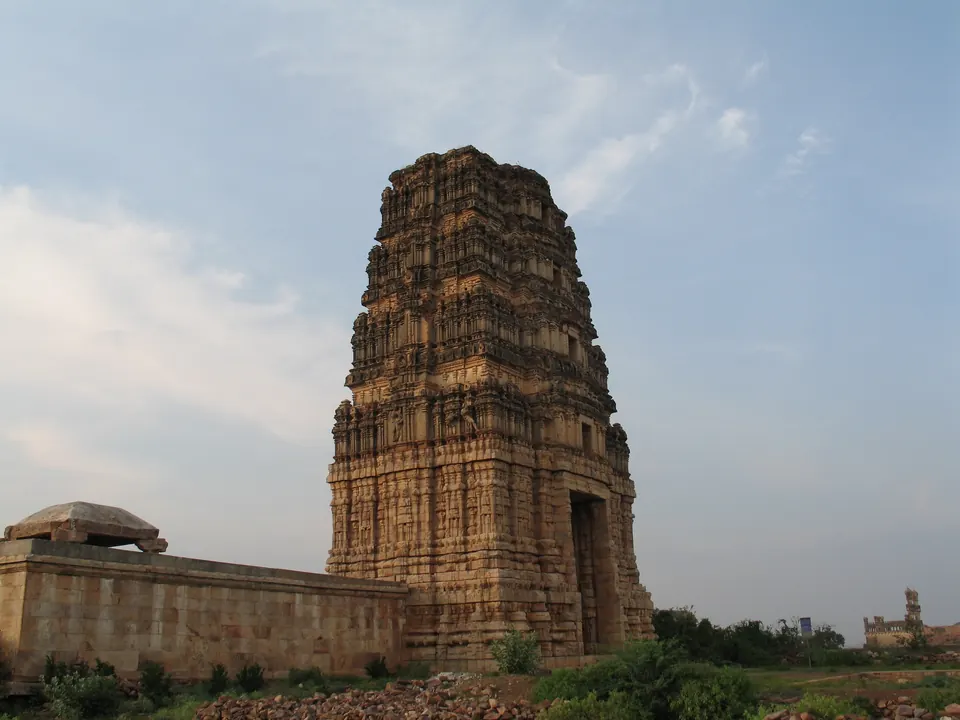
At Gandikota the Penner cuts a gorge four miles long through cliffs of bedded sandstone.1 The Cuddapah gazetteer of 1915 wrote that “the height overlooking the river on the south bank is crowned by extensive fortifications”.1 It added that, “even apart from their historical associations”, they “are well worthy of a visit”.1
The Imperial Gazetteer of 1908 described the fort as “perched on a hill overlooking the gorge of the Penner river, 1,670 feet above the sea”.2 It judged that a properly defended fort “should, in the conditions of warfare then existing, have been impregnable” (impossible to take).2 It called the fort “one of the most important strongholds in the Cuddapah country”, because it was “the key to the valley of the Penner”.2
The Cuddapah gazetteer notes that within the fort “are several wells, strongly revetted and provided with stone steps”.3 Their sides are lined with stone.3 There is also “a koneru known as Rayalcheruvu the springs of which are perennial” (a temple tank whose springs never dry up).3
Dating and attribution
The gazetteer summarises the sthala purana (temple legend) of the place.14 It says that in the 1213th year of the Salivahana era Kaka Maharaju of Bommanapalle founded the village and “fortified the hill which afterwards came to be known as Gandikota”.1 Later, it says, “Harihara Bukkarayalu” of Vijayanagar built the temple of Madhavasvami there.4
The gazetteer took the first date to correspond to about 1290.4 It suggested that Kaka Maharaju was a Kakatiya king or his viceroy at Valluru.4 It also observed that the legend treats Harihara and Bukka as a single king.4
The Imperial Gazetteer gives the same tradition from “an ancient grant in the fort”.2 It adds that Harihara “is said to have constructed a temple in it”.2 It then notes: “According to Firishta, however, the fort was not built until 1589.”2 See Bukka I and Harihara I.
Golconda and after
According to the gazetteer, the fort passed to Golconda after the fall of Vijayanagara, and it “became the headquarters of a Nawab”.5 The first Nawab is said to have been Mir Jumla.5 He “greatly strengthened the fortifications” and built the Jama Masjid out of the materials of temples.5
The gazetteer says: “The State granary within the fortifications—now used as a travellers’ bungalow—was built by Meer Jumla or one of his successors.”5 Later the fort was an outpost of the Nawabs of Cuddapah.5 Its walls were still mounted with cannon at the cession to the Company.5
The Imperial Gazetteer adds that Haidar Ali improved and garrisoned the fort.2 Captain Little took it in 1791, in the war with Tipu.2 See the Qutb Shahis.
Footnotes
-
C. F. Brackenbury, Madras District Gazetteers: Cuddapah, Vol. I (1915), p. 191 (archive.org (opens in a new tab)). ↩ ↩2 ↩3 ↩4 ↩5
-
Imperial Gazetteer of India: Madras, Vol. I (1908), pp. 393–394 (archive.org (opens in a new tab)). ↩ ↩2 ↩3 ↩4 ↩5 ↩6 ↩7 ↩8
-
Brackenbury, Cuddapah Gazetteer, Vol. I (1915), p. 194 (archive.org (opens in a new tab)). ↩ ↩2 ↩3
-
Brackenbury, Cuddapah Gazetteer, Vol. I (1915), p. 192 (archive.org (opens in a new tab)). ↩ ↩2 ↩3 ↩4 ↩5
-
Brackenbury, Cuddapah Gazetteer, Vol. I (1915), p. 193 (archive.org (opens in a new tab)). ↩ ↩2 ↩3 ↩4 ↩5 ↩6
Photos
References
Notes (0)
Sources (2)
Spotted an error on this page? Tell us
Last updated: