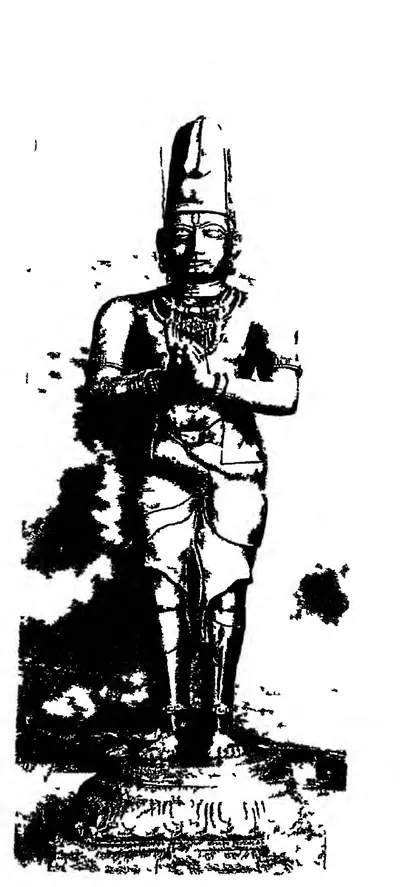
Harihara I (Vijayanagara)
First ruler of Vijayanagara and eldest of the five sons of Sangama. With his brother Bukka he founded the kingdom on the Tungabhadra about 1336. His first dated inscription, of 1340, calls him only a mahamandalesvara, 'great lord'. It is disputed whether he and his brothers came from the service of the Kakatiyas of Warangal, of the Rai of Kampili or of the Hoysalas. His brother Kampa held Udayagiri and Nellore, the first Vijayanagara base in the Telugu country.
Harihara I, also called Hariyappa, was the first ruler of Vijayanagara.123 Sewell, writing in 1900, dated his rule from about 1336 to 1343.123 In his later work he gave 1336 to about 1355.123 He cited a record that Harihara was crowned on 18 April 1336, and another showing him alive in August 1346.123
N. Venkataramanayya held that the two copper-plate grants dated 1336 were forged.4 He made a grant of 1340 at Badami the earliest dated record of the reign.4 See Vijayanagara.
Names and title
Nuniz calls the founder “Deorao”, which Sewell took for Deva Raya, a title of Harihara I.5 Ibn Batuta, who was in India from 1333 to 1342, calls Harihara “Haraib” or “Harib”, from Hariyappa.5
The earliest dated inscription, of 1340, calls him “Hariyappa Vodeya”.61 It gives him the Sanskrit title mahamandalesvara, “great lord”, not king.61 Sewell noted that a fort was built at Badami that year with his permission.61
Krishnaswami Aiyangar identified him with the “Harib” who held the Konkan coast up to Jamkhandi against the first Bahmani sultan.78 He wrote that the last known date of Hariyappa is 1346.78
Where he came from
The origin of the brothers is one of the oldest disputes in South Indian history.59 Nuniz says that Muhammad Tughluq took Anegundi and killed its chief.59 Later he made the chief’s former minister “Deorao” ruler in his place.59 Advised by the sage Madhava, “Deorao” founded the city of Vijayanagar on the south bank of the river.59
- Sewell’s reconstruction made Harihara and Bukka two brothers who had served in the treasury of Warangal.10 They fled when it was destroyed in 1323, and rose to be minister and treasurer at Anegundi, “Harihara I. (‘Hukka’) and Bukka I.”10
- Venkataramanayya concluded from Barani that the brothers “were persons of Telugu extraction, probably related to the Kakatiya royal family of Warrangal”.11 He thought they had served Kampila Raya as keepers of his treasury.11
- Heras argued instead that the Hoysala king Vira Ballala III placed Harihara on the throne at Vijayanagara as his mahamandalesvara on the northern frontier.1213
- Krishnaswami Aiyangar wrote that the eldest brother had “the southern Maratha territory under his charge” as one of the Hoysala wardens.1213
See the Vijayanagara page, which sets out the arguments.
Family
According to the Nellore copper plates of 1356, Sangama, the father of Harihara I, had five sons.14 Harihara was the eldest, Kampa the second and Bukka the third.14 Sewell took a family tree from the Epigraphia Indica, which names the other two Marapa and Muddapa.15 The same plates make Sangama II, who made the grant, a son of Kampa.14
Venkataramanayya read an inscription of Harihara II.16 In his reading, it recalls that in 1346 Hiriya Hariyappa Odeyar came to Sringeri with his brothers and his son-in-law Ballappa-dannayaka, a former Hoysala commander.16
The kingdom and the Telugu country
Nuniz says that Harihara reigned seven years “and did nothing therein but pacify the kingdom”.1 He built a temple at the capital in honour of the sage who had helped him, which Sewell identified with the great temple at Hampi.1
Krishnaswami Aiyangar wrote that the five brothers held a line of garrisons across the north.13 Nellore and Udayagiri, with the lands under them, were in the charge of the second brother Kampa.13 An inscription of Harihara’s reign, published among the Nellore inscriptions, says that he “conquered the whole world, beginning with the Angas and Kalingas”.17
According to Venkataramanayya, in 1346 Harihara, his brothers and his officers met at Sringeri to celebrate a festival of victory.16 He took this as the formal declaration of their independence.16 See Udayagiri and Nellore.
Succession
Who followed Harihara is itself disputed.14 The Nellore plates of 1356 say that Kampa followed Harihara, and that Kampa’s son Sangama II followed him a year before the grant.14 Sewell took this as a sign that the succession was contested, and that Bukka “somehow … got the upper hand” by 1354.14
In 1900 Sewell put Harihara’s death in or about 1343.12 His reason was that by 1344 a son of Pratapa Rudra of Warangal had taken refuge at Vijayanagara.12 In 1932 he dated the end of the reign to about 1355.12 See Bukka I.
Footnotes
-
Sewell, A Forgotten Empire (1900), pp. 26–27 (archive.org (opens in a new tab)). ↩ ↩2 ↩3 ↩4 ↩5 ↩6 ↩7 ↩8 ↩9 ↩10 ↩11 ↩12
-
Robert Sewell, ed. S. Krishnaswami Aiyangar, The Historical Inscriptions of Southern India (1932), p. 400 (archive.org (opens in a new tab)). ↩ ↩2 ↩3 ↩4 ↩5 ↩6 ↩7
-
Sewell, Historical Inscriptions (1932), p. 403, notes to the pedigrees (archive.org (opens in a new tab)). ↩ ↩2 ↩3 ↩4
-
Venkataramanayya, Kampili and Vijayanagara (1929), p. 28 (archive.org (opens in a new tab)). ↩ ↩2
-
Robert Sewell, A Forgotten Empire (Vijayanagar) (1900), p. 7 (archive.org (opens in a new tab)). ↩ ↩2 ↩3 ↩4 ↩5 ↩6
-
Sewell, A Forgotten Empire (1900), p. 25 (archive.org (opens in a new tab)). ↩ ↩2 ↩3
-
S. Krishnaswami Aiyangar, South India and her Muhammadan Invaders (1921), p. 181 (archive.org (opens in a new tab)). ↩ ↩2
-
Krishnaswami Aiyangar, in Cambridge History of India, Vol. III (1928), p. 490 (archive.org (opens in a new tab)). ↩ ↩2
-
Sewell, A Forgotten Empire (1900), p. 19 (archive.org (opens in a new tab)). ↩ ↩2 ↩3 ↩4
-
Sewell, A Forgotten Empire (1900), p. 23 (archive.org (opens in a new tab)). ↩ ↩2 ↩3
-
N. Venkataramanayya, Kampili and Vijayanagara (1929), p. 26 (archive.org (opens in a new tab)). ↩ ↩2 ↩3
-
H. Heras, Beginnings of Vijayanagara History (1929), p. 67 (archive.org (opens in a new tab)). ↩ ↩2 ↩3
-
S. Krishnaswami Aiyangar, “Hindu States in Southern India”, in Wolseley Haig (ed.), The Cambridge History of India, Vol. III (1928), p. 489 (archive.org (opens in a new tab)). ↩ ↩2 ↩3 ↩4 ↩5
-
Sewell, A Forgotten Empire (1900), p. 28 (archive.org (opens in a new tab)). ↩ ↩2 ↩3 ↩4 ↩5 ↩6
-
Sewell, A Forgotten Empire (1900), p. 24, pedigree after Epigraphia Indica III (archive.org (opens in a new tab)). ↩
-
Venkataramanayya, Kampili and Vijayanagara (1929), p. 32 (archive.org (opens in a new tab)). ↩ ↩2 ↩3 ↩4
-
Heras, Beginnings of Vijayanagara History (1929), p. 118, citing Butterworth’s Nellore Inscriptions (archive.org (opens in a new tab)). ↩
Related
Dynasties
References
Notes (0)
Sources (6)
Spotted an error on this page? Tell us
Last updated: