Hayat Bakhshi Mosque, Hayathnagar
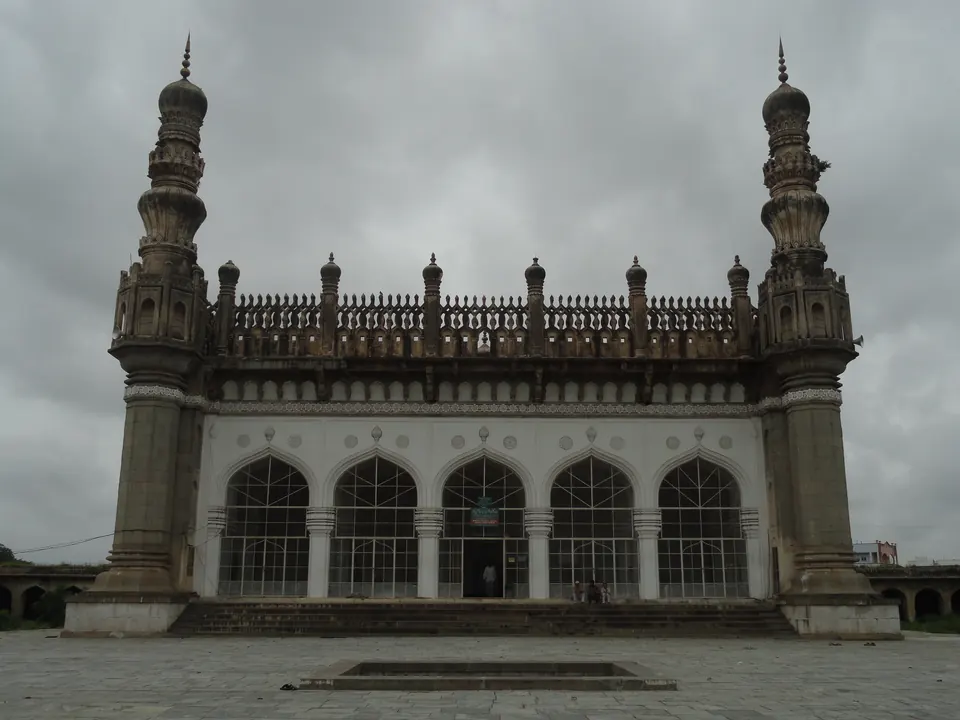
Large Qutb Shahi mosque of five double arches between two tall minarets. It stands on a terrace inside a vast walled caravanserai (travellers' inn) at Hayathnagar, about nine miles east of Hyderabad. The village was founded in AH 1035 (1625–26) by Hayat Bakhsh Begum, daughter of Muhammad Quli, queen of Sultan Muhammad and mother of Abdullah Qutb Shah. The mosque has no inscription. Bilgrami dated the village to 1626 and the mosque to Abdullah's reign.
Hayathnagar lies about nine miles east of Hyderabad.1 Syed Ali Asgar Bilgrami published the first description of its Qutb Shahi buildings in 1927.1 He wrote that Hayat Bakhsh Begum, known as Hayat Ma, mother of Abdullah Qutb Shah, founded the village in AH 1035 (1625–26; AH is the Islamic way of counting years) under the name Hayatabad.1 A masonry milestone pillar of the Qutb Shahi period could still be seen between the sixth and seventh miles of the road from the city.1
Hayat Bakhsh Begum was the daughter of Muhammad Quli Qutb Shah and the queen of Sultan Muhammad.2 In Bilgrami’s words she “took a prominent part during the reigns of three Qutbshahi Kings”.2 He names Hayatnagar as “a favourite resort of the Begam”.2 For her place in the government of her son see the Qutb Shahis.
The caravanserai and mosque
Outside what had been the royal buildings of the village, Bilgrami found “a grand mosque, on a terrace measuring about 150 feet each way”.3 It stands “inside a very extensive Karwansarai” (caravanserai).3 The mosque “is composed of 5 double arches of massive masonry and is flanked by two lofty minarets”.3 Its prayer niche is of plaster “and bears no inscription”.3 The floor is of local ashlar (cut stone), and the front is decorated in stucco.3 A small cistern for washing before prayer stands in the middle of the terrace.3
The courtyard of the caravanserai is about 450 by 400 feet.3 It is “surrounded on all sides by several hundred double rooms of massive masonry which were intended for the use of travellers”.3 From these the place was called the “Sarai of Man Saheba”.3 It had three lofty gates, on the north, east and south, of which only the eastern one was still open.34
At the north-east corner is a great well, the Hati Bauli (“elephant well”), “the water of which was formerly drawn by elephants”.3 It still watered the royal garden, the Khas Bagh, outside the walls.34 Beyond it lay the blocked entrance of an underground building called the Tal Makan.34
Date
There is no inscription on the mosque. Bilgrami’s list of monuments dates the Hayatnagar group to AH 1035 (1626), the year he gives for the founding of the village.51 His heading for the monument itself, however, gives the year of building as “Sultan Abdullah Qutb Shah’s reign 1085 A.H.”.16 That year falls after Abdullah’s death in AH 1083.16 The two dates cannot both be right, and Bilgrami does not explain the second.16
He also records a ceremony for the infant Abdullah: the first shaving of his head.13 His mother celebrated it in the royal palaces of the village “on a very grand scale, successively for twelve days”.13 Its cost is said to have reached two lakhs of huns (gold coins).13
Condition
The mosque had been thoroughly repaired in the reign of Asaf Jah VI.3 But in 1927 Bilgrami found the roof in need of repair and the walls overgrown.34 He found the caravanserai and mosque “entirely uninhabited”.3 He urged that, “being a very fine specimen of Qutbshahi architecture”, the mosque “should be specially preserved by the State Archaeological Department”.4
Footnotes
-
Bilgrami, Landmarks of the Deccan (1927), p. 55 (archive.org (opens in a new tab)). ↩ ↩2 ↩3 ↩4 ↩5 ↩6 ↩7 ↩8 ↩9 ↩10 ↩11
-
Bilgrami, Landmarks of the Deccan (1927), p. 169 (archive.org (opens in a new tab)). ↩ ↩2 ↩3
-
Bilgrami, Landmarks of the Deccan (1927), p. 56 and note (archive.org (opens in a new tab)). ↩ ↩2 ↩3 ↩4 ↩5 ↩6 ↩7 ↩8 ↩9 ↩10 ↩11 ↩12 ↩13 ↩14 ↩15 ↩16 ↩17 ↩18 ↩19
-
Bilgrami, Landmarks of the Deccan (1927), p. 57 (archive.org (opens in a new tab)). ↩ ↩2 ↩3 ↩4 ↩5
-
Syed Ali Asgar Bilgrami, Landmarks of the Deccan (1927), List of Monuments, p. 2, No. 18 (archive.org (opens in a new tab)). ↩
-
Bilgrami, Landmarks of the Deccan (1927), List of Monuments, p. 5, No. 70 (archive.org (opens in a new tab)). ↩ ↩2 ↩3
Photos
References
Notes (0)
Sources (1)
Spotted an error on this page? Tell us
Last updated: