Khairatabad Mosque
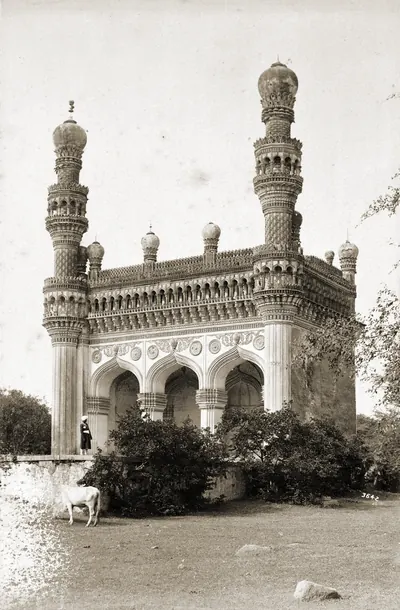
Small three-arched Qutb Shahi mosque at Khairatabad, Hyderabad, with an empty domed tomb beside it, after which the suburb is named. Neither building has an inscription. Bilgrami (1927), from a sanad (deed) of Aurangzeb's 37th year, says that Khairiyat-un-Nisa Begum, daughter of Sultan Muhammad Qutb Shah, built the mosque for her tutor Mulla Abdul Malik. He dates it between 1612 and 1626. Campbell (1898), Rocco (1929) and Syed Hossein Bilgrami (1905) make its builder Khairat-un-Nisa, a daughter of Ibrahim Qutb Shah.
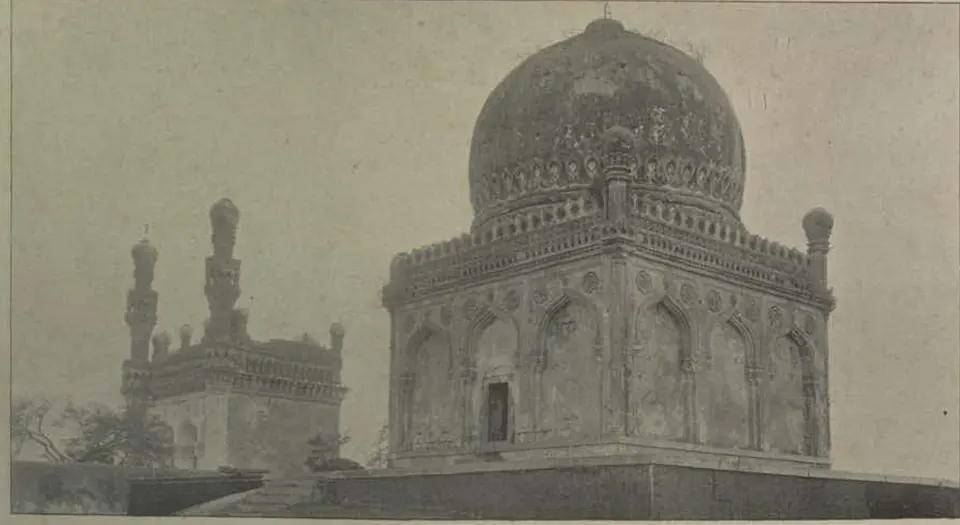
A small Qutb Shahi mosque stands in Khairatabad, a suburb of Hyderabad beyond Saifabad, overlooking the Husain Sagar.123 An empty domed tomb stands beside it.123 Syed Ali Asgar Bilgrami describes the mosque as having “a three-arched opening in front”, 54 feet by 30.3 A. Claude Campbell (1898) wrote that the suburb was named “after the royal lady whose tomb is to be seen” there.2
Neither building carries an inscription.4 So its builder and date come only from later documents and tradition.4 See Hyderabad and the Qutb Shahis.
Who built it
The sources name two different princesses.
- A daughter of Sultan Muhammad. Bilgrami saw a sanad (deed) held by the trustee (mutawalli) of the mosque, bearing the 37th regnal year of Aurangzeb.3 In his summary, “It is mentioned in the sanad that this mosque was built by Khairiatun-Nisa Begum, alias Man Saheba, daughter of Sultan Muhammad Qutb Shah, for her tutor Akhund Mulla Abdul Malik.”3 His list of monuments dates the mosque to “1020 A.H. (1612 A.D.) 1035 A.H. (1626 A.D.)”, the years of Sultan Muhammad’s reign.5
- A daughter of Ibrahim. Campbell says the mosque was “built by Khairatbai, a daughter of Sultan Ibrahim Kutub Shah, fourth king of Golconda”.1 He adds that “An old tomb close by is believed to contain her remains”.1 Sha Rocco (1929) also writes about this in his account of Ibrahim Qutb Shah.6 He says that Khairatabad is “a memorial of one of his daughters, Khairatibi”.6 He says the tomb next to the mosque “is believed to cover her remains”.6
The empty tomb
The two accounts also explain the empty tomb differently. According to Bilgrami’s sanad, the dome was built on the land granted to the tutor, north of the mosque.7 It was built “by Akhund for self-burial, but owing to his demise in the holy cities (Mecca and Madina) the dome remained vacant”.7
R. C. Temple edited Thomas Bowrey’s account of the 1670s, and Syed Hossein Bilgrami gave him a different explanation.4 He wrote of “The only court lady whose body was exhumed after seven years and sent to Kerbela (not Mecca) for burial in holy ground”.4 She was Khairat-un-Nissa Begam, a daughter of Ibrahim Qutb Shah.4
According to him, she was buried for a time under a dome built for this purpose in Khairatabad, not far from a mosque she had built herself.4 Her remains were moved to Kerbela seven years later.4 The empty mausoleum and mosque were still standing in his day, but “there are no inscriptions on either of them”.4
Temple offered this as the explanation of a story told by Bowrey.84 In Bowrey’s story the bones of a queen mother were dug up after seven years and sent to Mecca.84 Campbell adds that until shortly before 1898 the tomb had been used as a powder magazine (gunpowder store).1
The tutor’s grant
According to Bilgrami’s summary of the documents, the tutor gave the king, through the princess, a Quran written by the calligrapher Yaqut.37 He also gave a copy of the Shahnama.37 He was offered 700 huns (gold coins) and a robe of honour in return.37 He asked instead for land, and received 45 bighas as a grant (inam).37 In 1927 the trustee claimed descent from him and held the mosque and the land.37
Footnotes
-
A. Claude Campbell, Glimpses of the Nizam’s Dominions (1898), p. 204 (archive.org (opens in a new tab)). ↩ ↩2 ↩3 ↩4 ↩5
-
Campbell, Glimpses of the Nizam’s Dominions (1898), p. 206 (archive.org (opens in a new tab)). ↩ ↩2 ↩3
-
Bilgrami, Landmarks of the Deccan (1927), p. 57 (archive.org (opens in a new tab)). ↩ ↩2 ↩3 ↩4 ↩5 ↩6 ↩7 ↩8 ↩9 ↩10
-
Bowrey, ed. Temple, Geographical Account (1905), p. 113, note 1 (archive.org (opens in a new tab)). ↩ ↩2 ↩3 ↩4 ↩5 ↩6 ↩7 ↩8 ↩9 ↩10
-
Syed Ali Asgar Bilgrami, Landmarks of the Deccan (1927), List of Monuments, p. 2, No. 19 (archive.org (opens in a new tab)). ↩
-
Sha Rocco, Golconda and the Qutb Shahs (1929), p. 13 (archive.org (opens in a new tab)). ↩ ↩2 ↩3
-
Bilgrami, Landmarks of the Deccan (1927), p. 58 (archive.org (opens in a new tab)). ↩ ↩2 ↩3 ↩4 ↩5 ↩6 ↩7
-
Thomas Bowrey, ed. R. C. Temple, A Geographical Account of Countries round the Bay of Bengal, 1669 to 1679 (1905), p. 112 (archive.org (opens in a new tab)). ↩ ↩2
Photos
References
Notes (0)
Sources (4)
Spotted an error on this page? Tell us
Last updated: