Badshahi Ashurkhana
The royal hall of Muharram mourning in Hyderabad, built by Muhammad Quli Qutb Shah. The Imperial Gazetteer (1909) and Campbell (1898) date it to 1594. Bilgrami (1927) read a date of AH 1001 (1592–93) in the enamelled-tile inscription over the central niche, and dated the tile work to the last year of the king's reign. Abdullah Qutb Shah's name is also in the tiles, and the outer halls were added under Nizam Ali Khan.
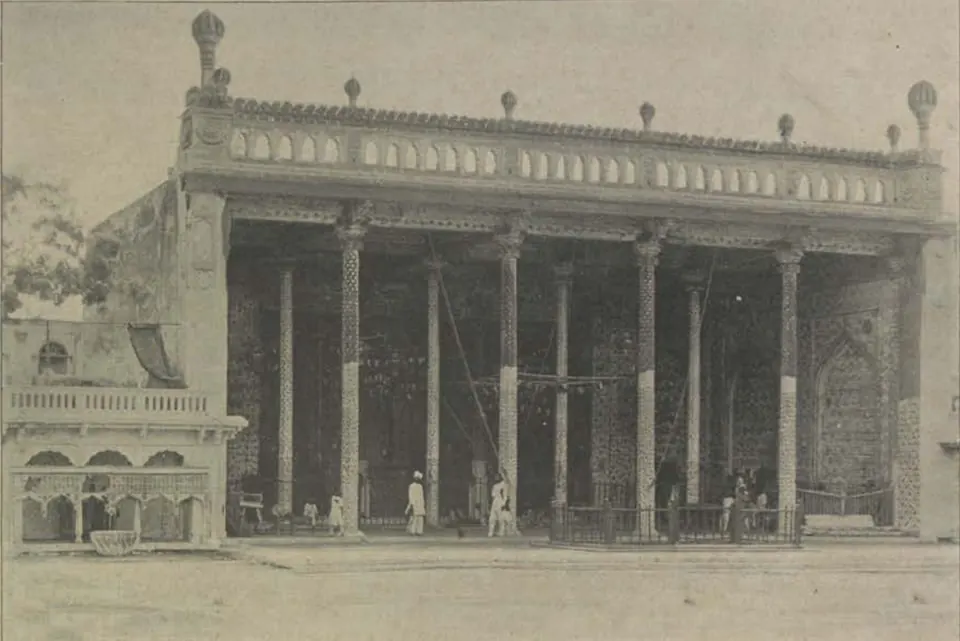
The Badshahi (“royal”) Ashurkhana stands in the old city of Hyderabad, near the Pathargatti, west of the palace of the Salar Jang family.12 The Imperial Gazetteer of 1909 says simply that the building “is used for the Muharram ceremonies”.3 A. Claude Campbell (1898) says that the Muharram procession started from it.4 See the Qutb Shahis and Muhammad Quli Qutb Shah.
Date
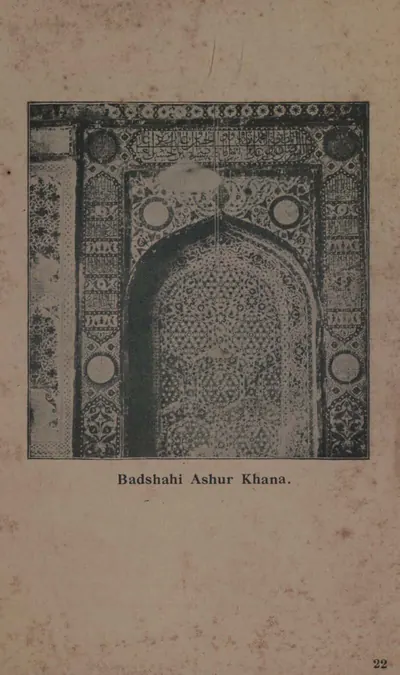
The gazetteer says the Ashur Khana “was erected by Sultan Muhammad Kuli Kutb Shah in 1594, at a cost of Rs. 66,000”.23 Campbell gives the same year.4 Syed Ali Asgar Bilgrami published the inscriptions on its tiles “for the first time” in 1927.1 Over the central niche he found a text in the Tughra style that ends “The slave of Ali Muhammad Qutb Shah in the year 1001”, that is AH 1001 (1592–93; AH is the Islamic way of counting years).1
Bilgrami took the inner hall to be the oldest part of the building, built by Muhammad Quli at a cost of Rs. 66,000.5 But he dated the Persian enamel work to “the last year of the reign of Sultan Muhammad Quli in 1020 A.H. (1611 A.D.)”.5 He noted that the word Quli is left out of the king’s name over the niche.65 The full name, “Abul Muzaffar Muhammad Quli Qutb Shah”, appears on the western wall.65
Sha Rocco (1929) says only that Muhammad Quli “commenced the Ashur Khana”.7 The Tarikh-i Zufra, as summarised by Bilgrami, lists an Ashur Khana among the buildings of Muhammad Quli’s reign.8
The tiles and their inscriptions
The tile inscriptions are religious texts: verses of the Quran, Shia prayers and invocations, with the names and titles of two kings. Besides Muhammad Quli’s name, the western wall carries “Abul Muzaffar Sultan Abdullah Qutb Shah”.65 Bilgrami took this to show that Abdullah Qutb Shah, Muhammad Quli’s grandson, “took a considerable part in the renovation of this building”.65 He also says that Abdullah brought in the use of standards in the Ashurkhana during Muharram.65
Bilgrami admired the enamel work.59 He wrote: “Notwithstanding the lapse of 3 centuries the freshness and resplendence of enamel tiles have maintained their brilliant lustre”.59 He compared it with the best tile work of Lahore and Multan.59 Rocco wrote that the building “still exhibits a fair amount of fine Persian enamel work”.7
Later additions
Later inscriptions record the work done under the Asaf Jahi Nizams:105
- under the Nizam Ali Khan (Asaf Jah II) the outer halls on wooden colonnades were added5
- a superintendent of buildings named Asad restored the decoration5
- a later trustee (mutawalli), Nawazish Ali Khan Shaida, built the main gate5
Asaf Jah II granted a jagir (land grant) worth Rs. 12,000 a year for its expenses, and Sikandar Jah added Rs. 2,000.9 In 1927 the large courtyard was used as a public auction house.9
Footnotes
-
Syed Ali Asgar Bilgrami, Landmarks of the Deccan (1927), p. 21 (archive.org (opens in a new tab)). ↩ ↩2 ↩3
-
Imperial Gazetteer of India: Hyderabad State (1909), p. 115 (archive.org (opens in a new tab)). ↩ ↩2
-
Imperial Gazetteer: Hyderabad (1909), p. 116 (archive.org (opens in a new tab)). ↩ ↩2
-
A. Claude Campbell, Glimpses of the Nizam’s Dominions (1898), p. 161 (archive.org (opens in a new tab)). ↩ ↩2
-
Bilgrami, Landmarks of the Deccan (1927), p. 24 (archive.org (opens in a new tab)). ↩ ↩2 ↩3 ↩4 ↩5 ↩6 ↩7 ↩8 ↩9 ↩10 ↩11 ↩12 ↩13 ↩14
-
Bilgrami, Landmarks of the Deccan (1927), p. 22 and plate (archive.org (opens in a new tab)). ↩ ↩2 ↩3 ↩4 ↩5
-
Sha Rocco, Golconda and the Qutb Shahs (1929), p. 14 (archive.org (opens in a new tab)). ↩ ↩2
-
Bilgrami, Landmarks of the Deccan (1927), p. 131 (archive.org (opens in a new tab)). ↩
-
Bilgrami, Landmarks of the Deccan (1927), p. 25 (archive.org (opens in a new tab)). ↩ ↩2 ↩3 ↩4 ↩5
-
Bilgrami, Landmarks of the Deccan (1927), p. 23 (archive.org (opens in a new tab)). ↩
Photos
References
Notes (0)
Sources (4)
Spotted an error on this page? Tell us
Last updated: