Venkatapati II (Vijayanagara)
King of Vijayanagara from 1586 to 1614, the youngest son of Tirumala and the last strong ruler of the empire. He was chosen king over his young nephews. He ruled first from Penukonda, then from Chandragiri, and from 1606 from Vellore. He fought Golconda for the Telugu country, and the Telugu Ramarajiyamu says peace was made with the Krishna as the boundary. Jesuit missionaries lived at his court, and Tenali Ramakrishna and Tarigoppula Mallana are counted among his poets. His death at Chandragiri in 1614 was followed by a war of succession.
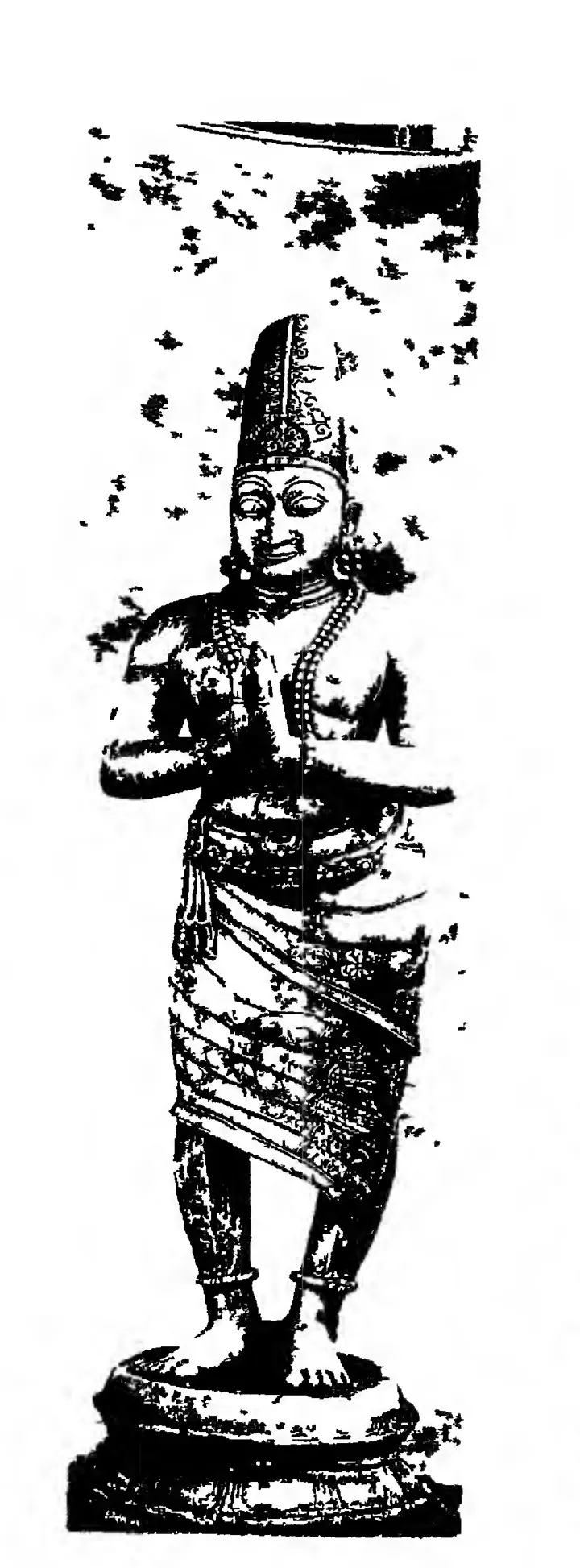
Venkatapati II reigned over Vijayanagara from 1586 until his death in 1614.12 Heras, who counted Achyuta’s short-lived son as Venkata I, called him Venkata II.3 Sewell called him Venkata I in 1900 and Venkatapati I in 1932.41 Sewell wrote that he “reigned for at least twenty-eight years, and died an old man in 1614”.4 See Vijayanagara.
Family
Venkatapati was the youngest of the four sons of Tirumala and Vengalamba named in the Vasucharitramu.56 That poem says that in his father’s reign he governed “as viceroy the kingdom of Chandragiri”.56 The Srutiranjani says that his brother Rama married Narasingama and had two sons, Tirumala and Sriranga.7
The Ramarajiyamu gives Venkatapati four wives: Venkatamma, Obamma, Krishnamma and Kondamma.89 It says that he adopted Sriranga, called Chikka Raya, the son of his brother Rama, and made him heir to the throne.89 The Ramarajiyamu says that Chikka Raya married Obamma and had a son, Rama Deva Raya, the prince rescued by Yachama Nayaka from the massacre of his family.9
The Jesuit Manuel Barradas wrote that the king was married to Bayama, a daughter of the chief Jagga Raya.10 According to Barradas, she had a Brahman woman’s child passed off as her own son.10 Krishnaswami Aiyangar suggested that she was the queen the Ramarajiyamu calls Venkatamma.11 See Tirumala.
Coming to the throne
Heras quoted a Jesuit letter of 1602 about the accession.312 It says that on the death of his brother the kingdom was given “by the unanimous vote of all the classes” to Venkatapati.312 This meant “rejecting the rights of the deceased’s children, who on account of their age, were not able to rule over a kingdom”.312 Heras also noted inscriptions which suggest that another brother, Rama, briefly reigned between Sriranga I and Venkatapati.312
Venkatapati was anointed by his family preceptor (teacher) Tatacharya.12 The Jesuit Du Jarric described him as “quite handsome, although a little dark; his eyes are big; he is of a medium size”.13 Heras wrote that before 1595 the nayakas (local rulers) of Tanjore, Madura and Gingi refused him allegiance.1415 In Heras’s account he put down the rebellion only after several years.1415
Wars for the Telugu country
Heras wrote that Venkatapati began his reign with an attack on Golconda. Muhammad Quli Qutb Shah besieged him at Penukonda.1617 The chief Jagadeva Raya threw himself into the fort, and the sultan had to raise the siege.1617 The Golconda chronicle blames the rains, but Heras read its account as hiding a defeat.1617
The Ramarajiyamu says that Venkatapati drove the son of Ibrahim Qutb Shah back as far as Golconda.8 It says he defeated his army on the Pennar.8 When the sultan asked for peace, Venkatapati “settled with him that the Krishna should thenceforward form the boundary between their respective territories”.8
Heras summarised the Golconda chronicle translated by Briggs.181920 It tells of later campaigns in the district of Kandbir, the Telugu jagirdars’ (land-holders’) revolt against Golconda and a march by Venkatapati towards Cumbum.181920 It claims them as Muslim victories.181920 Heras rejected this, and he saw in the Krishna boundary the recovery of the lost territories.181920 See Muhammad Quli Qutb Shah and the Qutb Shahis.
Penukonda, Chandragiri and Vellore
Heras wrote that about 1592 Venkatapati moved his court to Chandragiri, the city he had governed as viceroy.1521 He did so when the Sultan of Bijapur attacked Penukonda.1521
In 1603 the nayaka of Vellore, Lingama, rebelled.2223 The fort was taken, and about the middle of 1606 the king set up his court in Vellore.2223 He still lived at times at Chandragiri.2223
Krishnaswami Aiyangar noted that Venkatapati confirmed Raja Wodeyar of Mysore in Srirangapatna (then Seringapatam) in 1612.24 He called this “the first province effectively lost to the empire through defection”.24 See Vijayanagara.
Court, religion and the Jesuits
The Prapannamritam says that Venkatapati became a disciple of the Srivaishnava teacher Lakshmikumara Tatacharya.25 It says that many of his subjects followed him into the Vaishnava faith.25
Jesuit missionaries lived at his court at Chandragiri and Vellore from the end of the sixteenth century, and Heras gave a chapter to them.26 He also called Venkatapati “the great patron of literature among the first monarchs of the Aravidu family”.27
The Saiva scholar Appaya Dikshita wrote his Kuvalayananda at the king’s request.2829 G. R. Subramiah Pantulu wrote that Appaya was “known to the world as the court poet of Venkatapatiraya”.29 Tarigoppula Mallana, author of the Telugu Chandrabhanu Charitra, was attached to his court.303132 Chenchiah and Bhujanga Rao placed Tenali Ramakrishna there too.3031 See Tenali Ramakrishna.
Death and the succession
Barradas wrote from Cochin in 1616 about the old king’s death.3334 He tells how the king passed over the queen’s supposed son.3334 In the presence of the nobles, the king gave his ring of state to his nephew Chikka Raya.3334 He died three days later “at the age of sixty-seven years”, and three of his queens burned themselves on his pyre.3334
Heras dated the death to 1614 from the Portuguese viceroy’s report of it in December of that year.2 Jagga Raya then raised the supposed son to the throne and massacred Chikka Raya and his family.3511 This began a civil war that ended only when Jagga Raya fell in battle against Yachama Nayaka and Raghunatha Nayaka of Thanjavur (then Tanjore).3511 See Vijayanagara.
Footnotes
-
Robert Sewell, ed. S. Krishnaswami Aiyangar, The Historical Inscriptions of Southern India (1932), p. 402 (archive.org (opens in a new tab)). ↩ ↩2
-
Heras, The Aravidu Dynasty, Vol. I (1927), p. 507 (archive.org (opens in a new tab)). ↩ ↩2
-
H. Heras, The Aravidu Dynasty of Vijayanagara, Vol. I (1927), p. 300 and note (archive.org (opens in a new tab)). ↩ ↩2 ↩3 ↩4 ↩5
-
Robert Sewell, A Forgotten Empire (Vijayanagar) (1900), p. 218 (archive.org (opens in a new tab)). ↩ ↩2
-
Krishnaswami Aiyangar, Sources of Vijayanagar History (1919), p. 216, extract 66, the Vasucharitramu (archive.org (opens in a new tab)). ↩ ↩2
-
Krishnaswami Aiyangar, Sources of Vijayanagar History (1919), p. 217, the Vasucharitramu (archive.org (opens in a new tab)). ↩ ↩2
-
Krishnaswami Aiyangar, Sources of Vijayanagar History (1919), p. 213, the Srutiranjani (archive.org (opens in a new tab)). ↩
-
Krishnaswami Aiyangar, Sources of Vijayanagar History (1919), p. 243, extract 79, the Ramarajiyamu (archive.org (opens in a new tab)). ↩ ↩2 ↩3 ↩4 ↩5
-
Krishnaswami Aiyangar, Sources of Vijayanagar History (1919), p. 244, the Ramarajiyamu (archive.org (opens in a new tab)). ↩ ↩2 ↩3
-
Barradas, in Sewell, A Forgotten Empire (1900), p. 223 (archive.org (opens in a new tab)). ↩ ↩2
-
Krishnaswami Aiyangar, Sources of Vijayanagar History (1919), introduction, p. 20 (archive.org (opens in a new tab)). ↩ ↩2 ↩3
-
Heras, The Aravidu Dynasty, Vol. I (1927), p. 301 (archive.org (opens in a new tab)). ↩ ↩2 ↩3 ↩4 ↩5
-
Heras, The Aravidu Dynasty, Vol. I (1927), p. 302 (archive.org (opens in a new tab)). ↩
-
Heras, The Aravidu Dynasty, Vol. I (1927), p. 308 (archive.org (opens in a new tab)). ↩ ↩2
-
Heras, The Aravidu Dynasty, Vol. I (1927), p. 310 (archive.org (opens in a new tab)). ↩ ↩2 ↩3 ↩4
-
Heras, The Aravidu Dynasty, Vol. I (1927), p. 326 (archive.org (opens in a new tab)). ↩ ↩2 ↩3
-
Heras, The Aravidu Dynasty, Vol. I (1927), p. 327 (archive.org (opens in a new tab)). ↩ ↩2 ↩3
-
Heras, The Aravidu Dynasty, Vol. I (1927), pp. 331–333 (archive.org (opens in a new tab)). ↩ ↩2 ↩3 ↩4
-
Heras, The Aravidu Dynasty, Vol. I (1927), p. 333 and note (archive.org (opens in a new tab)). ↩ ↩2 ↩3 ↩4
-
Heras, The Aravidu Dynasty, Vol. I (1927), p. 334 (archive.org (opens in a new tab)). ↩ ↩2 ↩3 ↩4
-
Heras, The Aravidu Dynasty, Vol. I (1927), p. 311 (archive.org (opens in a new tab)). ↩ ↩2
-
Heras, The Aravidu Dynasty, Vol. I (1927), pp. 316–319 (archive.org (opens in a new tab)). ↩ ↩2 ↩3
-
Heras, The Aravidu Dynasty, Vol. I (1927), p. 320 (archive.org (opens in a new tab)). ↩ ↩2 ↩3
-
S. Krishnaswami Aiyangar (ed.), Sources of Vijayanagar History (1919), introduction, p. 19 (archive.org (opens in a new tab)). ↩ ↩2
-
Krishnaswami Aiyangar, Sources of Vijayanagar History (1919), p. 251, extract 83, the Prapannamritam (archive.org (opens in a new tab)). ↩ ↩2
-
Heras, The Aravidu Dynasty, Vol. I (1927), chapter XXII, p. 464 (archive.org (opens in a new tab)). ↩
-
Heras, The Aravidu Dynasty, Vol. I (1927), p. 517 (archive.org (opens in a new tab)). ↩
-
Krishnaswami Aiyangar, Sources of Vijayanagar History (1919), p. 250, extract 82, verses about Venkatapati Raya and Appaya Dikshita (archive.org (opens in a new tab)). ↩
-
G. R. Subramiah Pantulu, “Discursive Remarks on the Augustan Age of Telugu Literature”, Indian Antiquary XXVII (1898), p. 326 (archive.org (opens in a new tab)). ↩ ↩2
-
Chenchiah and Bhujanga Rao, A History of Telugu Literature (1928), p. 84 (archive.org (opens in a new tab)). ↩ ↩2
-
P. Chenchiah and Raja M. Bhujanga Rao, A History of Telugu Literature (1928), p. 83 (archive.org (opens in a new tab)). ↩ ↩2
-
Krishnaswami Aiyangar, Sources of Vijayanagar History (1919), p. 247, extract 80, the Chandrabhanu Charitramu of Tarigoppula Mallana (archive.org (opens in a new tab)). ↩
-
Sewell, A Forgotten Empire (1900), p. 222, the letter of Manuel Barradas (archive.org (opens in a new tab)). ↩ ↩2 ↩3 ↩4
-
Barradas, in Sewell, A Forgotten Empire (1900), p. 224 (archive.org (opens in a new tab)). ↩ ↩2 ↩3 ↩4
-
Barradas, in Sewell, A Forgotten Empire (1900), pp. 225–227 (archive.org (opens in a new tab)). ↩ ↩2
Photos
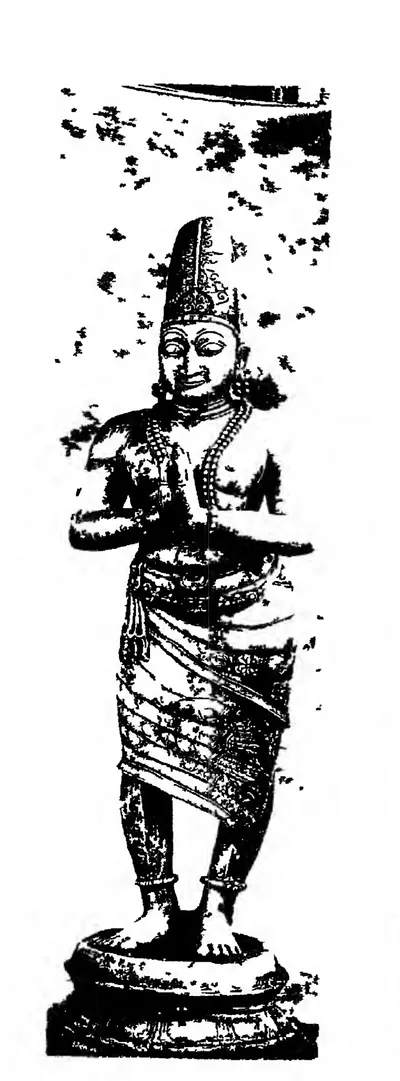 "Venkatapatiraya", labelled copper statue at the entrance of the Tirumala temple (ASI Annual Report 1911-12, plate LXXVI, fig. 4 (PDF p. 354))Historic photograph · 1915
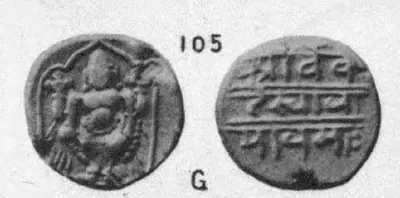 Gold coin No. 105: Vishnu; legend Sri Venkatesvaraya namah (Elliot, Coins of Southern India, 1886, Plate III, No. 105 (PDF p. 191 of scan 00074712bsb))Coin · 1886
Related
Dynasties
References
Notes (0)
Sources (6)
Spotted an error on this page? Tell us
Last updated: