Ibrahim Adil Shah II
Sixth Adil Shahi sultan of Bijapur (r. 1580–1627), nephew and successor of Ali Adil Shah I, called Jagat Guru. He was the patron of the historian Ferishta and the builder of the Ibrahim Rauza. In his reign Bijapur held Adoni against a siege of 1595–96. Early in the seventeenth century it took Kurnool from the last Hindu chief of the town. Heras places Ferishta's account of a failed Bijapur siege of Penukonda in these years.
Ibrahim was the son of Tahmasp, a brother of Ali Adil Shah I.12 Ali had named him his heir in AH 987 (AH is the Islamic way of counting years).12 He came to the throne in 1580 as a boy in his ninth year.12
Cousens says that he “was generally called Ibrahim Jagat Gir (the holder of the world), but sometimes Ibrahim Jagat Guru”.2 Cousens explains: “guru being a Hindu devotee and teacher, Ibrahim having been accused of leanings towards Hinduism”.2
The historian Muhammad Qasim Ferishta wrote with his support.3 He calls himself “placed, by the bounty of his sovereign, Ibrahim Adil Shah II., above all pecuniary wishes”.3 See the Adil Shahis of Bijapur.
Regents and Adoni
For his first years regents governed the kingdom.24 Ali’s widow Chand Bibi was in charge of the young king’s education.24 Cousens describes the quarrels of the nobles, the queen’s imprisonment at Satara and two invasions by Ahmadnagar and Golconda.24
Ferishta tells what happened under the regent Dilawar Khan.5 The minister “by stratagem got into his power Ghalib Khan, governor of the fortress of Adony, who had rebelled, and caused him to be blinded”.5
Ferishta also records that Muhammad Quli Qutb Shah wanted to keep the peace with Bijapur.6 So he “sent his sister to Ibrahim Adil Shah; and the nuptials were celebrated with great magnificence at Shahdoorg”.6
In AH 1003 (1595) Burhan Nizam Shah of Ahmadnagar made an alliance “with the Ray of Penkonda” against Bijapur.7 The Ray promised to besiege forts on the Karnatak frontier.7
Ferishta says that the next year the king sent a force against “one of the zemindars of the Carnatic, who, taking advantage of the war, had besieged the fortress of Adony”.8 The fort was “now in danger of falling from want of provisions”.8 Then news came that “the infidels of the Carnatic had on the approach of the royal troops raised the siege of Adony, and fled to their own country”.8
Ferishta’s history of Bijapur ends at this point.9 Briggs noted that Ferishta went on writing until about 1612 but never finished the Bijapur section.9 See Adoni.
Penukonda and Kurnool
Henry Heras placed in this reign the Bijapur siege of Penukonda that Ferishta tells under Ali I.1011 In his reconstruction, Venkata II of Vijayanagara had allied with Burhan Nizam Shah.1011 Ibrahim II then marched south and besieged Penukonda for three months.1011 Venkata went to Chandragiri, and the garrison was close to surrender.1011
Venkata then bribed Hundiatum Naik and his Bergi horse to desert.1011 So the sultan withdrew, “leaving Mustafa Khan to protect the frontiers”.1011 See Penukonda and Venkatapati II.
Heras adds that it was “probably not long after this event” that the Bijapur sultan sent Abdul Wahab with a powerful army to Kurnool.11 He was to take it from Gopala Raja, a grandson of Rama Raya.11
The Kurnool district manual places the conquest “at the beginning of the seventeenth century”.1213 It says that Gopala Raja was helped by troops from Venkatapati of Penukonda, but he had to flee through the northern gate of the fort.1213 It records that Abdul Wahab governed Kurnool for about sixteen years, until his death in 1618.1213
The Bellary gazetteer says that one of the first governors of Adoni remembered by name was Malik Rahiman Khan.14 He “held the post for twenty-seven years, from 1604 to 1631”.14 See Abdul Wahab Khan and Kurnool.
Bijapur at its height
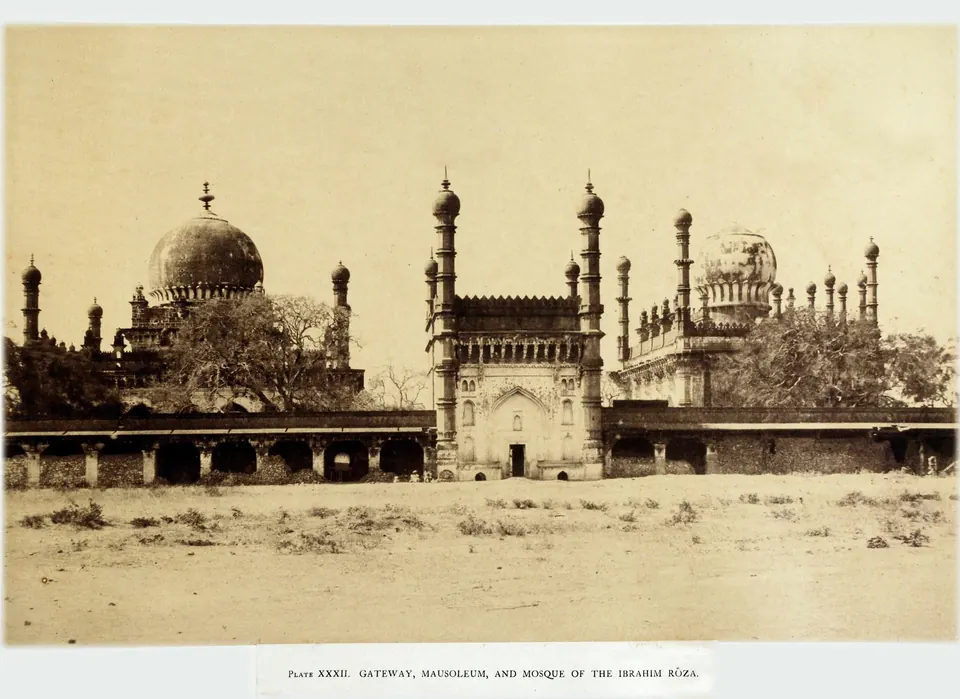
Cousens describes the long peace after 1595.15 In this time the king built “that splendid memorial of his—the mausoleum to the glory of his queen, Taj Sultana”, the Ibrahim Rauza.15 In 1599 he began a new city, Nauraspur, west of Bijapur.15
The Mughals now pressed on the Deccan.1516 Ibrahim’s daughter Sultana Begam was promised in marriage to Akbar’s son Daniyal.1516 Cousens quotes the traveller Pietro della Valle (1623–24) on the tribute, and on the humble ceremony with which the king received the emperor’s letters.1516
In 1624 Malik Ambar of Ahmadnagar plundered Nauraspur, and Ibrahim died in 1627.16 Cousens says that “Bijapur attained its high water-mark of prosperity during the reigns of Ibrahim II. and Sultan Muhammad”.16 See Bijapur.
Family
Ferishta says that Tahmasp had two sons, Ibrahim and Ismail.1715 The younger was kept a prisoner at Belgaum.1715 Cousens tells how rebels there proclaimed Ismail king in the 1590s.1715 He was defeated, blinded and imprisoned again.1715
Cousens says that Ibrahim’s eldest son, Darvesh Padshah, was passed over.16 A younger son, Muhammad, was raised to the throne in 1627 at the age of fifteen.16 See Muhammad Adil Shah.
Footnotes
-
Muhammad Qasim Ferishta, tr. John Briggs, History of the Rise of the Mahomedan Power in India, Vol. III (1829), p. 142 (archive.org (opens in a new tab)). ↩ ↩2 ↩3
-
Henry Cousens, Bijapur and its Architectural Remains (Archaeological Survey of India, Imperial Series, Vol. XXXVII, 1916), p. 11 (archive.org (opens in a new tab)). ↩ ↩2 ↩3 ↩4 ↩5 ↩6 ↩7 ↩8
-
Muhammad Qasim Ferishta, “The Author’s Preface to Vol. III”, tr. John Briggs, History of the Rise of the Mahomedan Power in India, Vol. III (1829), p. 2 of the preface (archive.org (opens in a new tab)). ↩ ↩2
-
Cousens, Bijapur and its Architectural Remains (1916), p. 12 (archive.org (opens in a new tab)). ↩ ↩2 ↩3
-
Ferishta, tr. Briggs, Vol. III (1829), p. 157 (archive.org (opens in a new tab)). ↩ ↩2
-
Ferishta, tr. Briggs, Vol. III (1829), p. 159 (archive.org (opens in a new tab)). ↩ ↩2
-
Ferishta, tr. Briggs, Vol. III (1829), p. 183 (archive.org (opens in a new tab)). ↩ ↩2
-
Ferishta, tr. Briggs, Vol. III (1829), p. 187 (archive.org (opens in a new tab)). ↩ ↩2 ↩3
-
Ferishta, tr. Briggs, Vol. III (1829), p. 188 and note (archive.org (opens in a new tab)). ↩ ↩2
-
Henry Heras, The Aravidu Dynasty of Vijayanagara, Vol. I (1927), p. 336 and note 1 (archive.org (opens in a new tab)). ↩ ↩2 ↩3 ↩4 ↩5 ↩6
-
Heras, Aravidu Dynasty I (1927), p. 337 and note 1 (archive.org (opens in a new tab)). ↩ ↩2 ↩3 ↩4 ↩5 ↩6 ↩7 ↩8
-
Narahari Gopalakristnamah Chetty, A Manual of the Kurnool District (1886), p. 28 (archive.org (opens in a new tab)). ↩ ↩2 ↩3
-
Chetty, Kurnool District (1886), p. 29 (archive.org (opens in a new tab)). ↩ ↩2 ↩3
-
W. Francis, Madras District Gazetteers: Bellary (1904), p. 196 (archive.org (opens in a new tab)). ↩ ↩2
-
Cousens, Bijapur and its Architectural Remains (1916), p. 13 (archive.org (opens in a new tab)). ↩ ↩2 ↩3 ↩4 ↩5 ↩6 ↩7 ↩8 ↩9 ↩10
-
Cousens, Bijapur and its Architectural Remains (1916), p. 14 (archive.org (opens in a new tab)). ↩ ↩2 ↩3 ↩4 ↩5 ↩6 ↩7
-
Ferishta, tr. Briggs, Vol. III (1829), p. 176 (archive.org (opens in a new tab)). ↩ ↩2 ↩3 ↩4
Photos
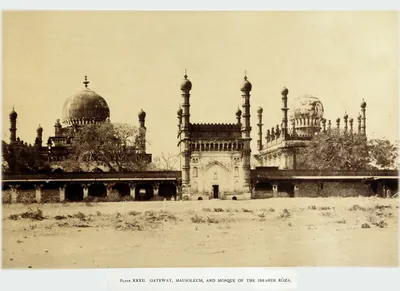 "Gateway, Mausoleum, and Mosque of the Ibrahim Roza" at Bijapur (Taylor and Fergusson, Architecture at Beejapoor, 1866, pl. XXXII)Historic photograph · 1866
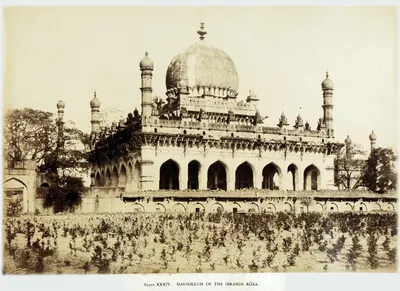 "Mausoleum of the Ibrahim Roza": the tomb of Ibrahim Adil Shah II at Bijapur (Taylor and Fergusson, Architecture at Beejapoor, 1866, pl. XXXIV)Historic photograph · 1866
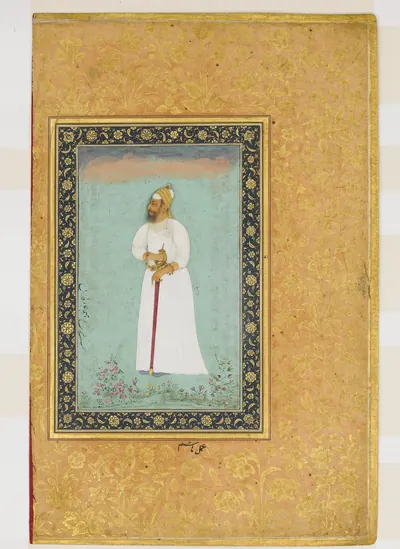 "Portrait of Ibrahim 'Adil Shah II of Bijapur", by Hashim, about 1620, folio from the Shah Jahan Album (Metropolitan Museum of Art)Other · c. 1620
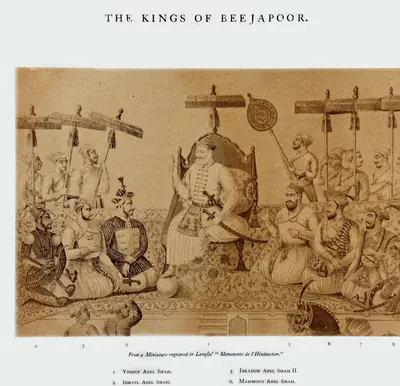 "The Kings of Beejapoor": the eight Adil Shahi kings from Yusuf to Sikandar, from a miniature engraved in Langlès' Monuments de l'Hindoustan (Taylor and Fergusson, Architecture at Beejapoor, 1866, frontispiece)Book plate · 1866
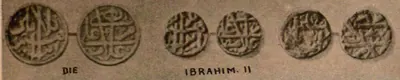 Copper coins of Ibrahim Adil Shah II with the reconstructed die (Cousens 1916, pl. CXV, row 2)Coin · 1916
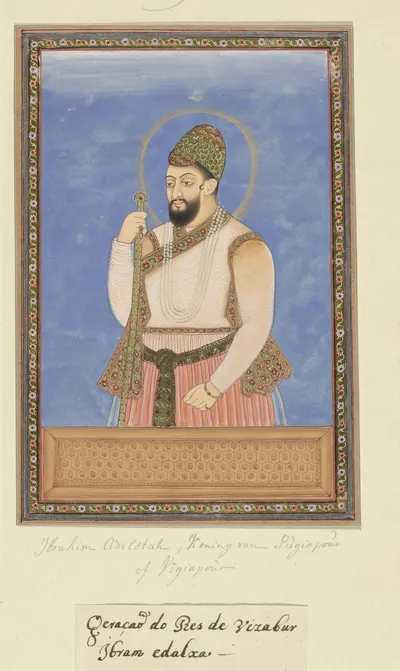 Ibrahim Adil Shah (II): Deccani portrait, about 1686, from the Witsen album in the Rijksmuseum (RP-T-00-3186-39); Dutch title: "Portrait of Ibrahim Adil Shah, who was the first ruler of Bijapur" (the next leaf names his son Sultan Mahmud, that is Muhammad, so this is Ibrahim II)Other · c. 1686
Related
Dynasties
References
Notes (0)
Sources (5)
Spotted an error on this page? Tell us
Last updated: