Sikandar Adil Shah
Ninth and last Adil Shahi sultan of Bijapur (r. 1672–1686). He came to the throne as a small boy and reigned under regents: Khawas Khan, Bahlol Khan, and the Abyssinian Siddi Masud, jagirdar (land-grant holder) of Adoni. In his reign Shivaji marched through the Kurnool country to take Bijapur's Karnatak forts (1677), and the Raichur doab was ceded to the Marathas. Aurangzeb took Bijapur on 12 September 1686. Sikandar died a prisoner in 1700.
Sikandar was the son of Ali Adil Shah II, and he came to the throne on his father’s death in November 1672.12 Jadunath Sarkar calls him “a boy of four”.2 Cousens and the Bombay gazetteer say he was five.13 Sarkar wrote that he was “destined to reign as the captive of his ministers and to die as the captive of the Mughals”.2 See the Adil Shahis of Bijapur.
The regents
Sarkar traces the regency through three hands:2
- Khawas Khan, leader of the Deccani party, “held supreme power for three years”2
- on 11 November 1675 Abdul Karim Bahlol Khan, head of the Afghan faction, imprisoned him and governed “amidst constant fights with the Deccani party and a war with the Mughals”2
- on Bahlol’s death on 23 December 1677, “Siddi Masaud, the leader of the Abyssinians, succeeded to the wazir-ship and the control of the puppet king (21st Feb. 1678)”2
Grant Duff dates Abdul Karim’s death to January 1678.4 Masud was the jagirdar (land-grant holder) of Adoni, and he was chosen largely for his wealth, on his promise to pay the arrears of the army.4 See Siddi Masud.
Shivaji in the Kurnool country
In 1677 Shivaji, in alliance with Golconda, marched into the Karnatak. Sarkar says that he left Hyderabad early in March 1677 “and marched due south towards the Krishna”.56 “This river was crossed at the Nivritti Sangam where the Bhavanashi flows into it, 24 miles north-east of Karnul”.56 He went on pilgrimage to Srisailam and then, “entering the Karnatak plains in April 1677, hastened southwards”.56
The Kurnool district manual dates his visit to 1674.7 It says that “after exacting three lakhs of rupees from Ananda Row, Désamukhi of Kurnool, he despatched his army to Handé Anantapur”.7 He then “proceeded himself to the holy shrine at Srisailam”.7
The Bombay gazetteer dates the expedition to 1676.8 It says that he “besieged and took the forts of Ginji and Vellor which were held by Bijapur troops”.8 He made an alliance with Golconda “for the conquest and division of all the southern territory of the Bijapur kingdom”.8
The Bellary gazetteer says that in 1677 he “took most of the possessions held by Bijapur in the Carnatic”.9 He took the fort of Bellary the next year.9 The gazetteer adds that “in 1680 this tract was formally ceded to him by the Sultan of Bijapur”.9 See Srisailam and Kurnool.
The princess and the Raichur doab
In 1677 Masud made peace with the Mughal general Dilir Khan.10 Under it, Sikandar’s sister “Shahar Banu Begam (popularly called Padishah Bibi) was to be sent to the Mughal Court to marry a son of the Emperor”.10 Sarkar says that she left Bijapur on 1 July 1679, and she was married to Prince Azam on 26 July 1681.11
Dilir Khan besieged Bijapur later in 1679, and Masud bought Shivaji’s help with the promise of the Raichur doab.12 After the siege was raised, “the Raichur Doab was ceded to him”.12 The cession was so unpopular that Masud was forced to retire to Adoni.12
The fall of Bijapur
Aurangzeb’s armies besieged Bijapur from 1685, and the emperor took command himself in 1686. Sarkar writes that the garrison had shrunk to two thousand men.1314 Sikandar and his officers “decided on capitulation, as the only means of preventing useless bloodshed”.1314 “Sunday, 12th September, 1686, saw the downfall of the Bijapur monarchy”.1314 On that day Sikandar left the citadel at one in the afternoon for Aurangzeb’s camp.1314
The emperor received him kindly and enrolled him among the Mughal nobles with the title of Khan and a pension of a lakh of rupees a year.15 He also took the Bijapur officers into imperial service.15 The Bombay gazetteer gives the date of the capitulation as about 15 October 1686.16 See Aurangzeb and the Mughals in the Telugu country.
Sikandar asked in vain for the trans-Krishna district of his old kingdom as a fief.17 He was kept in the state prison of Daulatabad with Abul Hasan, the deposed king of Golconda, and later in the emperor’s camp.17 Sarkar says that he died at the foot of Satara fort on 3 April 1700, “not yet completed 32 years of age”.17
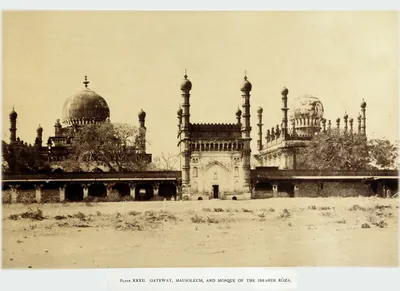
Cousens notes a report that he was poisoned in AH 1111 (1699; AH is the Islamic way of counting years).1 His simple grave is near the Dakhani Idgah at Bijapur.1 See Abul Hasan Tana Shah.
Footnotes
-
Henry Cousens, Bijapur and its Architectural Remains (Archaeological Survey of India, Imperial Series, Vol. XXXVII, 1916), p. 17 (archive.org (opens in a new tab)). ↩ ↩2 ↩3 ↩4
-
Jadunath Sarkar, History of Aurangzib, Vol. IV (2nd ed., 1930), p. 157 (archive.org (opens in a new tab)). ↩ ↩2 ↩3 ↩4 ↩5 ↩6 ↩7
-
James M. Campbell (ed.), Gazetteer of the Bombay Presidency, Vol. XXIII: Bijapur (1884), p. 431 (archive.org (opens in a new tab)). ↩
-
James Grant Duff, A History of the Mahrattas, Vol. I (1826), p. 282 and notes (archive.org (opens in a new tab)). ↩ ↩2
-
Jadunath Sarkar, Shivaji and his Times (2nd ed., 1920), p. 337 (archive.org (opens in a new tab)). ↩ ↩2 ↩3
-
Sarkar, Shivaji and his Times (1920), p. 339 (archive.org (opens in a new tab)). ↩ ↩2 ↩3
-
Narahari Gopalakristnamah Chetty, A Manual of the Kurnool District (1886), p. 29 (archive.org (opens in a new tab)). ↩ ↩2 ↩3
-
Bombay Gazetteer, Vol. XXIII: Bijapur (1884), p. 432 (archive.org (opens in a new tab)). ↩ ↩2 ↩3
-
W. Francis, Madras District Gazetteers: Bellary (1904), p. 44 (archive.org (opens in a new tab)). ↩ ↩2 ↩3
-
Sarkar, Aurangzib IV (1930), p. 173 (archive.org (opens in a new tab)). ↩ ↩2
-
Sarkar, Aurangzib IV (1930), p. 181 (archive.org (opens in a new tab)). ↩
-
Bombay Gazetteer, Vol. XXIII: Bijapur (1884), p. 433 (archive.org (opens in a new tab)). ↩ ↩2 ↩3
-
Sarkar, Aurangzib IV (1930), p. 388 (archive.org (opens in a new tab)). ↩ ↩2 ↩3 ↩4
-
Sarkar, Aurangzib IV (1930), p. 389 (archive.org (opens in a new tab)). ↩ ↩2 ↩3 ↩4
-
Sarkar, Aurangzib IV (1930), p. 390 (archive.org (opens in a new tab)). ↩ ↩2
-
Bombay Gazetteer, Vol. XXIII: Bijapur (1884), p. 435 (archive.org (opens in a new tab)). ↩
-
Sarkar, Aurangzib IV (1930), p. 393 (archive.org (opens in a new tab)). ↩ ↩2 ↩3
Photos
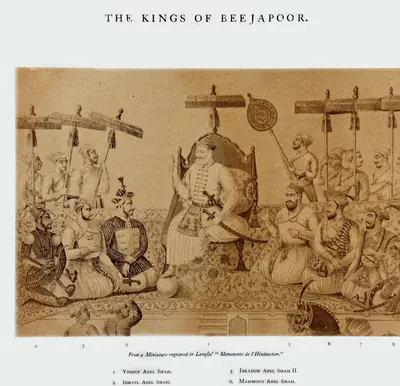 "The Kings of Beejapoor": the eight Adil Shahi kings from Yusuf to Sikandar, from a miniature engraved in Langlès' Monuments de l'Hindoustan (Taylor and Fergusson, Architecture at Beejapoor, 1866, frontispiece)Book plate · 1866
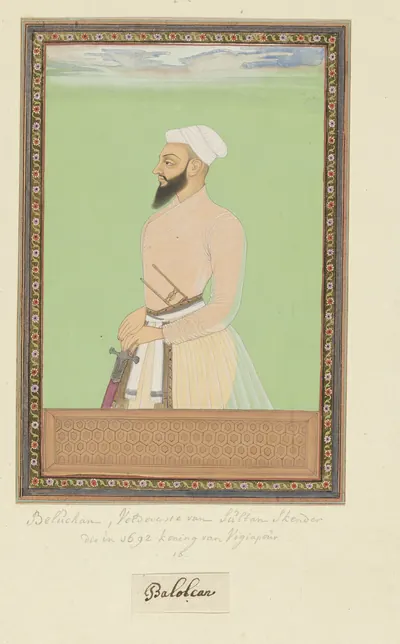 Bahlul Khan, commander-in-chief of Sultan Sikandar of Bijapur: Deccani portrait, about 1686, Witsen album, Rijksmuseum (RP-T-00-3186-44)Other · c. 1686
 Copper coins of Sikandar Adil Shah with the reconstructed die (Cousens 1916, pl. CXV, row 9)Coin · 1916
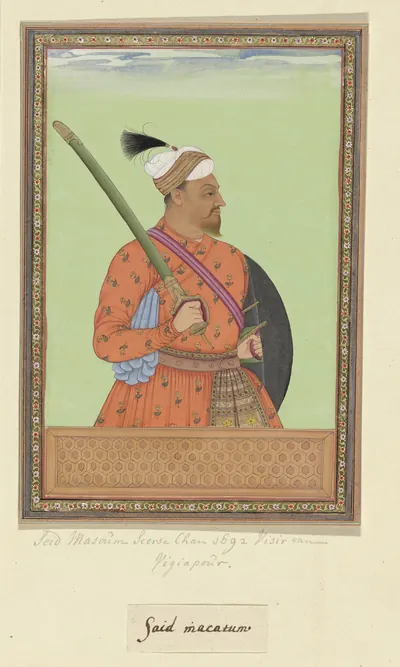 Sayyid Makhdum Sharza Khan, "who was vizier of Bijapur": Deccani portrait, about 1686, Witsen album, Rijksmuseum (RP-T-00-3186-45)Other · c. 1686
Related
Dynasties
References
Notes (0)
Sources (8)
Spotted an error on this page? Tell us
Last updated: