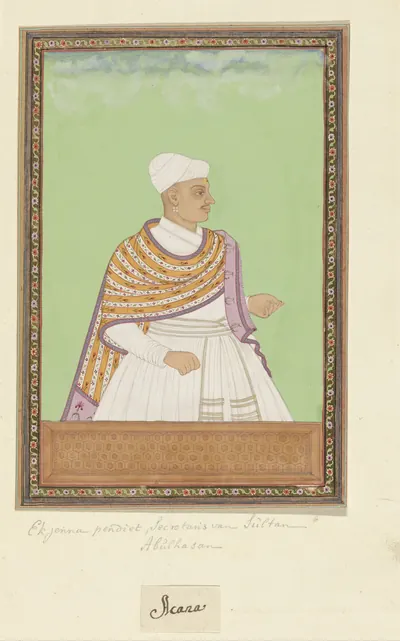
Akkanna
Telugu Brahmin, brother of the minister Madanna, who commanded the army of Abul Hasan Qutb Shah of Golconda in the 1670s and 1680s. With his brother he received Shivaji at Hyderabad in 1677. The Mughal peace terms of 1685 demanded his dismissal with his brother's, and the two were murdered together at Golconda in March 1686.
Akkanna was the brother of Madanna, the Brahmin chief minister of Abul Hasan Tana Shah, the last Qutb Shahi king of Golconda. When Madanna became wazir (chief minister) about 1673, Jadunath Sarkar writes, “his brother Akkanna became commander-in-chief”.1 Most of what is recorded about him is recorded together with his brother.
Career
The Dutch writer Havart, as quoted by Sarkar, said that the two brothers were born of a poor family.2 They began as money-changers in the service of a Golconda nobleman in 1666.2 Havart described Madanna as intelligent, but Akkanna as “a man of cunning and roguery with very little of understanding”.2
Bilgrami says the brothers were “Brahmins of the Carnatic”.3 With Madanna, Akkanna was among the courtiers who supported Abul Hasan’s accession in 1672.4
The Maratha king Shivaji came to Hyderabad in February 1677 to make an alliance with Golconda.5 The chronicler Sabhasad says that the king had at first been afraid to receive him.5 He was reassured by the Maratha envoy’s oaths given to him “and Akannapant, and Madannapant his ministers”.5
Shivaji asked the king not to come out to meet him.6 Then, Sabhasad says, “Madannapant and Akannapant,…the real masters of the whole State, came forward and led the king into the city”.6
The next day Madanna entertained Shivaji at his house.78 Sabhasad says that “the king, Madannapant and Akannapant dined together”.7 Jadunath Sarkar, from the same and other Maratha sources, says that “Madanna and Akanna sat with due respect and attention before Shivaji as he fed”.8 See Shivaji and the Marathas in the Telugu country.
Sarkar found a Madras record of 17 May 1682.9 It shows that Muhammad Ibrahim had shortly before been removed from the supreme command of the Golconda army (sar-i-lashkar), and Akkanna appointed in his place.9
The Kistna district manual of 1883 says that the two ministers set up their office at Vijayawada (then Bezwada).1011 It says the English at Fort St. George told their agent at Golconda to present “substantial gifts” to the two brothers.1011 These gifts were “to preserve their favour to the Honourable Company”.1011 Haig, in 1907, called him “Yenkanna”.12 See Vijayawada.
Death
In the eyes of Aurangzeb, Sarkar wrote, the Golconda king’s worst offence was that “he had made the Brahmans Madanna and Akkanna, his chief ministers”.13 He had “thus allowed Hindu influence to predominate in his administration”.13
Prince Shah Alam offered terms in 1685.14 In Khafi Khan’s words, they required that “Mâdanâ and Akanâ, the two brothers, and the chief causes of the war” be imprisoned and deprived of all authority.14
Early in March 1686 Madanna was murdered in the streets of Golconda as he left the king’s presence.1516 In Sarkar’s words, “Akkanna, who was with him, shared his brother’s fate on the spot”.1516 Havart’s version says the brothers were dragged through the streets.9 It says Akkanna’s head was trampled under the feet of an elephant, while Madanna’s was sent to Aurangzeb.9 For the disagreements over who ordered the murder, see Madanna.
Footnotes
-
Jadunath Sarkar, History of Aurangzib, Vol. IV (2nd ed., 1930), p. 399 (archive.org (opens in a new tab)). ↩
-
Sarkar, History of Aurangzib, Vol. IV (1930), p. 420, appendix (archive.org (opens in a new tab)). ↩ ↩2 ↩3
-
Syed Ali Asgar Bilgrami, Landmarks of the Deccan (1927), p. 109 note (archive.org (opens in a new tab)). ↩
-
Bilgrami, Landmarks of the Deccan (1927), p. 202 (archive.org (opens in a new tab)). ↩
-
R. P. Patwardhan and H. G. Rawlinson (eds.), Source Book of Maratha History (1928), pp. 164–165, translating Sabhasad (archive.org (opens in a new tab)). ↩ ↩2 ↩3
-
Patwardhan and Rawlinson, Source Book of Maratha History (1928), p. 165, translating Sabhasad (archive.org (opens in a new tab)). ↩ ↩2
-
Patwardhan and Rawlinson, Source Book of Maratha History (1928), p. 166, translating Sabhasad (archive.org (opens in a new tab)). ↩ ↩2
-
Jadunath Sarkar, Shivaji and his Times (2nd ed., 1920), p. 335 (archive.org (opens in a new tab)). ↩ ↩2
-
Sarkar, History of Aurangzib, Vol. IV (1930), p. 421 (archive.org (opens in a new tab)). ↩ ↩2 ↩3 ↩4
-
Gordon Mackenzie, A Manual of the Kistna District (1883), p. 36 (archive.org (opens in a new tab)). ↩ ↩2 ↩3
-
Mackenzie, Kistna District (1883), p. 38 (archive.org (opens in a new tab)). ↩ ↩2 ↩3
-
T. W. Haig, Historic Landmarks of the Deccan (1907), p. 188 (archive.org (opens in a new tab)). ↩
-
Sarkar, History of Aurangzib, Vol. IV (1930), pp. 406–407 (archive.org (opens in a new tab)). ↩ ↩2
-
Khafi Khan, Muntakhab-ul-Lubab, in H. M. Elliot and John Dowson (eds.), The History of India as Told by Its Own Historians, Vol. VII (1877), p. 321 (archive.org (opens in a new tab)). ↩ ↩2
-
Sarkar, History of Aurangzib, Vol. IV (1930), p. 417 (archive.org (opens in a new tab)). ↩ ↩2
-
Sarkar, History of Aurangzib, Vol. IV (1930), p. 418 (archive.org (opens in a new tab)). ↩ ↩2
Photos
References
Notes (0)
Sources (7)
Spotted an error on this page? Tell us
Last updated: