Shivaji
Founder of the Maratha kingdom (died 1680), crowned at Raigarh in 1674. In the Telugu country he is remembered for his Karnatak expedition of 1677. He made an alliance with Abul Hasan Qutb Shah of Golconda, and the king and his ministers Madanna and Akkanna received him at Hyderabad with great ceremony. He made a pilgrimage to Srisailam, crossed the Krishna near Kurnool and sent his army south through the Cuddapah country to Jinji. On the way home he took the fort of Bellary. In 1680 Bijapur gave him its rights over the Bellary and Anantapur country.
Shivaji founded the Maratha kingdom in the western Deccan in the middle of the seventeenth century.12 His long wars with Bijapur and the Mughals belong to the history of Maharashtra, so this page tells mainly of his Karnatak expedition of 1677, which touched the Telugu country, with a short outline of the rest. See the Marathas in the Telugu country.
Family and early life
Shivaji was the second son of Shahji Bhonsle and Jija Bai, a daughter of Lukhji Jadav of Sindkhed.1 He was born in the hill-fort of Shivner above Junnar.1 Sarkar says that there is no record from the time of the date of his birth or of his boyhood.1 Even Sabhasad, writing in 1694, “is silent on these points”.1
Sarkar adds that when Shivaji died in April 1680, “he had not yet completed 53 years of age”.3 The Jedhe chronology is a later Marathi record, translated in the Source Book of Maratha History.4 It gives his birth at Shivneri as Friday, 19 February 1630.4
His father served Bijapur in the Karnatak.5 Meanwhile Shivaji grew up with his mother on the family’s lands near Poona; see Shahji Bhonsle.5
The kingdom
Grant Duff says that Shivaji “had long struck coins, and styled himself Raja and Maha Raja” before he was formally crowned.2 He was crowned at Raigarh on 6 June 1674, and a Benares scholar, Gaga Bhatt, conducted the rites.2
The Source Book of Maratha History (1928) translates Sabhasad’s account of the coronation.6 It says that “the appellation of Chhatrapati was then assumed by him”.6 A new era was counted from that day.6
The alliance with Golconda
Sarkar writes that by 1676 the Golconda minister Madanna “had already made a subsidiary alliance with Shiva, promising him an annual tribute of one lakh of hun for the defence of the realm”.7 A Maratha envoy, Prahlad Niraji, lived at Hyderabad.7
Sabhasad says that Shivaji planned to conquer the Karnatak between the Tungabhadra and the Kaveri.89 He would not draw on his own treasury.89 He judged that Golconda, already paying him tribute, should be won by friendship.89
Prahlad passed on his wish for a meeting.89 “Padshah Tanashah” was afraid of the man who had “treacherously killed Afzalkhan”.89 Then Prahlad, Madanna and Akkanna calmed his fears.89 See Abul Hasan Tana Shah and the Qutb Shahis.
At Hyderabad, February–March 1677
Shivaji left Raigarh early in January 1677 and reached Hyderabad early in February.10 On the way he kept his army from plundering the Golconda country by hanging or maiming the first offenders.10
Sabhasad says that the king offered to come out to meet him, but Shivaji asked him not to.9 He said this was “for the Padshah was to him like an elder brother and himself was like a younger brother to the Padshah”.9 Instead Madanna and Akkanna, “the real masters of the whole State, came forward and led the king into the city”.9
The streets were sprinkled with saffron water and hung with garlands and flags.911 Women waved lamps before him.911 On his way to the Dad Mahal, Shivaji scattered money to the crowds.911
Sarkar describes the meeting there.12 The Sultan “embraced Shivaji, and seated him by his side on the royal carpet”.12 “The wazir Madanna was also permitted to sit down; all others kept standing”.12 The two kings talked for three hours.12
The next day Madanna gave a dinner.13 Sarkar says it was cooked by “the prime-minister’s venerable mother”.13 Madanna and Akkanna “sat with due respect and attention before Shivaji as he fed”.13 See Hyderabad.
Sarkar works out the agreement that followed.1314 It gave Shivaji a payment of 3,000 hun (gold coins) a day.1314 It also gave him a Golconda force of 5,000 men under Mirza Muhammad Amin, with artillery.1314 Shivaji promised the king a share of such conquests “as had not belonged to his father Shahji”.1314 The defensive alliance against the Mughals was renewed with oaths.1314
Sabhasad records the king’s parting words: “I expect you to help me on every occasion”.15 The king added: “The tribute payable every year will be regularly paid.”15 Later that year Shivaji wrote to his half-brother Vyankoji: “I came to Bhaganagar to see the Kutubshah on some diplomatic business; thence I went into the Karnatak and came to Chandi.”16
Srisailam and the road south
Early in March Shivaji marched south.1718 In Sarkar’s words, he crossed the Krishna “at the Nivritti Sangam where the Bhavanashi flows into it, 24 miles north-east of Karnul”.1718 He left his army at “Anantpur” and rode with a small escort to Srisailam.1718
Sabhasad says he bathed in the Nilaganga and “compared it to Kailas”.19 He “thought of offering himself—his head—in sacrifice at the shrine”.19 Then the goddess Bhavani, speaking through him, told him that she had “many things still to accomplish through you”.19
Sarkar says he spent some ten days there.1820 He built a bathing ghat called Shri-Gangesha, a monastery and a rest-house, and he fed a lakh of Brahmins.1820 Sarkar noted a grant of gifts for worship at the temple dated April 1677.1820 He thought it “may be a forged grant”, since the date is impossible.1820
The Kurnool manual gives a local account.2122 It says that he took three lakhs of rupees from Ananda Rao, the deshmukh (district revenue officer) of Kurnool.2122 He sent his army to “Handé Anantapur” and joined it there.2122 The manual dates the visit to 1674, three years earlier than Sarkar and the Jedhe chronology.2122
Grant Duff says the army went south “by the route of Kuddapah”.232425 It came down to the plains by the Damalcheruvu pass.232425 The English at Madras heard in May that the Maratha front had “already passed Tripati and Kalhastri”.232425
Gribble’s Cuddapah manual says Shivaji took the forts of the poligars (local chiefs) of the Kadapa (then Cuddapah) and Bellary country.2627 He put “a Mahratta Brahmin, a dependant of his own” in each.2627 See Kurnool, Tirupati and Srikalahasti.
Bellary and the end of the alliance
Shivaji took Jinji and the country round Vellore.28 In 1677–78 he came back through the Mysore plateau, “and then returned home through the Bellary and Dharwar districts”.28
Grant Duff says that near Bellary his foragers were killed by the garrison of the fort.29 The fort was held by the widow of a desai (local chief).29 He took it after a siege of twenty-seven days.29 The Bellary gazetteer adds that the fort was given back to her when she agreed to pay tribute.3031
The Golconda king had paid for the campaign and received no fort from it.32 He broke with Shivaji in 1678.32 Sarkar wrote that “the diplomatic system so patiently built up by Madanna Pandit fell to the ground”.32
In 1680 Shivaji helped Bijapur against the Mughals.333435 Bijapur then gave him “the tract around Kopaul and Bellary”.333435 The Anantapur gazetteer says it also gave him its rights over that country, so that “the poligars paid their tribute to him”.333435
Death and heirs
Shivaji died at noon on Sunday, 5 April 1680.3 Sambhaji was the eldest of Shivaji’s sons and followed him on the throne.3637 But Sarkar describes the last years of the reign as clouded by the prince’s flight to the Mughals in 1678.3637
His younger son Rajaram was born of Soyra Bai.383 Rumour accused her of poisoning Shivaji to keep the throne from Sambhaji, but Sarkar treats the charge with caution.383 Grant Duff calls Shahu “the son of Sumbhajee”.39 Sarkar notes that the alliance with Golconda went on under Sambhaji.40 Aurangzeb counted it among his charges against the Golconda king.40
Footnotes
-
Jadunath Sarkar, Shivaji and his Times (2nd ed., 1920), p. 19 (archive.org (opens in a new tab)). ↩ ↩2 ↩3 ↩4 ↩5
-
James Grant Duff, A History of the Mahrattas, Vol. I (1826), p. 263 (archive.org (opens in a new tab)). ↩ ↩2 ↩3
-
Sarkar, Shivaji and his Times (1920), p. 383 (archive.org (opens in a new tab)). ↩ ↩2 ↩3 ↩4
-
R. P. Patwardhan and H. G. Rawlinson (eds.), Source Book of Maratha History (1928), p. 33, translating the Jedhe chronology (archive.org (opens in a new tab)). ↩ ↩2
-
Sarkar, Shivaji and his Times (1920), pp. 21–22 (archive.org (opens in a new tab)). ↩ ↩2
-
Patwardhan and Rawlinson, Source Book of Maratha History (1928), p. 163, translating Sabhasad (archive.org (opens in a new tab)). ↩ ↩2 ↩3
-
Sarkar, Shivaji and his Times (1920), p. 329 (archive.org (opens in a new tab)). ↩ ↩2
-
Patwardhan and Rawlinson, Source Book of Maratha History (1928), p. 164, translating Sabhasad (archive.org (opens in a new tab)). ↩ ↩2 ↩3 ↩4 ↩5 ↩6
-
Patwardhan and Rawlinson, Source Book of Maratha History (1928), p. 165, translating Sabhasad (archive.org (opens in a new tab)). ↩ ↩2 ↩3 ↩4 ↩5 ↩6 ↩7 ↩8 ↩9 ↩10 ↩11 ↩12
-
Sarkar, Shivaji and his Times (1920), p. 330 (archive.org (opens in a new tab)). ↩ ↩2
-
Sarkar, Shivaji and his Times (1920), pp. 331–333 (archive.org (opens in a new tab)). ↩ ↩2 ↩3
-
Sarkar, Shivaji and his Times (1920), p. 334 (archive.org (opens in a new tab)). ↩ ↩2 ↩3 ↩4
-
Sarkar, Shivaji and his Times (1920), p. 335 (archive.org (opens in a new tab)). ↩ ↩2 ↩3 ↩4 ↩5 ↩6 ↩7 ↩8
-
Sarkar, Shivaji and his Times (1920), p. 336 (archive.org (opens in a new tab)). ↩ ↩2 ↩3 ↩4 ↩5
-
Patwardhan and Rawlinson, Source Book of Maratha History (1928), pp. 166–167, translating Sabhasad (archive.org (opens in a new tab)). ↩ ↩2
-
Patwardhan and Rawlinson, Source Book of Maratha History (1928), p. 170, Shivaji’s letter to Vyankoji (archive.org (opens in a new tab)). ↩
-
Sarkar, Shivaji and his Times (1920), p. 337 (archive.org (opens in a new tab)). ↩ ↩2 ↩3
-
Sarkar, Shivaji and his Times (1920), p. 338 and note (archive.org (opens in a new tab)). ↩ ↩2 ↩3 ↩4 ↩5 ↩6 ↩7
-
Patwardhan and Rawlinson, Source Book of Maratha History (1928), p. 167, translating Sabhasad (archive.org (opens in a new tab)). ↩ ↩2 ↩3
-
Sarkar, Shivaji and his Times (1920), p. 339 (archive.org (opens in a new tab)). ↩ ↩2 ↩3 ↩4
-
Narahari Gopalakristnamah Chetty, A Manual of the Kurnool District (1886), p. 29 (archive.org (opens in a new tab)). ↩ ↩2 ↩3 ↩4
-
R. P. Patwardhan and H. G. Rawlinson (eds.), Source Book of Maratha History (1928), p. 48, translating the Jedhe chronology (archive.org (opens in a new tab)). ↩ ↩2 ↩3 ↩4
-
Grant Duff, History of the Mahrattas, Vol. I (1826), p. 278 (archive.org (opens in a new tab)). ↩ ↩2 ↩3
-
Grant Duff, History of the Mahrattas, Vol. I (1826), p. 279 (archive.org (opens in a new tab)). ↩ ↩2 ↩3
-
Sarkar, Shivaji and his Times (1920), p. 341 note (archive.org (opens in a new tab)). ↩ ↩2 ↩3
-
J. D. B. Gribble, A Manual of the District of Cuddapah (1875), p. 92 (archive.org (opens in a new tab)). ↩ ↩2
-
Gribble, Cuddapah (1875), p. 93 (archive.org (opens in a new tab)). ↩ ↩2
-
Sarkar, Shivaji and his Times (1920), p. 348 (archive.org (opens in a new tab)). ↩ ↩2
-
Grant Duff, History of the Mahrattas, Vol. I (1826), p. 284 (archive.org (opens in a new tab)). ↩ ↩2 ↩3
-
Francis, Bellary (1904), p. 216 (archive.org (opens in a new tab)). ↩
-
Francis, Bellary (1904), p. 217 (archive.org (opens in a new tab)). ↩
-
Sarkar, Shivaji and his Times (1920), p. 360 (archive.org (opens in a new tab)). ↩ ↩2 ↩3
-
Grant Duff, History of the Mahrattas, Vol. I (1826), p. 293 (archive.org (opens in a new tab)). ↩ ↩2 ↩3
-
W. Francis, Madras District Gazetteers: Anantapur (1905), p. 22 (archive.org (opens in a new tab)). ↩ ↩2 ↩3
-
W. Francis, Madras District Gazetteers: Bellary (1904), p. 44 (archive.org (opens in a new tab)). ↩ ↩2 ↩3
-
Sarkar, Shivaji and his Times (1920), p. 362 (archive.org (opens in a new tab)). ↩ ↩2
-
Sarkar, Shivaji and his Times (1920), p. 380 (archive.org (opens in a new tab)). ↩ ↩2
-
Sarkar, Shivaji and his Times (1920), p. 382 (archive.org (opens in a new tab)). ↩ ↩2
-
Grant Duff, History of the Mahrattas, Vol. I (1826), p. 404 (archive.org (opens in a new tab)). ↩
-
Jadunath Sarkar, History of Aurangzib, Vol. IV (2nd ed., 1930), pp. 400–401 (archive.org (opens in a new tab)). ↩ ↩2
Photos
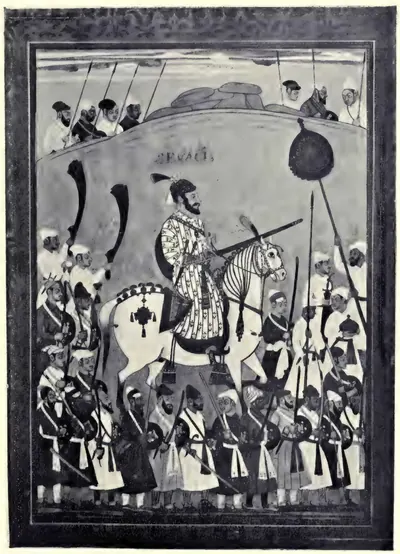 "Rājah Shivā Jī, Mahrattah": painting from Manucci's album of portraits, made for him by Mir Muhammad (Manucci, Storia do Mogor, tr. Irvine, Vol. III, 1907, pl. XXXV)Book plate · 1907
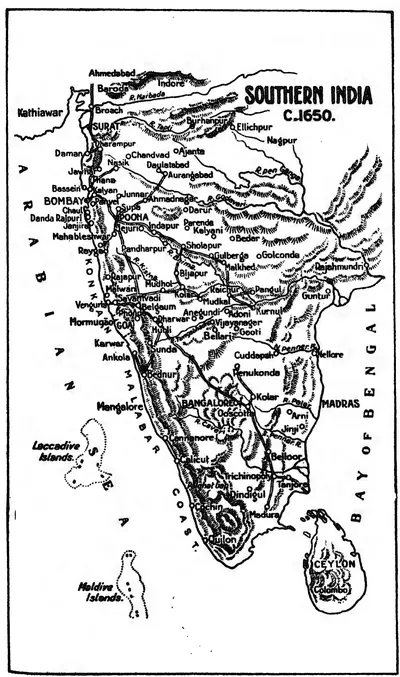 "Southern India c. 1650": map in the Source Book of Maratha History (1928), facing p. 176Map · 1928
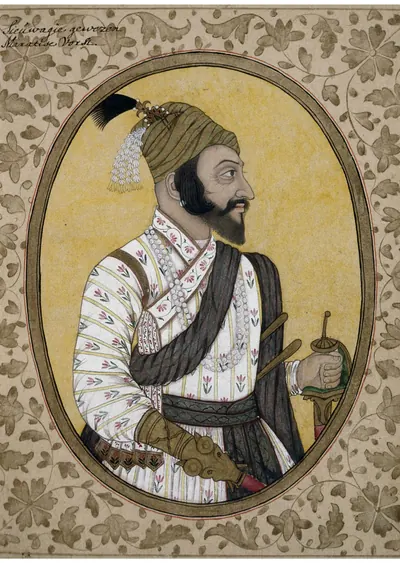 Shivaji: Deccani portrait, 1680–1687, British Museum 1974,0617,0.11.12, recorded by the museum as made in the Deccan and acquired at GolcondaOther · 1680–1687
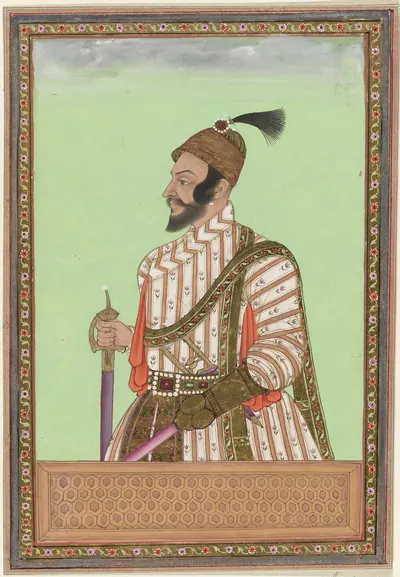 Shivaji: Deccani portrait, c. 1675–85, folio 46 of the Witsen album, Rijksmuseum (RP-T-00-3186-46); the Dutch inscription names him "Siwagii, Vorst in Decam" and links his son Sambhaji with Abul Hasan, king of GolcondaOther · c. 1675–85
Related
Dynasties
References
Notes (0)
Sources (8)
Spotted an error on this page? Tell us
Last updated: