Jamshid Quli Qutb Shah
Second Qutb Shahi sultan of Golconda (1543–1550), the third son of Sultan Quli. The Golconda chronicle says he had his father killed at prayer and blinded the heir, his brother Qutb-ud-din. His reign was spent in wars with Bidar and Bijapur, and his younger brother Ibrahim fled to Vijayanagara. He died of a long illness in 1550.
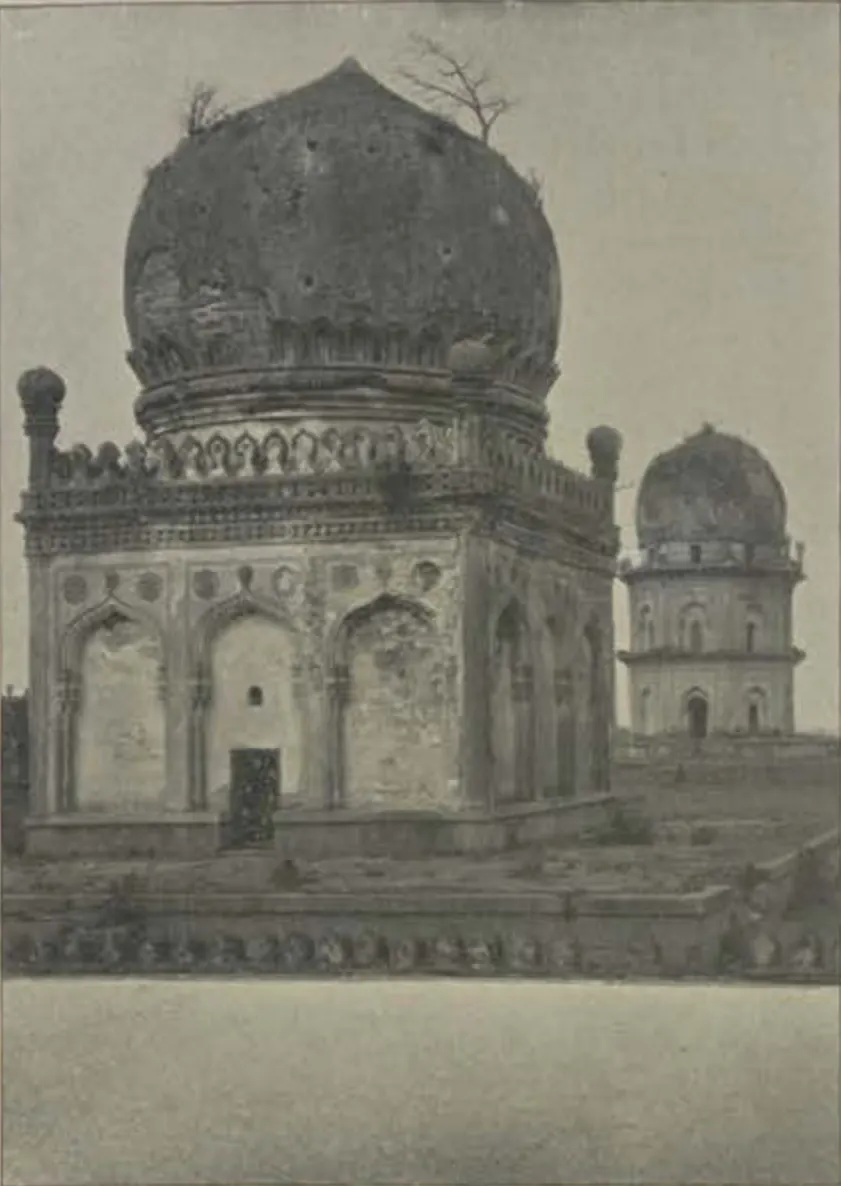
Jamshid was the second king of the Qutb Shahi dynasty of Golconda. The Golconda chronicle translated by John Briggs names him Yar Quli Jamshid Khan.1 It makes him the third of the six sons of Sultan Quli.1
He reigned for about seven years, from 1543 to 1550.12 His reign began with the murder of his father and the blinding of his elder brother.12 Both the chronicle and the historian Ferishta remember him as a cruel king.12
The murder of Sultan Quli
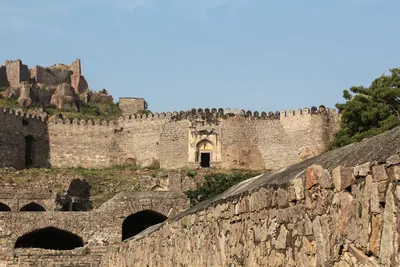
According to the chronicle, Sultan Quli had chosen his second son, Qutb-ud-din, as his heir. Jamshid was found to be planning his brother’s murder.1 So the king had him shut up in a dungeon in the fort of Golconda.1 From his prison Jamshid persuaded the commandant of the fort, Mir Mahmud Hamadani, to kill his father.1
The commandant struck the old king down with a sabre on 2 Jumada II AH 950 (September 1543; AH is the Islamic way of counting years), while he knelt at prayer in the principal mosque.34 He then released Jamshid and had Qutb-ud-din blinded, and Jamshid was crowned.34
Ferishta tells the story differently.5 In his account Jamshid, “who had long been wishing for his father’s death”, persuaded one of his slaves to stab the king while he was examining jewels.5 Jamshid then killed the slave so that his own part should not become known.5 Bilgrami, writing in 1927, follows the chronicle’s account of the death in the mosque.6
Wars with Bidar and Bijapur
Jamshid sent orders for the arrest of his younger brother Ibrahim, who held Devarakonda. Ibrahim escaped to Kasim Barid of Bidar.47 Kasim Barid marched on Golconda on his behalf, until Burhan Nizam Shah of Ahmadnagar came to Jamshid’s help.47
The chronicle says Burhan Nizam Shah offered to crown Jamshid with the royal insignia (emblems of kingship).8 But Jamshid refused, “saying, that if he could not maintain his right to the crown in the field he was unworthy of wearing it”.8
The rest of his reign was spent in the wars of the Deccan sultans. The chronicle describes campaigns against Bidar.910 In them a Telugu captain, “Jugdew Row Naigwary”, built a fort on the heights above Kaulas.910 It also describes the capture of the fort of Medak.910 Bilgrami dates the fort at Kaulas and the occupation of Narayankhed and Ahsanabad to AH 951 (1544).11
Briggs noted that the chronicle again and again shows Jamshid deserting his allies once he had gained his own ends.1213 Ferishta makes this charge against all the Qutb Shahi kings.1213
The wound in the face
Ferishta says that Jamshid was retreating from the Bijapuri fort of Etgir when the Bijapur general Asad Khan Lari cut him down.14 Asad Khan’s sabre “struck off the tip of his nose, his cheek, and part of his upper lip”.14 The wound disfigured him for life and made it difficult for him to eat or drink.14
The Golconda chronicle tells the same story of his father, Sultan Quli, wounded at Kovilkonda in a war with Ismail Adil Shah.15 Briggs preferred the chronicle’s version.15 Robert Sewell pointed out the conflict in 1900.16 Bilgrami gives the wound to both father and son.611
Illness and death
Ferishta writes that Jamshid fell ill and lingered for two years.2 As his illness grew, “his disposition became morose, and he put many persons to death on the most trivial occasion”.2 His surviving brothers fled, Ferishta says: Haidar Khan to Bidar, where he died, and Ibrahim to Vijayanagara.2
The chronicle says that after his last war he “gave himself up entirely to the luxuries of the table”.17 It says he died of a severe illness in AH 957 (1550), after a reign of nearly seven years.17 Bilgrami says he died of cancer.11
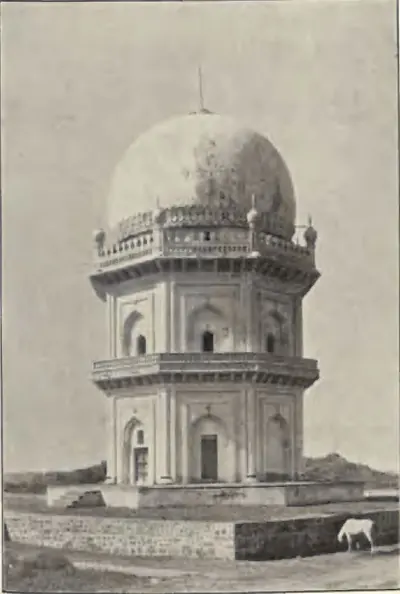
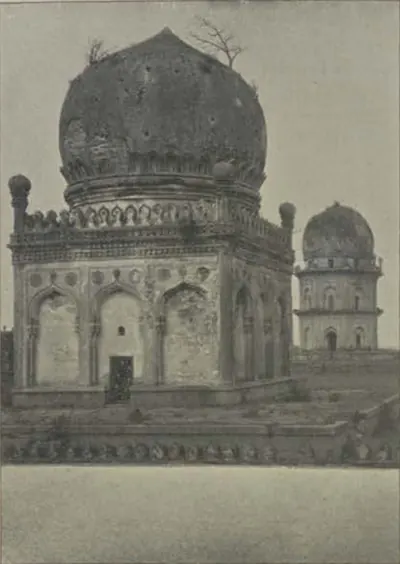
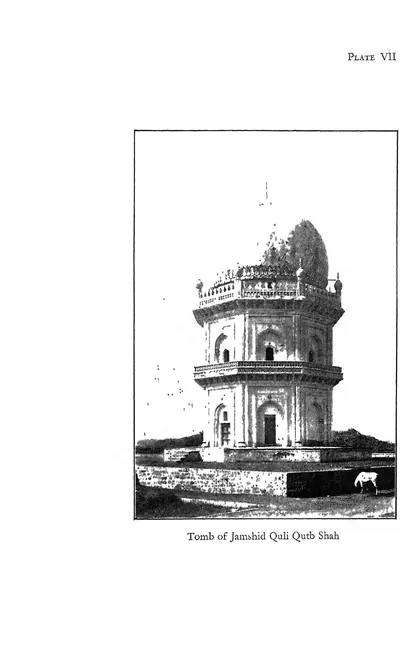
He was buried beside his father.18 Bilgrami identifies his tomb among the Qutb Shahi tombs by its closeness to Sultan Quli’s.18 He also says that Jamshid “was fond of poetry”, and he quotes verses by him.18
Succession
His son Subhan Quli succeeded him as a child, with Saif Khan Ain-ul-Mulk as regent.19 The chronicle gives the boy’s age as seven, Ferishta as two.1920 Within months a party of nobles invited Ibrahim back from Vijayanagara.2122 The Telugu infantry of the forts handed Golconda to him in July 1550.2122 See Ibrahim Qutb Shah.
The Kistna district manual sums up the change.23 It says that the Muslim nobles placed the child on the throne, “but the Hindu Minister Jagadéva Rao, supported by all the Hindu soldiery, declared for Prince Ibrahim”.23
Footnotes
-
Briggs, Rise of the Mahomedan Power, Vol. III (1829), pp. 377–378 (archive.org (opens in a new tab)). ↩ ↩2 ↩3 ↩4 ↩5 ↩6 ↩7 ↩8
-
Ferishta, tr. Briggs, Rise of the Mahomedan Power, Vol. III (1829), p. 327 (archive.org (opens in a new tab)). ↩ ↩2 ↩3 ↩4 ↩5 ↩6
-
Briggs, Rise of the Mahomedan Power, Vol. III (1829), p. 377 (archive.org (opens in a new tab)). ↩ ↩2
-
Briggs, Rise of the Mahomedan Power, Vol. III (1829), p. 379 (archive.org (opens in a new tab)). ↩ ↩2 ↩3 ↩4
-
Ferishta, tr. Briggs, Rise of the Mahomedan Power, Vol. III (1829), pp. 323–324 (archive.org (opens in a new tab)). ↩ ↩2 ↩3
-
Bilgrami, Landmarks of the Deccan (1927), p. 195 (archive.org (opens in a new tab)). ↩ ↩2
-
Briggs, Rise of the Mahomedan Power, Vol. III (1829), p. 380 (archive.org (opens in a new tab)). ↩ ↩2
-
Briggs, Rise of the Mahomedan Power, Vol. III (1829), p. 382 (archive.org (opens in a new tab)). ↩ ↩2
-
Briggs, Rise of the Mahomedan Power, Vol. III (1829), p. 384 (archive.org (opens in a new tab)). ↩ ↩2 ↩3
-
Briggs, Rise of the Mahomedan Power, Vol. III (1829), p. 385 (archive.org (opens in a new tab)). ↩ ↩2 ↩3
-
Bilgrami, Landmarks of the Deccan (1927), p. 196 (archive.org (opens in a new tab)). ↩ ↩2 ↩3
-
Briggs, Rise of the Mahomedan Power, Vol. III (1829), p. 383 and note (archive.org (opens in a new tab)). ↩ ↩2
-
Briggs, Rise of the Mahomedan Power, Vol. III (1829), p. 386 and note (archive.org (opens in a new tab)). ↩ ↩2
-
Ferishta, tr. Briggs, Rise of the Mahomedan Power, Vol. III (1829), pp. 325–326 (archive.org (opens in a new tab)). ↩ ↩2 ↩3
-
Golconda chronicle, in Muhammad Qasim Ferishta, tr. John Briggs, History of the Rise of the Mahomedan Power in India, Vol. III (1829), p. 371 and note (archive.org (opens in a new tab)). ↩ ↩2
-
Robert Sewell, A Forgotten Empire (Vijayanagar) (1900), p. 135 and note (archive.org (opens in a new tab)). ↩
-
Briggs, Rise of the Mahomedan Power, Vol. III (1829), p. 389 (archive.org (opens in a new tab)). ↩ ↩2
-
Syed Ali Asgar Bilgrami, Landmarks of the Deccan (1927), p. 118 (archive.org (opens in a new tab)). ↩ ↩2 ↩3
-
Briggs, Rise of the Mahomedan Power, Vol. III (1829), p. 390 (archive.org (opens in a new tab)). ↩ ↩2
-
Ferishta, tr. Briggs, Rise of the Mahomedan Power, Vol. III (1829), p. 329 (archive.org (opens in a new tab)). ↩
-
Briggs, Rise of the Mahomedan Power, Vol. III (1829), pp. 392–393 (archive.org (opens in a new tab)). ↩ ↩2
-
Briggs, Rise of the Mahomedan Power, Vol. III (1829), p. 394 (archive.org (opens in a new tab)). ↩ ↩2
-
Gordon Mackenzie, A Manual of the Kistna District (1883), p. 29 (archive.org (opens in a new tab)). ↩ ↩2
Photos
Related
Dynasties
References
Notes (0)
Sources (4)
Spotted an error on this page? Tell us
Last updated: