Yajna Sri Satakarni
Late Satavahana king of the later 2nd century CE, the last whose inscriptions and coins are found in both the western Deccan and the Krishna–Godavari country. His Chinna inscription, from the coast south of the Krishna, is dated in his 27th year. His silver coins bear what E. J. Rapson in 1908 called the only known coin-portrait of a Satavahana king.
Gautamiputra Sri Yajna Satakarni, usually called Yajna Sri, was one of the last major kings of the Satavahana dynasty. E. J. Rapson judged from his inscriptions and coins that he ruled the whole of the dynasty’s lands, in both the eastern and the western Deccan.1 In Rapson’s view the kingdom divided after him.1
Vincent Smith likewise called him the last king to hold both the eastern and the western provinces.2 His records come from the Krishna district and from the caves near Bombay and Nasik, so he is an important figure for the Satavahana period in the Telugu country.
Inscriptions and dates
Rapson knew of four inscriptions of his reign:34
- Chinna, a village in the Krishna district: a private gift dated in his 27th year, the latest year recorded for him. See Chinna inscription.
- Nasik: dated in his 7th year. It records that the wife of the general Bhavagopa completed a cave that an ascetic had begun and left unfinished, and gave it to the Buddhist monks. In É. Senart’s translation the king is the lord Sri Yajna Satakarni, son of Gotami.5
- Kanheri, near Bombay: one dated in his 16th year, which gives the monks of the Krishnagiri hill money put out at interest and the income of a field; and a private gift whose date is lost.
James Burgess also counted an inscription of Sri Yajna among the records of the Amaravati stupa (relic mound).6 The inscriptions give only years of reign, so his dates in our calendar are uncertain:
- Rapson (1908): accession about 169 CE, a date that rests only on the reign-lengths in the Matsya Purana, which he thought untrustworthy. He reigned for at least 27 years.3
- Burgess (1887): about 178–200 CE.6
- Smith (1924): twenty-nine years from about 166 CE.7
- Robert Sewell (1932), after Vincent Smith: accession about 184 CE and a reign of 29 years.8
- D. C. Sircar (1939): he ended his rule not long after 200 CE and was the last great king of the dynasty.9
The Chinna inscription
G. Bühler edited the Chinna record in 1892.10 He reported that the stone had been found on the sea-shore south of the Krishna, close to the village of Chinna.10 It had been moved to the Madras Museum, and its six lines are all damaged.10
It is dated in the 27th year of “the king, the lord Siriyana Satakani, the son of the (Queen of the) Gautama (race)”.11 It records something done by a “Mahataraka” whose name is broken.11 This person is described as “a sacrificer”, perhaps for the Buddha.11 Bühler pointed out that the year agrees with the 29 years given to the king by the Vayu and Matsya Puranas.11
In 1959 D. C. Sircar observed that the letters of the Chinna inscription looked no earlier than the Ikshvaku inscriptions of the mid-3rd century.12 He noted that this did not fit well with the usual order of the late kings.12 Sircar also noted that the Chinna record does not call Yajna Sri a Satavahana.1314
Scholars had disagreed over a word in the record, araka.1314 Some thought it linked him to the Aira (Arya) family that Sircar placed in the Krishna–Guntur region.1314 Smith’s table records the reading aryaka in place of the usual title svami.15
Extent of his kingdom
Rapson listed Yajna Sri’s coins from the Krishna and Godavari districts, from the Chanda district of the Central Provinces, and from Sopara on the western coast.1 In 1894 Alexander Rea reported earlier finds at Gudivada in the Krishna district.16 Robert Sewell had picked up lead coins there.16 Alexander Cunningham read three of them as coins of the Andhra kings Gautamiputra Yajna Sri and Sri Chanda.16
Rapson’s catalogue also includes a coin of Yajna Sri that Sewell obtained “from Amaravati”, and others that Walter Elliot collected in the Krishna (then Kistna) district.1718 Vincent Smith provisionally gave him some heavy lead coins from Chittala in the Godavari district.1920 Rapson instead gave them to an unidentified early king whose name ended in -vira.1920
The satrap Rudradaman had held the northern Konkan for a time.21 Rapson noted that the Kanheri inscriptions showed it back in Satavahana hands.21
Sewell’s account differs.8 In his king-list Yajna Sri won back some lost land, but the Chutu-Satakarnis held Poona and Nasik.8 They were a branch of the royal family that paid tribute to the Saka kings.8 On that view his kingdom lay mostly in the Telugu districts and the eastern Deccan.8
In 1939 Sircar described local families of the south-eastern Deccan, among them the Ikshvakus.9 In his account they were still loyal to the Satavahanas under Pulumavi and Yajna Sri, and later pushed aside his weaker successors.9
Coins
The lead coins of the Andhra country fall into two local fabrics (styles of making), which Rapson called A and B.222320 Both changed design during Yajna Sri’s reign.222320 On fabric A a stupa of six arches topped by a crescent replaced the earlier three-arched stupa.222320 On fabric B an elephant appeared beside the horse, and later kings kept it.222320
An elephant also marks the potin (alloy) coins of the Chanda district.24 There Rapson recorded issues of Pulumavi, Yajna Sri and later kings.24 Smith took the many bronze and lead coins of Yajna Sri to have been the money of the eastern provinces.7 He thought that some coins with a ship belonged to this reign, and suggested that the king’s power “was not confined to the land”.7
In the west Yajna Sri issued silver coins modelled on those of the Western Kshatrapas, with the king’s head on one side.2526 Rapson called this “the only known coin-portrait of an Andhra monarch”.2526 He knew three specimens.2526 Bhagvanlal Indraji found one in the stupa at Sopara, the old capital of the northern Konkan.2526 The others came from Amreli in Kathiawar and from Baroda.2526
Rapson warned against concluding from the last two that Yajna Sri ruled further north.2526 He explained the satrap-style coins by the fact that Rudradaman had earlier held the Konkan.2526 The legend on the reverse is in a form of Brahmi found nowhere else.2526 Rapson thought it closest to the script of the Bhattiprolu inscriptions of the Krishna district.2526 He saw in it “a reminiscence of the old home of the race in the Telugu country”.27
Bhagvanlal had read the reverse as naming Yajna Sri’s father “Chaturapana”.282927 Walter Elliot doubted that there was room for the letters, and Rapson rejected the reading.282927
Patron of Nagarjuna?
Chinese and Tibetan accounts say that the Buddhist teacher Nagarjuna had a royal patron of the “Sadvahana” family.30 The patron’s personal name survives only in garbled forms.30 Burgess suggested that this king was probably one of the last of the dynasty, possibly Sri Yajna.30 He presented this as no more than a possibility.30 Working from Tibetan chronology, he placed Nagarjuna’s leadership of the Buddhist community roughly between 137 and 197 CE, if Yajna Sri was the patron.31
Footnotes
-
Rapson, Catalogue of the Coins of the Andhra Dynasty (1908), p. xlii (archive.org (opens in a new tab)). ↩ ↩2 ↩3
-
Smith, Early History of India (1924), p. 226 (archive.org (opens in a new tab)). ↩
-
Rapson, Catalogue of the Coins of the Andhra Dynasty (1908), p. xli (archive.org (opens in a new tab)). ↩ ↩2
-
Rapson, Catalogue of the Coins of the Andhra Dynasty (1908), p. lii (archive.org (opens in a new tab)). ↩
-
É. Senart, “The Inscriptions in the Caves at Nasik”, Epigraphia Indica VIII (1906), p. 94 (archive.org (opens in a new tab)). ↩
-
James Burgess, The Buddhist Stupas of Amaravati and Jaggayyapeta (1887), p. 5 (archive.org (opens in a new tab)). ↩ ↩2
-
Vincent A. Smith, The Early History of India, 4th ed. (1924), p. 223 (archive.org (opens in a new tab)). ↩ ↩2 ↩3
-
Robert Sewell, The Historical Inscriptions of Southern India (1932), p. 325 (archive.org (opens in a new tab)). ↩ ↩2 ↩3 ↩4 ↩5
-
D. C. Sircar, The Successors of the Satavahanas in Lower Deccan (1939), p. 3 (archive.org (opens in a new tab)). ↩ ↩2 ↩3
-
G. Bühler, “A New Inscription of the Andhra King Yajnasri Gautamiputra”, Epigraphia Indica I (1892), p. 95 (archive.org (opens in a new tab)). ↩ ↩2 ↩3
-
Bühler, “A New Inscription of the Andhra King Yajnasri Gautamiputra” (1892), p. 96 (archive.org (opens in a new tab)). ↩ ↩2 ↩3 ↩4
-
D. C. Sircar, “Two Inscriptions from Guntur District”, Epigraphia Indica XXXII (1959), p. 83, note 9 (archive.org (opens in a new tab)). ↩ ↩2
-
D. C. Sircar, “Two Inscriptions from Guntur District”, Epigraphia Indica XXXII (1959), p. 85, note 3 (archive.org (opens in a new tab)). ↩ ↩2 ↩3
-
D. C. Sircar, “Two Inscriptions from Guntur District”, Epigraphia Indica XXXII (1959), p. 86 (archive.org (opens in a new tab)). ↩ ↩2 ↩3
-
Smith, Early History of India (1924), table “The Later Andhra Kings and Connected Dynasties”, PDF p. 271 (archive.org (opens in a new tab)). ↩
-
Alexander Rea, South Indian Buddhist Antiquities (1894), p. 20 (archive.org (opens in a new tab)). ↩ ↩2 ↩3
-
Rapson, Catalogue of the Coins of the Andhra Dynasty (1908), catalogue p. 34 (archive.org (opens in a new tab)). ↩
-
Rapson, Catalogue of the Coins of the Andhra Dynasty (1908), catalogue p. 38 (archive.org (opens in a new tab)). ↩
-
E. J. Rapson, Catalogue of the Coins of the Andhra Dynasty, the Western Ksatrapas, the Traikutaka Dynasty, and the “Bodhi” Dynasty (1908), catalogue p. 2 (archive.org (opens in a new tab)). ↩ ↩2
-
Rapson, Catalogue of the Coins of the Andhra Dynasty (1908), p. lxxiv (archive.org (opens in a new tab)). ↩ ↩2 ↩3 ↩4 ↩5 ↩6
-
Rapson, Catalogue of the Coins of the Andhra Dynasty (1908), p. xxxix, note 1 (archive.org (opens in a new tab)). ↩ ↩2
-
Rapson, Catalogue of the Coins of the Andhra Dynasty (1908), p. lxxii (archive.org (opens in a new tab)). ↩ ↩2 ↩3 ↩4
-
Rapson, Catalogue of the Coins of the Andhra Dynasty (1908), p. lxxiii (archive.org (opens in a new tab)). ↩ ↩2 ↩3 ↩4
-
Rapson, Catalogue of the Coins of the Andhra Dynasty (1908), p. lxxx (archive.org (opens in a new tab)). ↩ ↩2
-
Rapson, Catalogue of the Coins of the Andhra Dynasty (1908), p. lxxxix (archive.org (opens in a new tab)). ↩ ↩2 ↩3 ↩4 ↩5 ↩6 ↩7 ↩8 ↩9
-
Rapson, Catalogue of the Coins of the Andhra Dynasty (1908), p. xc (archive.org (opens in a new tab)). ↩ ↩2 ↩3 ↩4 ↩5 ↩6 ↩7 ↩8 ↩9
-
Rapson, Catalogue of the Coins of the Andhra Dynasty (1908), p. xci (archive.org (opens in a new tab)). ↩ ↩2 ↩3
-
Walter Elliot, Coins of Southern India (1886), p. 24 (archive.org (opens in a new tab)). ↩ ↩2
-
Elliot, Coins of Southern India (1886), p. 25 (archive.org (opens in a new tab)). ↩ ↩2
-
James Burgess, The Buddhist Stupas of Amaravati and Jaggayyapeta (1887), p. 8 (archive.org (opens in a new tab)). ↩ ↩2 ↩3 ↩4
-
Burgess, Amaravati and Jaggayyapeta (1887), p. 9 (archive.org (opens in a new tab)). ↩
Photos
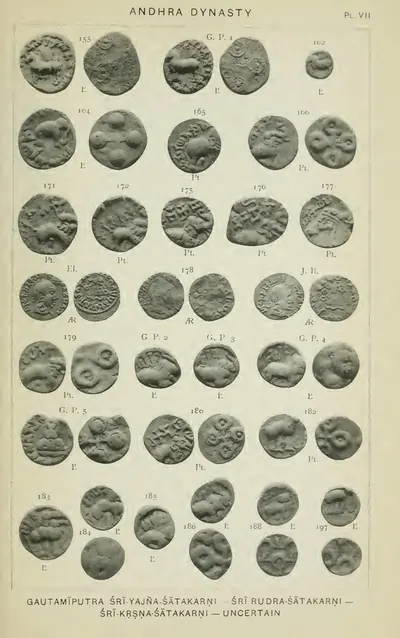 Coins of "Gautamiputra Sri-Yajna-Satakarni - Sri Rudra-Satakarni - Sri-Krsna-Satakarni - uncertain" (Rapson 1908, Pl. VII)Coin · 1908
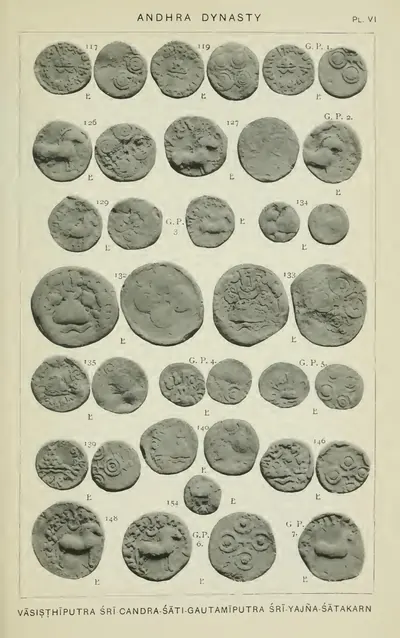 Lead coins of "Vasisthiputra Sri Candra-Sati" and "Gautamiputra Sri-Yajna-Satakarni" from the Kistna and Godavari districts (Rapson 1908, Pl. VI)Coin · 1908
 Silver portrait coins of Gautamiputra Sri-Yajna-Satakarni, catalogued under Surastra (Rapson 1908, Pl. VII, row 4)Coin · 1908
Related
Dynasties
References
Notes (0)
Sources (10)
Spotted an error on this page? Tell us
Last updated: