Gudivada
Taluk town in the Krishna delta, about twenty miles north-west of Machilipatnam. It has the remains of a demolished Buddhist stupa. An old village mound here has yielded large numbers of Satavahana (Andhra) lead coins, beads and pottery.
Gudivada is the headquarters of the taluk of the same name in the Krishna delta. Alexander Rea put it twenty miles north-west of Machilipatnam (then Masulipatam).1 The Imperial Gazetteer of 1908 placed the town at 16° 27′ N, 81° E and called it “a place of great antiquity”.2 It noted a ruined Buddhist stupa (relic mound) in the middle of the town.2 To the west lay an old town site where Andhra lead coins had been found.2 For the Satavahana period it is one of the main find-spots of the dynasty’s coins.3
The stupa
The remains of the stupa stand in a low mound in the village, about 140 feet square.1 This is much smaller than the mound at Amaravati.1 A district officer named Boswell first reported it to the Madras Government in 1870.1 He recorded its local name, lanja dibba (“harlot’s mound”), and a story that a dancing girl had raised it.1
People told Boswell of a stone casket dug up there with a pearl, gold leaf and other relics.1 They also told of ninety-nine Buddhist or Jain temples and ninety-nine tanks in former times.1 Boswell later reported that the mound had been dug for bricks for road-making.1
The sources differ on when the stupa was destroyed:
- In a letter quoted by Rea, Walter Elliot said that a brick mound was demolished about 1840 to repair the road between Vijayawada (then Bezwada) and Bandar.4 Four stone vases were found in it, each containing a crystal reliquary (relic box).4 They were set in the sides of the mound, not at the centre.4
- In 1886 Elliot dated the demolition by the Public Works Department to about 1842.5
- The 1910 revision of Fergusson’s History of Indian Architecture says the stupa was destroyed “it is said about 1860”.6
Robert Sewell obtained an account from a Public Works subordinate.14 It told of four stone receptacles, each holding a casket, found “at the four corners”.14 Sewell could not learn what they contained or what had become of them.14
Rea dug three trenches round the mound in 1892.4 He found the foundations three feet below the level of the roads.4 The brickwork survived to a height of nine to eleven feet.4 The brick was laid in circular courses and was solid to the centre, as at Bhattiprolu.4 Sewell, on an earlier visit, had found no trace of sculptures or of a rail.1
The ancient village and its finds
West of the town the ground rises to a large cultivated mound called Lamapadu dibba.7 Long low ridges, each about a quarter of a mile long, mark the walls of a square fort that enclosed the ancient village.7 Local tradition linked the village with ninety-nine Buddhist temples and tanks.7 It also said the village was a place of importance in the grain trade between Vijayawada and Eluru (then Ellore).7 Bricks and broken pottery lie on the surface, and small objects turn up after rain or ploughing.7
Robert Sewell collected coins, beads and other small objects there.7 Alexander Cunningham read three of the lead coins as issues of the Andhra kings Gautamiputra Yajna Sri and Sri Chanda.7 Sewell also had three coins showing a ship with a crescent-shaped hull, two masts and a large steering oar.7
Sewell found a terracotta female head with braided hair.7 The beads were of clay, bone, crystal, glass, amber and many kinds of stone, including garnets.7 Some pots had mouths three or four feet across, probably for storing grain.7 Sewell concluded that the people had been “highly experienced lapidaries” (workers in precious stones).7
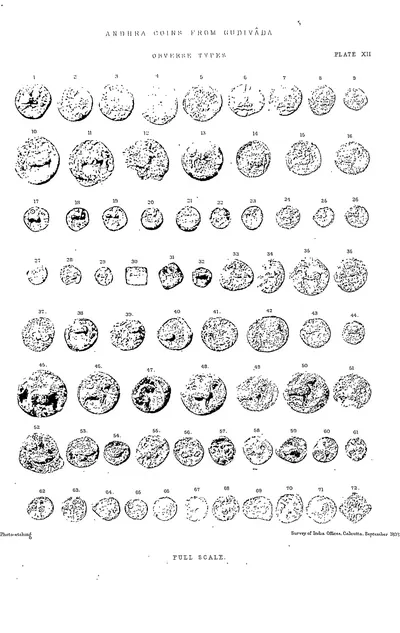
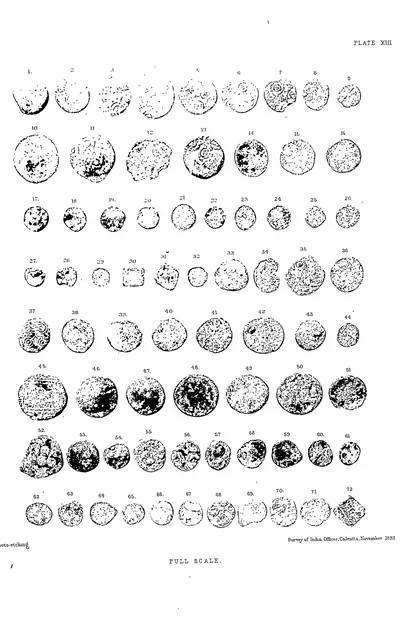
Rea himself collected 120 lead coins on the site and published the best 72.8 He arranged them by their main design: a stupa (chaitya), a horse, a lion, a ship and an elephant.910 Most have the “Ujjain symbol” on the reverse.910 He argued that they were struck between a broad reverse die and a narrow obverse punch.910
E. J. Rapson noted that coins of both Andhra lead fabrics (types of make) occur together at Gudivada.31112 His catalogue includes Gudivada specimens of Vasishthiputra Pulumavi and Siva Sri Satakarni.31112 The 1910 revision of Fergusson dated the Gudivada coins, mostly of lead, probably to the first three centuries CE.6
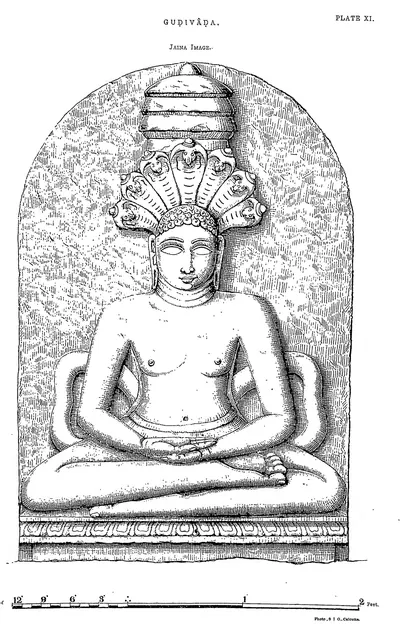
In the courtyard of the Bhimesvara temple Rea saw a seated Jain image under a seven-headed serpent.7 The temple Brahmins claimed it and worshipped it as Munisvarasvami.7
See also Satavahanas and Trade and economy.
Footnotes
-
Alexander Rea, South Indian Buddhist Antiquities (1894), p. 18 (archive.org (opens in a new tab)). ↩ ↩2 ↩3 ↩4 ↩5 ↩6 ↩7 ↩8 ↩9 ↩10 ↩11 ↩12
-
Imperial Gazetteer of India, Provincial Series: Madras, Vol. I (1908), p. 322 (archive.org (opens in a new tab)). ↩ ↩2 ↩3
-
E. J. Rapson, Catalogue of the Coins of the Andhra Dynasty, the Western Ksatrapas, the Traikutaka Dynasty, and the “Bodhi” Dynasty (1908), p. lxxi and n. 1 (archive.org (opens in a new tab)). ↩ ↩2 ↩3
-
Rea, South Indian Buddhist Antiquities (1894), p. 19 (archive.org (opens in a new tab)). ↩ ↩2 ↩3 ↩4 ↩5 ↩6 ↩7 ↩8 ↩9 ↩10
-
Walter Elliot, Coins of Southern India (1886), p. 22, n. 1 (archive.org (opens in a new tab)). ↩
-
James Fergusson, rev. James Burgess, History of Indian and Eastern Architecture, Vol. I (1910), p. 83 (archive.org (opens in a new tab)). ↩ ↩2
-
Rea, South Indian Buddhist Antiquities (1894), p. 20, quoting Robert Sewell (archive.org (opens in a new tab)). ↩ ↩2 ↩3 ↩4 ↩5 ↩6 ↩7 ↩8 ↩9 ↩10 ↩11 ↩12 ↩13 ↩14
-
Rea, South Indian Buddhist Antiquities (1894), p. 21 (archive.org (opens in a new tab)). ↩
-
Rea, South Indian Buddhist Antiquities (1894), p. 22 (archive.org (opens in a new tab)). ↩ ↩2 ↩3
-
Rea, South Indian Buddhist Antiquities (1894), p. 23 (archive.org (opens in a new tab)). ↩ ↩2 ↩3
-
Rapson, Catalogue of the Coins of the Andhra Dynasty (1908), catalogue p. 20 (archive.org (opens in a new tab)). ↩ ↩2
-
Rapson, Catalogue of the Coins of the Andhra Dynasty (1908), catalogue p. 29 (archive.org (opens in a new tab)). ↩ ↩2
Photos
References
Notes (0)
Sources (5)
Spotted an error on this page? Tell us
Last updated: