Chilukuri Veerabhadra Rao
Chilukuri Veerabhadra Rao was a Telugu historian and writer of the early 20th century, author of the Andhrula Charitramu, a history of the Andhras in Telugu published in three parts from 1910 to 1916. He took part in the Swadeshi movement at Rajahmundry in 1907, was one of the four founders of the Andhra Historical Research Society, and was honoured with the title Andhra Charitra Chaturanana.
Download
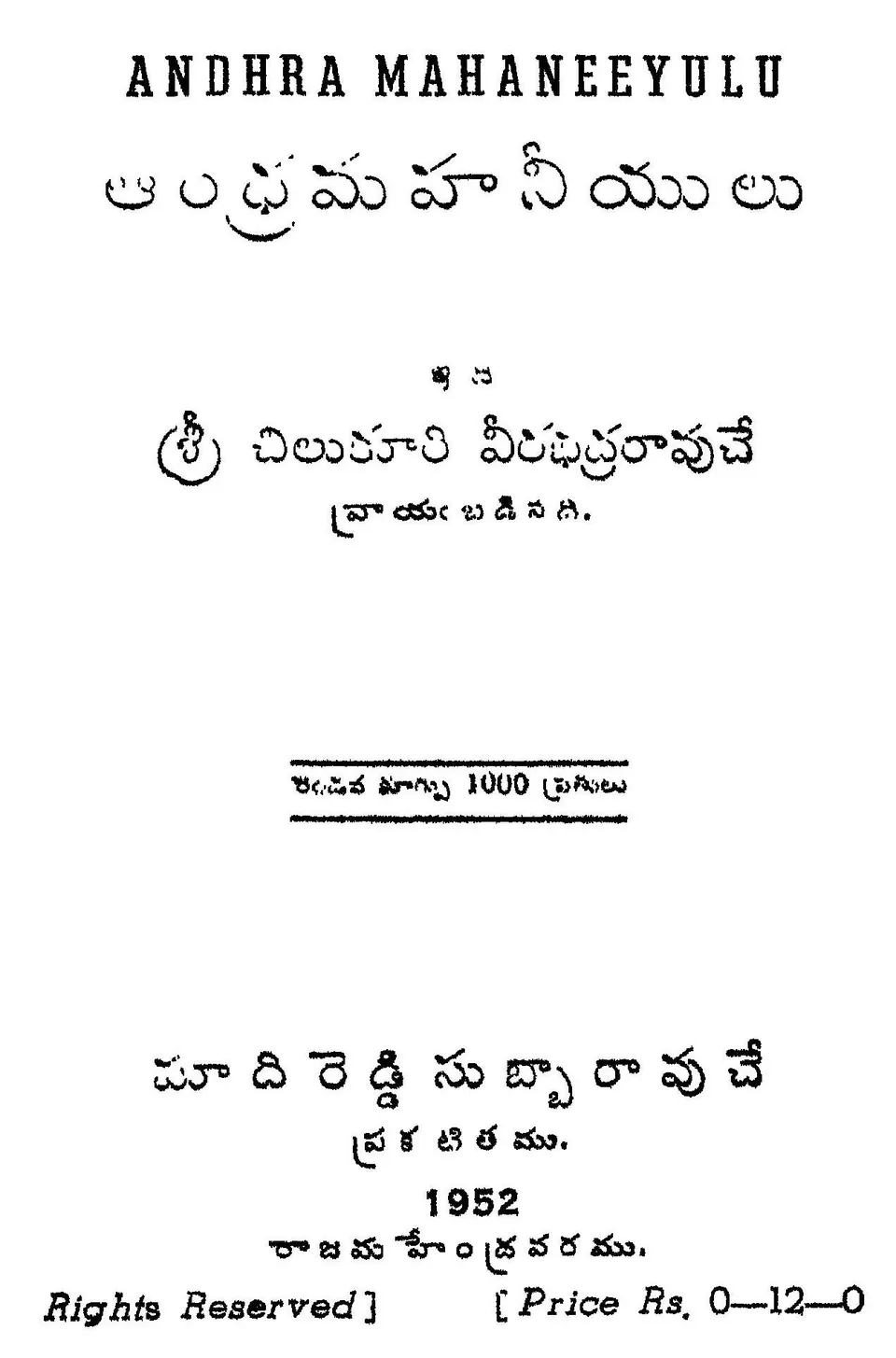
Chilukuri Veerabhadra Rao was a Telugu writer who wrote a long history of the Andhras in Telugu.12 He was also a nationalist in the Swadeshi movement, a novelist, and a founder of the Andhra Historical Research Society at Rajahmundry.345 For his work on history he was given the title Andhra Charitra Chaturanana, “the four-faced Brahma of Andhra history”.2
A history of the Andhras
His great work was the Andhrula Charitramu (“history of the Andhras”).1 The Vignana Chandrika Mandali of Madras published it in parts, the first in 1910 and the third in 1916.16 The third part prints letters of praise from other scholars.16
One of these was from K. V. Lakshmana Rao, editor of the Vignana Chandrika. He wrote that the history was “a unique production disclosing extensive research in the field of Ancient History”.16 He also praised Veerabhadra Rao’s “idiomatic, elegant, chaste, and charming style”.6 Another writer, in the Madras newspaper The Hindu, sent readers to the book for the origin and meaning of the word “Andhra”.6
The monthly Bharati noted in 1929 that his first history, the Jirna Karnata Rajya Charitramu, had been written thirty years before.2 Since then, it said, he had made the hard road of Andhra history easy for others, and his history had given strength to the Andhra movement.2
Swadeshi at Rajahmundry
He was also part of the national movement. Sarojini Regani writes that in 1907 young men at Rajahmundry formed the Bala Bharati Samiti to promote the Swadeshi movement.3 Chilukuri Veerabhadra Rao was one of the prominent men linked with it.3 On Maha Sivaratri the Samiti went in procession to Kotilingala on the Godavari, and at the meeting there he spoke on Swadeshi.3
Novelist and society founder
P. T. Raju, in his survey of Telugu literature (1944), names Veerabhadra Rao’s Nayakurali Darpamu among the historical novels worth mentioning.5
He was one of the four founders of the Andhra Historical Research Society at Rajahmundry.4 At the Andhra Mahasabha held at Nandyal, the Andhras honoured him with the title Andhra Charitra Chaturanana.2 When he died, the Society’s council recorded its deep sorrow and called him a “pioneer and premier worker in the cause of Andhra Historical Research”.4
Footnotes
-
Chilukuri Veerabhadra Rao, Andhrula Charitramu, Part III (Madras: Vignana Chandrika Mandali, 1916), press notices, p. ii (archive.org (opens in a new tab)). ↩ ↩2 ↩3 ↩4 ↩5
-
“Vimarsa Chandrika”, note in the section “Kalagura Gampa”, Bharati, Vol. 6, No. 5 (May 1929), PDF p. 137 (in Telugu) (archive.org (opens in a new tab)). Paraphrased. ↩ ↩2 ↩3 ↩4 ↩5
-
Sarojini Regani, Highlights of the Freedom Movement in Andhra Pradesh, p. 33 (archive.org (opens in a new tab)). Cite-only; paraphrased. ↩ ↩2 ↩3 ↩4
-
Proceedings of the Managing Council, Journal of the Andhra Historical Research Society, Vol. XIII (1942), PDF p. 82 (archive.org (opens in a new tab)). Cite-only; paraphrased. ↩ ↩2 ↩3
-
P. T. Raju, Telugu Literature (1944), p. 77 (archive.org (opens in a new tab)). Cite-only; paraphrased. ↩ ↩2
-
Veerabhadra Rao, Andhrula Charitramu, Part III (1916), press notices, p. iii (archive.org (opens in a new tab)). ↩ ↩2 ↩3 ↩4 ↩5
Photos
References
Notes (0)
Sources (5)
Spotted an error on this page? Tell us
Last updated: