Devavarman (Salankayana)
Salankayana king of Vengi. He is known from a Prakrit grant of his 13th year addressed to the villagers of Ellore, in which he calls himself a performer of the horse sacrifice and a devotee of Shiva. His place in the family is unknown. Scholars have made him a son of Hastivarman, an earlier king (perhaps Hastivarman's father), and a successor of Nandivarman I.
The king of the Ellore plates
Devavarman is known from one set of copper plates, in Prakrit with two Sanskrit verses, which E. Hultzsch edited in 1908.123 The plates had lain for a long time in the office of the Head Assistant Collector at Narsapur, and where they were found is not recorded.123
They were issued from Vengipura and addressed to the villagers of Elura, which Hultzsch identified with the town of Eluru (then Ellore), seven miles from Pedda-Vegi.123 In them the king is “the performer of horse-sacrifices, the Salankayana, the fervent Mahesvara, who is devoted to the feet of the lord (his) father, (and) who meditates at the feet of the holy Chitrarathasvamin”.4 The grant is dated in his 13th year.2 See the Ellore plates of Devavarman.
Hultzsch’s edition gave the family its name in modern writing. He observed that the Kolleru plates of Nandivarman used nearly the same epithets and were also issued from Vengipura.3 He proposed calling the family “the Salankayana Maharajas of Vengipura”.3
Devavarman’s grant is in Prakrit and Nandivarman’s in Sanskrit, so Hultzsch concluded that Devavarman “was presumably an ancestor” of Nandivarman.3 Sewell’s chronology of 1932 likewise calls Devavarman an earlier ruler than Chandavarman and his son.5
Where he fits in the family
No grant names Devavarman’s father or son. R. Subba Rao, D. C. Sircar, K. R. Subramanian and B. V. Krishna Rao each placed him differently.6789
- Subba Rao suggested in 1926 that Devavarman was a younger son of Hastivarman, who did not rule as sovereign.6 He drew up a family tree on that basis.6 Sircar reports that M. Somasekhara Sarma, who first published the Peddavegi plates, also made Devavarman a son of Hastivarman.10
- Sircar thought Devavarman ruled before Hastivarman, because the script of the Peddavegi plates looks slightly later than that of the Ellore plates. He suggested that Devavarman may have been Hastivarman’s immediate predecessor, perhaps his father, and so not his son.710
- K. R. Subramanian took Devavarman to be the founder of the Salankayana power in Vengi, two generations before Hastivarman.118
- Krishna Rao, editing the Kanukollu plates in 1960, concluded that Nandivarman I seems to have reigned before Devavarman.9 He thought that the dating of Nandivarman I’s grant, by season and fortnight, was older than Devavarman’s dating by the month of Pausha.9
The horse sacrifice
Devavarman is the only Salankayana king known to claim the horse sacrifice (ashvamedha).12 Sircar thought it showed that he was a prince of some importance.13 In Sircar’s view it probably marked a success against the Pallavas, who had held the Andhra country with their headquarters at Dhanyakataka.13
K. V. Lakshmana Rao thought the claim copied the Gupta emperors, and was made soon after Samudragupta’s southern campaign. In his words: “He must have seen some of the Imperial grants with similar titles and coolly imitated them.”1415 He thought later kings dropped the claim as “too big a boast for the owners of a petty principality”.1415 Sircar argued the opposite. In his view Devavarman ruled before that campaign, and the Guptas may have borrowed the idea from the south.1316
Subramanian compared Devavarman’s sacrifice with the horse sacrifice of the Ikshvaku king Chamtamula about half a century earlier.17
Religion
In his grant Devavarman calls himself a fervent devotee of Mahesvara (Shiva). Like all the kings of the family, he also calls himself a devotee of Chitrarathasvamin.418
The seal of his plates is almost worn away.2 V. Venkayya, quoted by Hultzsch, saw on it “a faint trace of some quadruped—perhaps a tiger”.2 Sircar thought the figure was probably the bull found on the seals of the other Salankayana kings.19
Date
Sircar’s chronology of 1939 placed Devavarman about 320–345. On grounds of language he argued that the king could not be earlier than A.D. 300 and reigned a little after the accession of the Pallava Sivaskandavarman.1016 As editor of the Kanukollu plates in 1960, Sircar dated the Ellore grant to about the middle of the 4th century.9
Subramanian put Devavarman’s accession in the last quarter of the 3rd century.8 K. V. Lakshmana Rao, who made him a successor of Hastivarman, placed him about 375.20 Dubreuil, in 1920, placed all the Salankayana kings he knew, Devavarman among them, between about 350 and 450.21
Footnotes
-
E. Hultzsch, “Plates of Vijaya-Devavarman”, Epigraphia Indica IX (1907–08), p. 56 (archive.org (opens in a new tab)). ↩ ↩2 ↩3
-
Hultzsch, “Plates of Vijaya-Devavarman” (1908), p. 57 (archive.org (opens in a new tab)). ↩ ↩2 ↩3 ↩4 ↩5 ↩6
-
Hultzsch, “Plates of Vijaya-Devavarman” (1908), p. 58 (archive.org (opens in a new tab)). ↩ ↩2 ↩3 ↩4 ↩5 ↩6
-
Hultzsch, “Plates of Vijaya-Devavarman” (1908), p. 59, translation (archive.org (opens in a new tab)). ↩ ↩2
-
Robert Sewell and S. Krishnaswami Aiyangar, The Historical Inscriptions of Southern India (1932), p. 18 (archive.org (opens in a new tab)). ↩
-
R. Subba Rao, “Pedavegi Copper-plates of Nandivarman II”, Journal of the Andhra Historical Research Society I, pt. 2 (1926), p. 94 (archive.org (opens in a new tab)). ↩ ↩2 ↩3
-
D. C. Sircar, The Successors of the Satavahanas in Lower Deccan (1939), p. 69 and note (archive.org (opens in a new tab)). ↩ ↩2
-
Subramanian, Buddhist Remains in Andhra (1932), p. 91 (archive.org (opens in a new tab)). ↩ ↩2 ↩3
-
B. V. Krishna Rao, “Two Salankayana Charters from Kanukollu”, Epigraphia Indica XXXI (1955–56, publ. 1960), p. 3, with D. C. Sircar’s editorial notes (archive.org (opens in a new tab)). ↩ ↩2 ↩3 ↩4
-
Sircar, Successors of the Satavahanas (1939), p. 73, chronological chart and note (archive.org (opens in a new tab)). ↩ ↩2 ↩3
-
K. R. Subramanian, Buddhist Remains in Andhra and the History of Andhra between 225 and 610 A.D. (1932), p. 89 (archive.org (opens in a new tab)). ↩
-
Subba Rao, “Pedavegi Copper-plates” (1926), p. 97 (archive.org (opens in a new tab)). ↩
-
Sircar, Successors of the Satavahanas (1939), p. 86 (archive.org (opens in a new tab)). ↩ ↩2 ↩3
-
K. V. Lakshmana Rao, “Two Copper-plate Grants of the Salankayanas of Vengi”, Journal of the Andhra Historical Research Society V, pt. 1 (1930), p. 24 (archive.org (opens in a new tab)). ↩ ↩2
-
K. V. Lakshmana Rao, “Two Copper-plate Grants of the Salankayanas of Vengi”, Journal of the Andhra Historical Research Society V, pt. 1 (1930), p. 25 (archive.org (opens in a new tab)). ↩ ↩2
-
Sircar, Successors of the Satavahanas (1939), p. 87 and note 1 (archive.org (opens in a new tab)). ↩ ↩2
-
Subramanian, Buddhist Remains in Andhra (1932), p. 90 (archive.org (opens in a new tab)). ↩
-
Sircar, Successors of the Satavahanas (1939), p. 83 (archive.org (opens in a new tab)). ↩
-
Sircar, Successors of the Satavahanas (1939), p. 90 (archive.org (opens in a new tab)). ↩
-
K. V. Lakshmana Rao, “Two Copper-plate Grants of the Salankayanas of Vengi”, Journal of the Andhra Historical Research Society V, pt. 1 (1930), pp. 26–27 (archive.org (opens in a new tab)). ↩
-
G. Jouveau-Dubreuil, Ancient History of the Deccan (1920), p. 89 (archive.org (opens in a new tab)). ↩
Photos
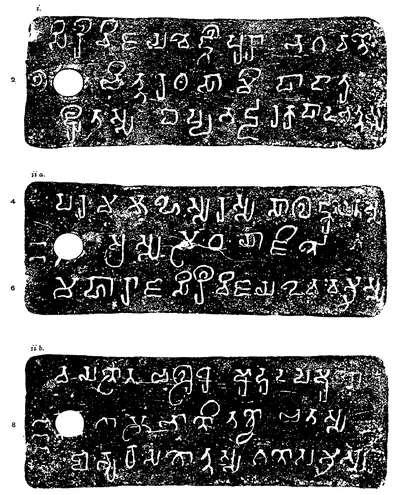 Ellore Prakrit grant: "Plates of Vijaya-Devavarman", plates i, ii a and ii b (Epigraphia Indica IX, plate between pp. 58 and 59 (PDF p. 83))Inscription rubbing · 1908
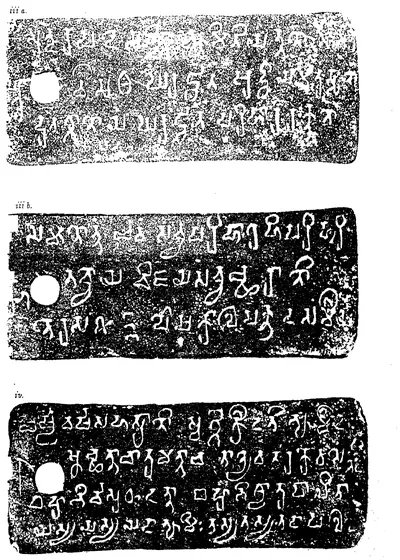 Ellore Prakrit grant: "Plates of Vijaya-Devavarman", plates iii a, iii b and iv (Epigraphia Indica IX, plate between pp. 58 and 59 (PDF p. 84))Inscription rubbing · 1908
Related
Dynasties
References
Notes (0)
Sources (9)
Spotted an error on this page? Tell us
Last updated: