Ellore plates of Devavarman
A Prakrit copper-plate grant of the 13th year of the Salankayana king Devavarman, issued from Vengipura. It is addressed to the villagers of Elura (Ellore, now Eluru), and gives twenty nivartanas of land and house sites to a Brahmin. E. Hultzsch edited it in 1908, and it gave the dynasty its modern name, 'the Salankayana Maharajas of Vengipura'.
These plates are the only record of the Salankayana king Devavarman.12 They are also the only grant of the dynasty in which a king claims the horse sacrifice.12 E. Hultzsch edited them in 1908.1 He used them to give the family the name by which it has been known since: the Salankayana Maharajas of Vengipura.1
Discovery and description
Hultzsch worked from two sets of ink impressions sent to him by V. Venkayya.3 Venkayya had received the plates from the Collector of Kistna district.3 He reported that they belonged to the Head Assistant Collector of Narsapur, in whose office they had lain for a long time.34 He added that “the person from whom they were originally obtained is not known”.34 The name “Ellore plates” therefore refers to the village addressed in the grant, not to a recorded findspot.1
There are four plates, about 5¾ inches long and 2¼ to 2⅜ inches high, without raised rims.4 Venkayya cut the ring for the first time.4 Its ends were fixed under an oval seal, which was almost worn away.4 On it he saw “a faint trace of some quadruped—perhaps a tiger”.4
D. C. Sircar thought the figure was more probably a bull, the emblem found on the seals of the other Salankayana kings.5 The inner faces are numbered in order like the pages of a book.4 The sacred syllable om stands in place of the figure 1.4
Script and language
The letters are like those of the grants of the Pallava Simhavarman and of the Kolleru plates of Nandivarman.4 The grant is in Prakrit prose, except for the last plate, which carries two of the usual Sanskrit verses.4
Hultzsch noted that its Prakrit is more archaic (older in form) than literary Prakrit in one important point.4 Single consonants between vowels are generally kept.4 Unlike the cave inscriptions, it writes double consonants in full.4 The month name Pausha appears in its Sanskrit form.4
Content
The grant was issued “from the prosperous and victorious Vengipura” by the word of the Maharaja Vijaya-Devavarman.16 He is called “the performer of horse-sacrifices, the Salankayana, the fervent Mahesvara”.16 The grant is addressed to the villagers of Elura, headed by the muluda.6 Hultzsch thought this word Dravidian but could not trace it.6
The grant orders that a Brahmin named Ganasarman of the Ba[bhura] gotra (clan) be given twenty nivartanas of land in a good locality.16 He was also to receive a house site for himself.16 He was to get another for the men who took half the crop and for his door-keepers, and to be free of all dues.16
The grant is dated on the tenth tithi (lunar day) of the dark fortnight of Pausha, in the thirteenth year of the reign.6 Sircar thought muluda, read differently in other Salankayana grants, probably meant the head of the village.5
The places
Hultzsch identified Elura with the modern town of Eluru (then Ellore), seven miles from Pedda-Vegi. Vengipura, the capital, had already been identified with Pedda-Vegi.1 Hultzsch confirmed this identification on a visit there in 1902.1 Villagers showed him a small mound as the site of the temple of Chitrarathasvamin, the family god of the Salankayanas.1 See Vengi.
Date
Hultzsch placed Devavarman before Nandivarman, the son of Chandavarman.1 His reason was that this grant is in Prakrit and Nandivarman’s in Sanskrit.1 Dubreuil included Devavarman among Salankayana kings who reigned between about 350 and 450.7 Sircar argued in 1939 that the king could not be earlier than A.D. 300, and placed him about 320–345.8
B. V. Krishna Rao thought its month-and-fortnight dating later than the season-and-fortnight dating of the Kanukollu grant of Nandivarman I. Sircar, as editor, gave that grant and this one to the same age, about the middle of the 4th century.910 Sewell’s chronology of 1932 lists this grant, with the Komarti plates, under about the 4th century.11
Footnotes
-
Hultzsch, “Plates of Vijaya-Devavarman” (1908), p. 58 (archive.org (opens in a new tab)). ↩ ↩2 ↩3 ↩4 ↩5 ↩6 ↩7 ↩8 ↩9 ↩10 ↩11 ↩12 ↩13 ↩14 ↩15
-
R. Subba Rao, “Pedavegi Copper-plates of Nandivarman II”, Journal of the Andhra Historical Research Society I, pt. 2 (1926), p. 97 (archive.org (opens in a new tab)). ↩ ↩2
-
E. Hultzsch, “Plates of Vijaya-Devavarman”, Epigraphia Indica IX (1907–08), p. 56 (archive.org (opens in a new tab)). ↩ ↩2 ↩3 ↩4
-
Hultzsch, “Plates of Vijaya-Devavarman” (1908), p. 57 (archive.org (opens in a new tab)). ↩ ↩2 ↩3 ↩4 ↩5 ↩6 ↩7 ↩8 ↩9 ↩10 ↩11 ↩12 ↩13 ↩14
-
Sircar, Successors of the Satavahanas (1939), p. 90 (archive.org (opens in a new tab)). ↩ ↩2
-
Hultzsch, “Plates of Vijaya-Devavarman” (1908), p. 59, text and translation (archive.org (opens in a new tab)). ↩ ↩2 ↩3 ↩4 ↩5 ↩6 ↩7 ↩8
-
G. Jouveau-Dubreuil, Ancient History of the Deccan (1920), p. 89 (archive.org (opens in a new tab)). ↩
-
D. C. Sircar, The Successors of the Satavahanas in Lower Deccan (1939), p. 87, note 1 (archive.org (opens in a new tab)). ↩
-
B. V. Krishna Rao, “Two Salankayana Charters from Kanukollu”, Epigraphia Indica XXXI (1955–56, publ. 1960), p. 2 (archive.org (opens in a new tab)). ↩
-
Krishna Rao, “Two Salankayana Charters from Kanukollu” (1960), p. 3, with D. C. Sircar’s editorial notes (archive.org (opens in a new tab)). ↩
-
Robert Sewell and S. Krishnaswami Aiyangar, The Historical Inscriptions of Southern India (1932), p. 18 (archive.org (opens in a new tab)). ↩
Photos
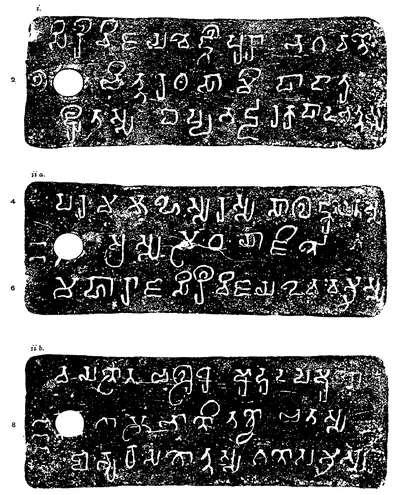 Ellore Prakrit grant: "Plates of Vijaya-Devavarman", plates i, ii a and ii b (Epigraphia Indica IX, plate between pp. 58 and 59 (PDF p. 83))Inscription rubbing · 1908
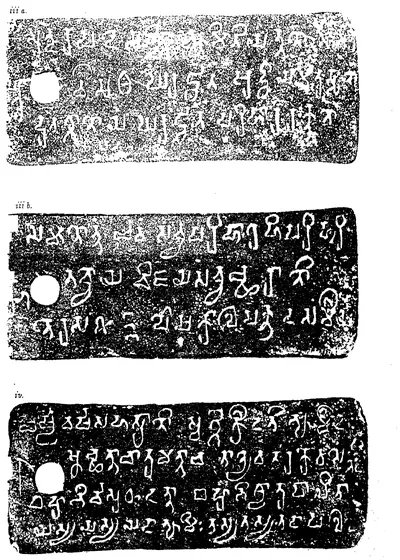 Ellore Prakrit grant: "Plates of Vijaya-Devavarman", plates iii a, iii b and iv (Epigraphia Indica IX, plate between pp. 58 and 59 (PDF p. 84))Inscription rubbing · 1908
References
Notes (0)
Sources (6)
Spotted an error on this page? Tell us
Last updated: