Ismail Adil Shah
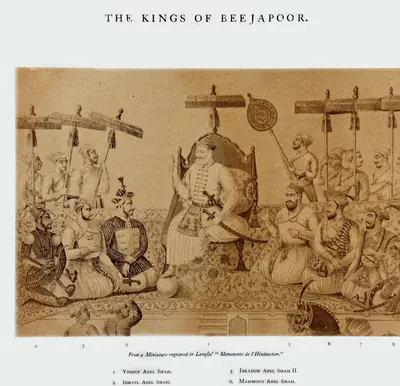
Second Adil Shahi sultan of Bijapur (r. 1510–1534), the son of Yusuf Adil Khan. The fortresses of Raichur and Mudgal changed hands with Vijayanagara in his reign. In 1520 Krishnadevaraya besieged Raichur and routed his army on the Krishna. After Krishnadevaraya's death, Ismail took both forts back.
Ismail was the only son of Yusuf Adil Khan and his queen Bubuji Khanum.12 He succeeded his father at Bijapur in 1510.12 Cousens says he was “about twelve or thirteen years of age” at his accession.34 His father’s minister, Kamal Khan Dakhani, governed for him.34 Kamal Khan then tried to seize the throne and was killed by an agent of the young king’s mother.34 See the Adil Shahis of Bijapur.
Raichur lost and fought for
The disorder at Bijapur gave the Vijayanagara regent Timraj his chance. Ferishta says that while Ismail was taken up with the troubles at home, Timraj “still continued before Rachore, which at last surrendered to him”.5
In AH 927 (1520–21; AH is the Islamic way of counting years), Ferishta continues, Ismail prepared to recover “Moodkul and Rachore from the Ray of Beejanuggur”, that is, Mudgal and Raichur from the king of Vijayanagara.67 The Ray camped on the Krishna with at least fifty thousand horse and held all the ferries.67
At a banquet the king was heated with wine.78 He plunged across the river on his elephant, with about two hundred and fifty elephants and a few thousand men.78 The whole Hindu army met him and drove him back into the river, with the loss of nearly half his force.78 He “took a solemn vow never to indulge again in wine till he had wiped away the stain of this defeat”.78 On the advice of his commander Asad Khan, he returned to Bijapur and sought an alliance with Ahmadnagar.9
The two accounts of 1520
The Portuguese chronicler Fernao Nuniz tells the story the other way round, in the narrative that Robert Sewell translated in A Forgotten Empire (1900). In Nuniz’s account, Raichur belonged to Ismail, and it was Krishnadevaraya who marched against it in 1520. The Bellary gazetteer (1904) follows Nuniz.1011 It says that Krishnadevaraya’s army drove the Muslims into the river and attacked Ismail’s camp, “who barely escaped with his life”.1011 It adds that “Ismail never again attacked the Vijayanagar territories while Krishna Deva was alive”.1011
Sewell noted that Ferishta differed, and he preferred Nuniz.12 He wrote of Nuniz: “his account is so graphic and detailed that it is impossible to believe that he could have been mistaken. Firishtah did not write for many years later and was much more liable to error.”12 See Raichur.
After Krishnadevaraya’s death, the gazetteer adds, “Ismail Adil Shah of Bijapur speedily took his measure and attacked Mudkal and Raichur and captured them”.11
Family and death
Ferishta says that Ismail’s sister Maryam was married to Burhan Nizam Shah of Ahmadnagar, at a meeting of the two kings at Sholapur.9 The marriage sealed the alliance that Asad Khan had advised.9
Cousens names Ismail’s sons:1314
- Mallu, the eldest, who succeeded him in 1534 and was deposed and blinded after seven months1314
- Ibrahim, “the favourite”, who was raised to the throne in his place1314
- Abdullah, whom a later plot tried to put on the throne instead of Ibrahim1314
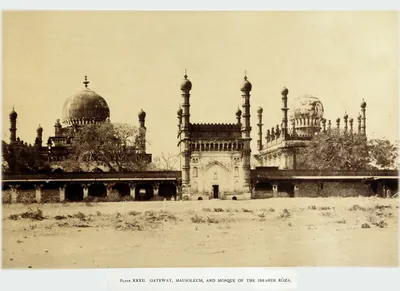
Ismail fell ill during a campaign against Golconda and died at Sagar in AH 941 (1534).4 He was buried beside his father at Gogi.4 See Ibrahim Adil Shah I.
Footnotes
-
Muhammad Qasim Ferishta, tr. John Briggs, History of the Rise of the Mahomedan Power in India, Vol. III (1829), p. 31 (archive.org (opens in a new tab)). ↩ ↩2
-
Henry Cousens, Bijapur and its Architectural Remains (Archaeological Survey of India, Imperial Series, Vol. XXXVII, 1916), p. 2 (archive.org (opens in a new tab)). ↩ ↩2
-
Cousens, Bijapur and its Architectural Remains (1916), p. 3 (archive.org (opens in a new tab)). ↩ ↩2 ↩3
-
Cousens, Bijapur and its Architectural Remains (1916), p. 4 (archive.org (opens in a new tab)). ↩ ↩2 ↩3 ↩4 ↩5
-
Ferishta, tr. Briggs, Vol. III (1829), p. 44 (archive.org (opens in a new tab)). ↩
-
Ferishta, tr. Briggs, Vol. III (1829), p. 48 (archive.org (opens in a new tab)). ↩ ↩2
-
Ferishta, tr. Briggs, Vol. III (1829), p. 49 (archive.org (opens in a new tab)). ↩ ↩2 ↩3 ↩4 ↩5 ↩6
-
Ferishta, tr. Briggs, Vol. III (1829), p. 50 (archive.org (opens in a new tab)). ↩ ↩2 ↩3 ↩4
-
Ferishta, tr. Briggs, Vol. III (1829), p. 51 (archive.org (opens in a new tab)). ↩ ↩2 ↩3
-
W. Francis, Madras District Gazetteers: Bellary (1904), p. 39 (archive.org (opens in a new tab)). ↩ ↩2 ↩3
-
Francis, Bellary (1904), p. 40 (archive.org (opens in a new tab)). ↩ ↩2 ↩3 ↩4
-
Robert Sewell, A Forgotten Empire (Vijayanagar) (1900), p. 136 and note (archive.org (opens in a new tab)). ↩ ↩2
-
Cousens, Bijapur and its Architectural Remains (1916), p. 5 (archive.org (opens in a new tab)). ↩ ↩2 ↩3 ↩4
-
Cousens, Bijapur and its Architectural Remains (1916), p. 6 (archive.org (opens in a new tab)). ↩ ↩2 ↩3 ↩4
Photos
Related
Dynasties
References
Notes (0)
Sources (4)
Spotted an error on this page? Tell us
Last updated: