Yusuf Adil Khan (Yusuf Adil Shah)
Founder of the Adil Shahi dynasty of Bijapur (r. about 1489–1510). He was a foreign-born officer of the Bahmani kings who governed the province of Bijapur with the title Adil Khan. He declared his independence in AH 895 (1489–90). In 1493 he defeated the Vijayanagara regent Timmaraja and took Mudgal and Raichur. This began a century of war over the Raichur doab.
Yusuf Adil Khan founded the line of sultans that ruled from Bijapur for almost two hundred years.1 The historian Ferishta wrote at the court of his great-grandson Ibrahim Adil Shah II.1 Ferishta tells a romantic story of Yusuf’s birth.1 In it he was a son of the Ottoman sultan Murad II, smuggled out of Turkey as a child when his brother ordered his death.1 He was brought up at Sava in Persia, and sold at Bidar as a Georgian slave to the minister Mahmud Gawan.1
Henry Cousens wrote the outline history in the Archaeological Survey’s volume on Bijapur (1916).1 He records another account, that Yusuf was the son of a governor of Sava.1 He notes that “from the fact that the crescent, the Turkish national symbol, surmounts the old state buildings of Bijapur, it would appear that his descendants believed in their princely descent”.1 See the Adil Shahis of Bijapur.
Governor and king
Yusuf served in the army of the Bahmani kingdom.1 Then he was made governor of the province of Bijapur with the title of Adil Khan, “the just”.1 The Bahmani state broke up in the last years of Mahmud Shah, and Yusuf gathered a force of Turks and Mughals.1
In Cousens’s words, in 1489, “like the governors of other provinces, he openly declared his independence by ordering the khutbah to be read in the public mosques in his own name”.1 (The khutbah is the Friday sermon, which names the ruler.) Ferishta puts his taking of royal power, and that of Malik Ahmad of Ahmadnagar, in AH 895 (1489–90; AH is the Islamic way of counting years).2
The first war over Raichur
Yusuf’s kingdom bordered Vijayanagara along the Krishna and the Tungabhadra.3 The fortresses of Mudgal and Raichur, in the doab (land between two rivers) between them, were at once in dispute.3
Ferishta says that the Bahmani minister Qasim Barid invited the king of Vijayanagara to take the two forts from Yusuf.3 The Vijayanagara general Timraj (Timmaraja), “having crossed the river Toongbudra, laid waste the country as far as Moodkul and Rachore”.3 Yusuf was too weak to resist, and he made peace with him.3
Some time later Yusuf heard of quarrels at Vijayanagara, and he marched to take back Raichur.45 He fell ill on the bank of the Krishna.45 He got better in time to meet Timraj, who was advancing on Bijapur.45
In Ferishta’s account the battle was fought in the month of Rajab, AH 898, which Briggs gives as April 1493.56 Yusuf’s troops gave way at first, but he rallied them and charged very hard.56 “Timraj, unable to stand the shock, fled, leaving two hundred elephants, and a thousand horses in the hands of the victors, besides sixty lacks of hoons”.56 The young king of Vijayanagara died of his wounds on the way home.56
Yusuf then sent an officer who took the forts of Mudgal and Raichur in forty days.67 Cousens summed up the result: “henceforth, Vijayanagar became a thorn in the side of Bijapur”.1 Its lands ran “for some two hundred miles or more with those of the Muhammadan kingdom”.1
Kurnool in local memory
The Manual of the Kurnool District (1886) records a local tradition that Kurnool was at this time “part of the estate of Yusuf Savai”.89 It says the Vijayanagara king sent his general Rama Raja to take the town.89 This Rama Raja was the grandfather of the Rama Raja who fell in 1565.89 He was to drive out Yusuf’s agents and hold the town as a nayankara fief (land held for military service).89 The manual explains the name Savai from Sava in Persia, where Yusuf was brought up.9 See Kurnool.
Family and death
Ferishta says that early in his reign Yusuf put down a rising of Mukund Rao, a Maratha officer of the Bahmani government.10 He married Mukund Rao’s sister and gave her the title of Bubuji Khanum.10 By her he had three daughters and one son, Ismail, who followed him on the throne.10 Ferishta adds that the daughters married Burhan Nizam Shah of Ahmadnagar, Ala-ud-din Imad Shah of Berar and the Bahmani prince Ahmad Shah.10
Ferishta says that Yusuf died at Bijapur of dropsy “in the seventy-fifth year of his age, after having reigned with great prosperity twenty-one years”.11 Cousens gives the year as 1510.112 He adds that Yusuf had his son Ismail crowned in his presence.112 At his own request he was buried at Gogi, near the tomb of the saint Shah Chanda Husaini.112
Footnotes
-
Henry Cousens, Bijapur and its Architectural Remains (Archaeological Survey of India, Imperial Series, Vol. XXXVII, 1916), p. 2 (archive.org (opens in a new tab)). ↩ ↩2 ↩3 ↩4 ↩5 ↩6 ↩7 ↩8 ↩9 ↩10 ↩11 ↩12 ↩13 ↩14 ↩15 ↩16 ↩17
-
Muhammad Qasim Ferishta, tr. John Briggs, History of the Rise of the Mahomedan Power in India, Vol. III (1829), p. 9 (archive.org (opens in a new tab)). ↩
-
Ferishta, tr. Briggs, Vol. III (1829), p. 10 (archive.org (opens in a new tab)). ↩ ↩2 ↩3 ↩4 ↩5
-
Ferishta, tr. Briggs, Vol. III (1829), p. 11 (archive.org (opens in a new tab)). ↩ ↩2 ↩3
-
Ferishta, tr. Briggs, Vol. III (1829), p. 12 (archive.org (opens in a new tab)). ↩ ↩2 ↩3 ↩4 ↩5 ↩6 ↩7
-
Ferishta, tr. Briggs, Vol. III (1829), p. 13 (archive.org (opens in a new tab)). ↩ ↩2 ↩3 ↩4 ↩5
-
Ferishta, tr. Briggs, Vol. III (1829), p. 14 (archive.org (opens in a new tab)). ↩
-
Narahari Gopalakristnamah Chetty, A Manual of the Kurnool District (1886), p. 24 (archive.org (opens in a new tab)). ↩ ↩2 ↩3 ↩4
-
Chetty, Kurnool District (1886), p. 25 (archive.org (opens in a new tab)). ↩ ↩2 ↩3 ↩4 ↩5
-
Ferishta, tr. Briggs, Vol. III (1829), p. 31 (archive.org (opens in a new tab)). ↩ ↩2 ↩3 ↩4
-
Ferishta, tr. Briggs, Vol. III (1829), p. 30 (archive.org (opens in a new tab)). ↩
-
Cousens, Bijapur and its Architectural Remains (1916), p. 3 (archive.org (opens in a new tab)). ↩ ↩2 ↩3
Photos
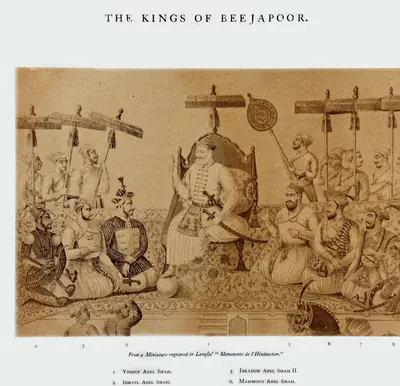 "The Kings of Beejapoor": the eight Adil Shahi kings from Yusuf to Sikandar, from a miniature engraved in Langlès' Monuments de l'Hindoustan (Taylor and Fergusson, Architecture at Beejapoor, 1866, frontispiece)Book plate · 1866
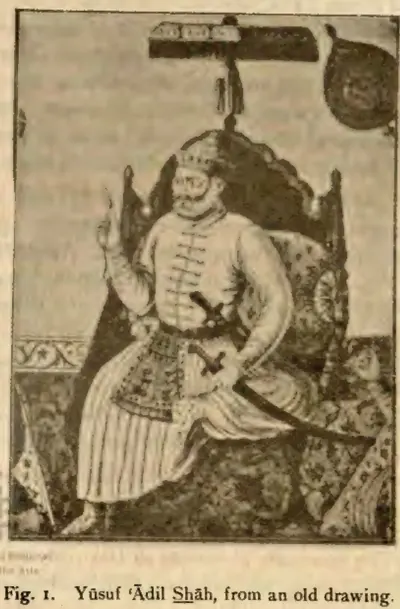 "Yusuf Adil Shah, from an old drawing" (Cousens, Bijapur and its Architectural Remains, 1916, p. 3, fig. 1)Drawing · 1916
Related
Dynasties
References
Notes (0)
Sources (3)
Spotted an error on this page? Tell us
Last updated: