Krishnadeva Raya
King of Vijayanagara from 1509 to 1529, of the Tuluva dynasty, and the most famous ruler of the empire. In 1512–16 he took Udayagiri, Kondavidu and Kondapalli from the Gajapati Prataparudra. He marched to Simhachalam and married the Gajapati's daughter. In 1520 he defeated the Adil Shah at Raichur. He wrote the Telugu poem Amuktamalyada, in which the god says Telugu is the best of the languages of the land. His court, with Allasani Peddana and Nandi Timmana, began the age of the Telugu prabandha (long narrative poem).
Krishnadeva Raya was king of Vijayanagara from 1509 to 1529.1234 He was the third king of the Tuluva dynasty.1234 Sewell’s later work gives these dates:1234
S. Krishnaswami Aiyangar dated his death to 1530.1234 In 1919 Krishnaswami Aiyangar wrote that his rule “made such an impression upon the people that his name is handed down in tradition as ‘the king’”.5 See Vijayanagara.
Family
Two poems name his parents: the Parijatapaharanamu of Nandi Timmana and the king’s own Amuktamalyada.67 They name his father as Narasa and his mother as Nagamba, or Nagamamba.67 They make Vira Narasimha his half-brother, born of Narasa’s wife Tippamba.67
Subramiah Pantulu quoted an inscription of 1516 at Simhachalam in 1898.8 It records gifts made for the merit of the king’s mother Nagadevamma and his father Narasaraya.8 It records other gifts made through his wives Chinnadevamma and Tirumaladevamma.8
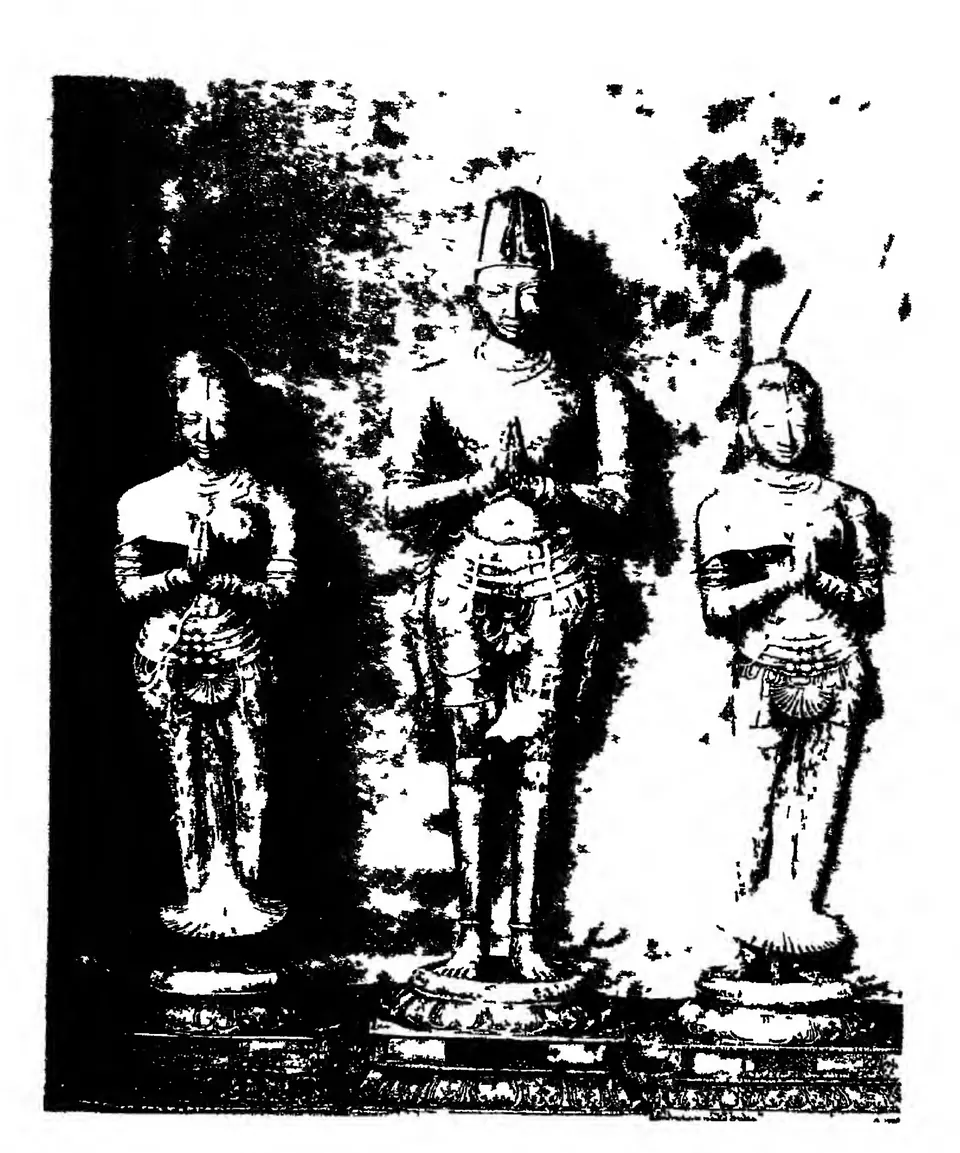
The Telugu prose Rayavachakamu and the poem Krishnarayavijayam tell it differently.910 They call his father Vira Narasimha and leave out the elder brother who ruled before him.910 The Rayavachakamu names his two queens as Tirumala Devi and Chinna Devi.11 He set up copper statues of them, with his own, before the god at Tirupati.11
Nuniz tells a different story.121314 He says Chinnadevi had been a courtesan whom the king loved as a young man and married when he came to the throne.121314 Nuniz says the king married four wives in all.121314 Paes says that he had twelve lawful wives, three of them chief wives.121314
Sewell’s later family tree gives Krishnadeva Raya two daughters and a son.12 Tirumalamba married Aliya Rama Raya, and Vengala married Rama Raya’s brother Tirumala.12 The son, Tirumala, died young about 1525.12 The Ramarajiyamu also says that Aliya Rama Raya married Tirumalamba, “the daughter of the Emperor Krishna Raya”.15
Nuniz tells how the king of Orissa asked how he might ransom his captured queen.1617 Saluva Timma answered that he should give his daughter in marriage to Krishnaraya, and the marriage took place.1617 The Rayavachakamu names the princess Jaganmohini.1617
Krishnaswami Aiyangar noted a tradition about her.18 It says she was neglected and lived apart at Kambam, where she is said to have built the great tank.18 See Prataparudra Gajapati, Aliya Rama Raya and Tirumala.
Coming to the throne
Nuniz tells a story about his brother, the king he calls “Busbalrao”.1920 On his deathbed this king ordered the minister Saluva Timma to put out Krishnaraya’s eyes, so that his own eight-year-old son would rule next.1920 Krishnaraya, then over twenty, said he wished to live as a holy man.1920 The minister showed the dying king the eyes of a goat instead.1920
Nuniz adds that on becoming king he sent his nephew and his three brothers to the fortress of Chandragiri for his own safety.2122 He stayed a year and a half at the capital, studying the affairs of the kingdom.2122
Krishnaswami Aiyangar wrote that the king called Saluva Timma Appaji, “reverend father”.3 The minister stayed in power and was treated almost with respect.3 See Saluva Timma.
The eastern campaigns
He first put down the Raja of Ummattur and took his stronghold of Sivasamudram.2324 Then, in Krishnaswami Aiyangar’s account, he took Saluva Timma’s advice to leave the sultans alone for a time and invade the lands of Orissa.2324
Nuniz says that he besieged Udayagiri, “the King of Orya’s”, for a year and a half.2225 He cut roads across the rocks and captured an aunt of the king of Orissa there.2225 He then besieged Kondavidu and defeated the king of Orissa in a battle across a river.252627 He took the fort after two months.252627 Kondapalli fell after three months, with a queen and a son of the king.252627
Nuniz says he went on to a city he calls “Symamdary”.252627 There he waited six months for the Gajapati and set up an inscription daring him to fight.252627
Krishnaswami Aiyangar gives these dates.23 The war against Udayagiri took up 1512 and 1513, and Kondavidu fell in the first half of 1515.23 He wrote that the king broke up his camp at Vijayawada (then Bezwada), took Kondapalli and marched as far as Simhachalam.23
Subramiah Pantulu quoted the Simhachalam inscription of 1516.8 It says that the king came there “on his first campaign”, after he had subdued Udayagiri, Kondavidu, Kondapalli and Rajahmundry.8 See Udayagiri, Kondavidu, Kondapalli and Simhachalam.
The colophons (closing verses) of the Amuktamalyada sum up the campaign.28 They list:
- the capture of the Gajapati’s uncle at Udayagiri
- the capture of his son Virabhadra at Kondavidu
- the capture of Praharesvara with his treasure at Kondapalli
- the king’s worship at Simhachalam
- a pillar with an inscription set up at Potnuru28
Krishnaswami Aiyangar wrote that peace was made with the Krishna as the border.29 The land south of the river was given as the princess’s dowry.29 He called the result “meagre”.29 In his view the king had only won back a province that had once been Vijayanagara’s, “yet he was not ashamed to assume the vainglorious title of Gajapatisaptangaharana”.29
Nuniz says that the king gave back to Orissa “the lands on the other side of the river, and kept those on the hither side for himself”.16 Briggs translated a Golconda chronicle, which Sewell summarised.3031 It makes Sultan Quli Qutb Shah the king’s enemy at Kondavidu and Bellamkonda instead.3031 See Potnuru, the Gajapatis and Sultan Quli.
Raichur and the western wars
In 1520 the king advanced on Raichur, then held by the Adil Shah of Bijapur.2932 He defeated Ismail Adil Shah.2932
Krishnaswami Aiyangar wrote that one of the king’s inscriptions mentions the battle.2932 It was fought on 19 May 1520 at Kembhavi, “Red Well”.2932 A Telugu poem rejoices that the well was reddened with the blood of the enemy.2932 In 1919 he had suggested that the Amuktamalyada’s Kembhavi was the battle usually named after Raichur.2932
Nuniz describes the siege and battle at length.3334 He says that afterwards the king took Gulbarga.3334 There he made the eldest of three captive sons of the Bahmani king the king of the Deccan.3334 Sewell thought that after this victory he “grew to be haughty and insolent in his demands”.35 See Raichur and the Bahmanis.
The king Paes saw
Paes described him about 1520 as “of medium height, and of fair complexion and good figure, rather fat than thin”.3614 He had marks of small-pox on his face.3614 Paes called him “the most feared and perfect king that could possibly be, cheerful of disposition and very merry”.3614 He was a ruler “of much justice, but subject to sudden fits of rage”.3614 Paes gives his title as “king of kings, lord of the greater lords of India, lord of the three seas and of the land”.3614
Sewell wrote that he rose early and exercised with clubs and the sword.37 He rode well and led his armies in person.37 Above all he wanted horses for his wars.3839 He offered Albuquerque a large sum for the sole right to the horse trade at Goa.3839
Poet and patron
Krishnadeva Raya wrote the Amuktamalyada, also called Vishnuchittiyamu.2840 It is a Telugu poem on Goda, the daughter of the Vaishnava saint Vishnuchitta.2840 He also wrote the Sanskrit drama Jambavati Kalyanam.2840 Its prologue says it was first staged at the spring festival of Virupaksha at the capital.2840
In the Amuktamalyada the god Andhra Vishnu of Srikakulam appears to the king in a dream.2841 The god tells him that Telugu is the best of the languages of the land.2841 The verse is quoted on the Vijayanagara page.2841
Chenchiah and Bhujanga Rao wrote that “for insight into human nature, and for facility in depicting elusive moods by some striking phrase, Krishnadevaraya has no superior, and scarcely an equal”.4243 They wrote that his poem opened the age of the prabandha (long narrative poem).4243
Subramiah Pantulu reported that some people held the Amuktamalyada to be Peddana’s work, published in the king’s name.4445 He rejected this view because of its style and grammar.4445 He thought the poem was finished after the victory of 1520.4445
The court poets, the Ashtadiggajas (eight great poets), have their own pages.4647 They include Allasani Peddana, whom the king called “Andhrakavitapitamaha”, as Krishnaswami Aiyangar noted, and Nandi Timmana.4647
Subramiah Pantulu says that the king was called Andhra Bhoja, “on account of his occupying the same place in Telugu literature as king Bhoja in the Sanskrit”.44 Legend added much.3 Krishnaswami Aiyangar noted that the stories of “Rayar and Appaji” told in South India are like those told of Harun-ur-Rashid and of Vikramaditya.3
Temples and towns
Sewell was told that the king marked his accession by building the great tower at the entrance of the Hampi temple.212448 He built the Krishnaswami temple for the image brought from Udayagiri.212448 He also built the Hazara Ramaswami temple by his palace.212448
Krishnaswami Aiyangar wrote that after the eastern war he made large grants to temples in the south.293613 He built the town of Nagalapura, now Hospet, “in memory of his mother Nagaladevi”.293613 Paes says the new town bore the name of his wife.293613 Nuniz says it was built in honour of the courtesan Chinadevi.293613
The Rayavachakamu describes his gifts at Tirupati and Kalahasti.11 It also describes a journey to the southern shrines.11
Last years and death
Nuniz says that the king wanted his son to rule after him.495051 He made the boy king at the age of six and acted as his minister.495051 When the boy died, the king believed Saluva Timma’s son had poisoned him.495051 He imprisoned the minister and his family, and later blinded them.495051
Krishnaswami Aiyangar wrote that the king fell sick in 1525.29 His last years were troubled by the revolt of Vira Narasimha, called Sellappa, and by the disobedience of Nagama Nayaka at Madura.29
Nuniz says that before his death he chose his brother Achyuta, then held at Chandragiri, to rule after him.52 He did this because his own son was only eighteen months old.52 See Achyuta Raya.
Footnotes
-
Robert Sewell, ed. S. Krishnaswami Aiyangar, The Historical Inscriptions of Southern India (1932), p. 401 (archive.org (opens in a new tab)). ↩ ↩2 ↩3 ↩4 ↩5 ↩6 ↩7 ↩8
-
Sewell, Historical Inscriptions (1932), p. 403, notes to the pedigrees (archive.org (opens in a new tab)). ↩ ↩2 ↩3 ↩4 ↩5 ↩6 ↩7 ↩8
-
S. Krishnaswami Aiyangar, “Hindu States in Southern India”, in Wolseley Haig (ed.), The Cambridge History of India, Vol. III (1928), p. 495 (archive.org (opens in a new tab)). ↩ ↩2 ↩3 ↩4 ↩5 ↩6 ↩7 ↩8 ↩9
-
Krishnaswami Aiyangar, in Cambridge History of India, Vol. III (1928), p. 498 (archive.org (opens in a new tab)). ↩ ↩2 ↩3 ↩4 ↩5
-
Krishnaswami Aiyangar, Sources of Vijayanagar History (1919), introduction, p. 11 (archive.org (opens in a new tab)). ↩
-
Krishnaswami Aiyangar, Sources of Vijayanagar History (1919), p. 106, extract 35, the Parijatapaharanamu of Nandi Timmana (archive.org (opens in a new tab)). ↩ ↩2 ↩3
-
Krishnaswami Aiyangar, Sources of Vijayanagar History (1919), pp. 109–110, extract 37, the Amuktamalyada (archive.org (opens in a new tab)). ↩ ↩2 ↩3
-
G. R. Subramiah Pantulu, “Discursive Remarks on the Augustan Age of Telugu Literature”, Indian Antiquary XXVII (1898), p. 296 (archive.org (opens in a new tab)). ↩ ↩2 ↩3 ↩4 ↩5
-
Krishnaswami Aiyangar, Sources of Vijayanagar History (1919), p. 111, extract 38, the Rayavachakamu (archive.org (opens in a new tab)). ↩ ↩2
-
Krishnaswami Aiyangar, Sources of Vijayanagar History (1919), p. 129, extract 39, the Krishnarayavijayam of Kumara Dhurjati (archive.org (opens in a new tab)). ↩ ↩2
-
Krishnaswami Aiyangar, Sources of Vijayanagar History (1919), p. 117, the Rayavachakamu (archive.org (opens in a new tab)). ↩ ↩2 ↩3 ↩4
-
Nuniz, in Sewell, A Forgotten Empire (1900), p. 362 (archive.org (opens in a new tab)). ↩ ↩2 ↩3 ↩4
-
Nuniz, in Sewell, A Forgotten Empire (1900), p. 363 (archive.org (opens in a new tab)). ↩ ↩2 ↩3 ↩4 ↩5 ↩6 ↩7 ↩8
-
Paes, in Sewell, A Forgotten Empire (1900), p. 247 (archive.org (opens in a new tab)). ↩ ↩2 ↩3 ↩4 ↩5 ↩6 ↩7 ↩8 ↩9
-
Krishnaswami Aiyangar, Sources of Vijayanagar History (1919), p. 184, extract 57, the Ramarajiyamu (archive.org (opens in a new tab)). ↩
-
Nuniz, in Sewell, A Forgotten Empire (1900), p. 320 (archive.org (opens in a new tab)). ↩ ↩2 ↩3 ↩4
-
Krishnaswami Aiyangar, Sources of Vijayanagar History (1919), p. 116, the Rayavachakamu (archive.org (opens in a new tab)). ↩ ↩2 ↩3
-
Krishnaswami Aiyangar, Sources of Vijayanagar History (1919), p. 143, extract 44, the Tukka Panchakam (archive.org (opens in a new tab)). ↩ ↩2
-
Fernao Nuniz, “Chronicle”, in Sewell, A Forgotten Empire (1900), p. 314 (archive.org (opens in a new tab)). ↩ ↩2 ↩3 ↩4
-
Nuniz, in Sewell, A Forgotten Empire (1900), p. 315 (archive.org (opens in a new tab)). ↩ ↩2 ↩3 ↩4
-
Sewell, A Forgotten Empire (1900), p. 123 (archive.org (opens in a new tab)). ↩ ↩2 ↩3 ↩4 ↩5
-
Nuniz, in Sewell, A Forgotten Empire (1900), p. 316 (archive.org (opens in a new tab)). ↩ ↩2 ↩3 ↩4
-
Krishnaswami Aiyangar, in Cambridge History of India, Vol. III (1928), p. 496 (archive.org (opens in a new tab)). ↩ ↩2 ↩3 ↩4 ↩5
-
Sewell, A Forgotten Empire (1900), p. 130 (archive.org (opens in a new tab)). ↩ ↩2 ↩3 ↩4 ↩5
-
Nuniz, in Sewell, A Forgotten Empire (1900), p. 317 (archive.org (opens in a new tab)). ↩ ↩2 ↩3 ↩4 ↩5 ↩6 ↩7
-
Nuniz, in Sewell, A Forgotten Empire (1900), p. 318 (archive.org (opens in a new tab)). ↩ ↩2 ↩3 ↩4 ↩5
-
Nuniz, in Sewell, A Forgotten Empire (1900), p. 319 and note (archive.org (opens in a new tab)). ↩ ↩2 ↩3 ↩4 ↩5
-
Krishnaswami Aiyangar, Sources of Vijayanagar History (1919), p. 133, extract 40, the Amuktamalyada (archive.org (opens in a new tab)). ↩ ↩2 ↩3 ↩4 ↩5 ↩6 ↩7 ↩8 ↩9
-
Krishnaswami Aiyangar, in Cambridge History of India, Vol. III (1928), p. 497 (archive.org (opens in a new tab)). ↩ ↩2 ↩3 ↩4 ↩5 ↩6 ↩7 ↩8 ↩9 ↩10 ↩11 ↩12 ↩13 ↩14 ↩15 ↩16
-
Sewell, A Forgotten Empire (1900), p. 132 (archive.org (opens in a new tab)). ↩ ↩2
-
Sewell, A Forgotten Empire (1900), p. 134 (archive.org (opens in a new tab)). ↩ ↩2
-
S. Krishnaswami Aiyangar (ed.), Sources of Vijayanagar History (1919), addenda, p. viii (archive.org (opens in a new tab)). ↩ ↩2 ↩3 ↩4 ↩5 ↩6
-
Sewell, A Forgotten Empire (1900), p. 136 (archive.org (opens in a new tab)). ↩ ↩2 ↩3
-
Nuniz, in Sewell, A Forgotten Empire (1900), p. 358 (archive.org (opens in a new tab)). ↩ ↩2 ↩3
-
Sewell, A Forgotten Empire (1900), p. 122 (archive.org (opens in a new tab)). ↩
-
Domingos Paes, “Narrative”, in Sewell, A Forgotten Empire (1900), p. 246 and note (archive.org (opens in a new tab)). ↩ ↩2 ↩3 ↩4 ↩5 ↩6 ↩7 ↩8 ↩9
-
Robert Sewell, A Forgotten Empire (Vijayanagar) (1900), p. 121 (archive.org (opens in a new tab)). ↩ ↩2
-
Sewell, A Forgotten Empire (1900), p. 126 (archive.org (opens in a new tab)). ↩ ↩2
-
Sewell, A Forgotten Empire (1900), p. 127 (archive.org (opens in a new tab)). ↩ ↩2
-
Krishnaswami Aiyangar, Sources of Vijayanagar History (1919), p. 142, extract 42, the Jambavati Kalyanam (archive.org (opens in a new tab)). ↩ ↩2 ↩3 ↩4
-
Krishnadeva Raya, Amuktamalyada, canto I, as printed in Krishnaswami Aiyangar, Sources of Vijayanagar History (1919), p. 135 (archive.org (opens in a new tab)). ↩ ↩2 ↩3
-
P. Chenchiah and Raja M. Bhujanga Rao, A History of Telugu Literature (1928), p. 70 (archive.org (opens in a new tab)). ↩ ↩2
-
Chenchiah and Bhujanga Rao, A History of Telugu Literature (1928), p. 71 (archive.org (opens in a new tab)). ↩ ↩2
-
Subramiah Pantulu, Indian Antiquary XXVII (1898), p. 297 (archive.org (opens in a new tab)). ↩ ↩2 ↩3 ↩4
-
Subramiah Pantulu, Indian Antiquary XXVII (1898), p. 298 (archive.org (opens in a new tab)). ↩ ↩2 ↩3
-
Krishnaswami Aiyangar, Sources of Vijayanagar History (1919), p. 153, extract 49, Peddana’s verses on Krishna Deva Raya (archive.org (opens in a new tab)). ↩ ↩2
-
Chenchiah and Bhujanga Rao, A History of Telugu Literature (1928), p. 72 (archive.org (opens in a new tab)). ↩ ↩2
-
Sewell, A Forgotten Empire (1900), p. 131 (archive.org (opens in a new tab)). ↩ ↩2 ↩3
-
Nuniz, in Sewell, A Forgotten Empire (1900), p. 359 (archive.org (opens in a new tab)). ↩ ↩2 ↩3 ↩4
-
Nuniz, in Sewell, A Forgotten Empire (1900), p. 360 (archive.org (opens in a new tab)). ↩ ↩2 ↩3 ↩4
-
Nuniz, in Sewell, A Forgotten Empire (1900), p. 361 (archive.org (opens in a new tab)). ↩ ↩2 ↩3 ↩4
-
Nuniz, in Sewell, A Forgotten Empire (1900), p. 367 (archive.org (opens in a new tab)). ↩ ↩2
Photos
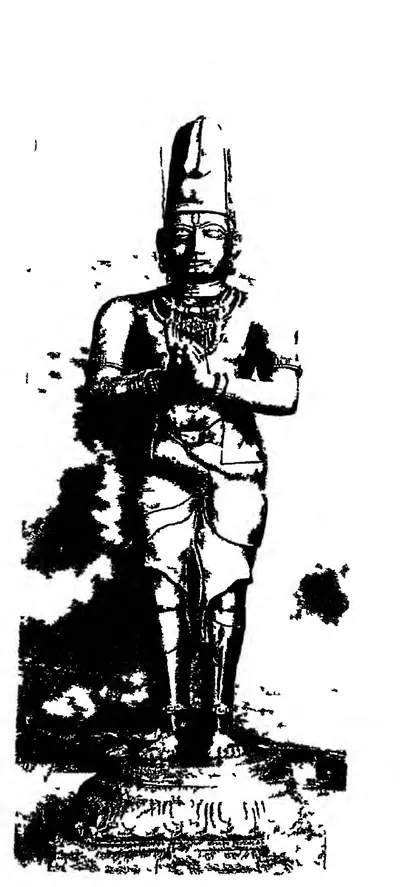
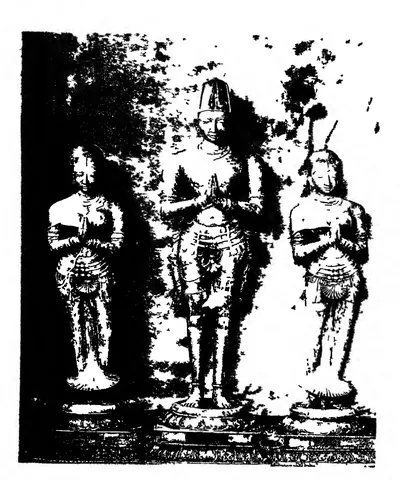 "Chinnadevi", "Krishnaraya-Maharaya" and "Tirumaladevi", copper statues in the Tirumala temple (ASI Annual Report 1911-12, plate LXXVI, figs. 1-3 (PDF p. 354))Historic photograph · 1915
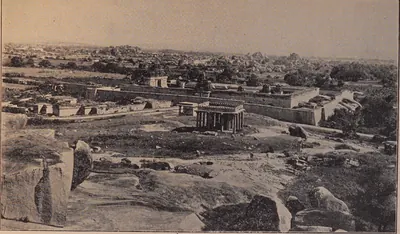 "General view of Krishnapuram showing the Krishna Temple in a high walled enclosure", Hampi (Madras Archaeological Report 1916-17, plate X (PDF p. 249))Historic photograph · 1917
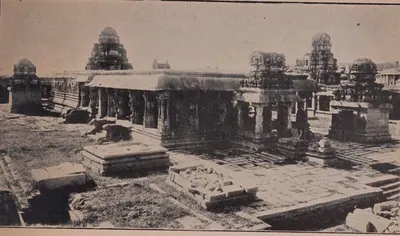 "General view of the Krishna Temple at Krishnapuram", Hampi (Madras Archaeological Report 1916-17, plate XI-a (PDF p. 251))Historic photograph · 1917
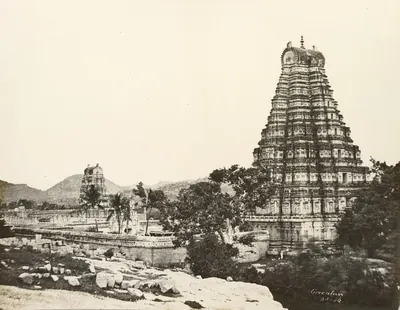
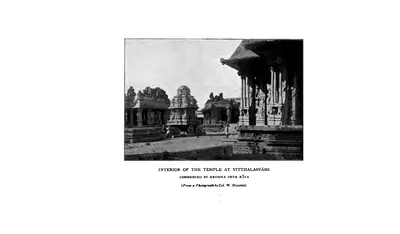 "Interior of the Temple at Vitthalasvami, commenced by Krishna Deva Raya" (from a photograph by Col. W. Hooper) (Sewell 1900, PDF p. 161)Historic photograph · 1900
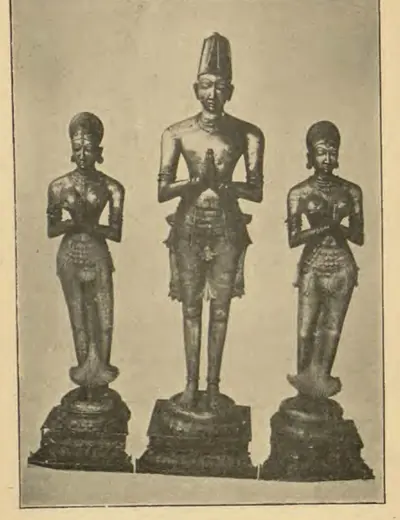 "Metal images of Krishna Raya and his two queens, Tirupati Temple, Chittoor District" (Longhurst, Hampi Ruins, 3rd ed. 1933, fig. 14, p. 42 (PDF p. 56))Historic photograph · 1933
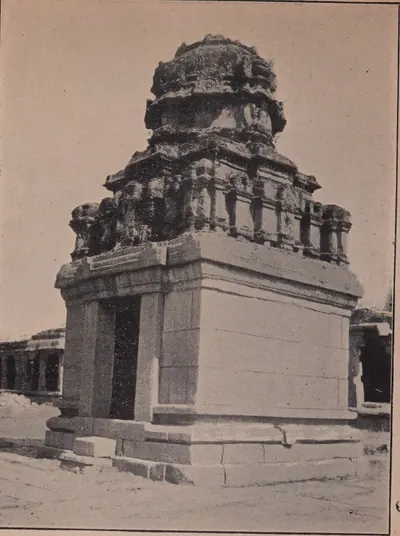 "Small attendant shrine with inscriptions at the Krishna Temple at Krishnapuram" (Madras Archaeological Report 1916-17, plate XII-b (PDF p. 253))Historic photograph · 1917
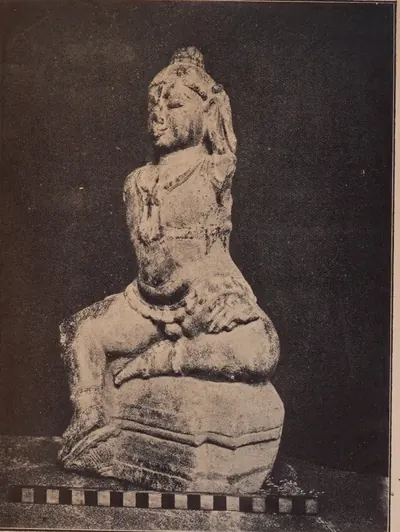 "Stone image of Balakrishna from the Krishna temple at Krishnapuram" (Madras Archaeological Report 1916-17, plate XII-a (PDF p. 253))Historic photograph · 1917
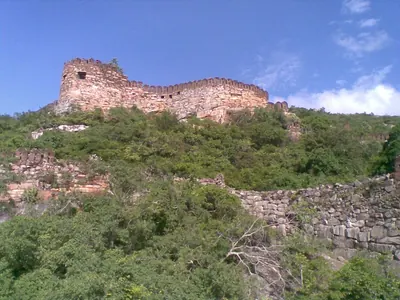
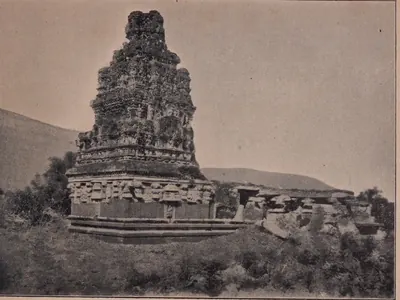 "The Krishna Temple at Udayagiri" (Madras Archaeological Report 1916-17, plate IV-a (PDF p. 237))Historic photograph · 1917
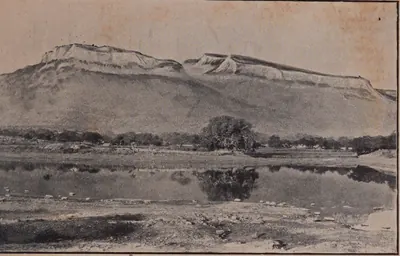 "Udayagiri in the Nellore District" (Madras Archaeological Report 1916-17, plate I-a (PDF p. 231 of 31761123499139))Historic photograph · 1917
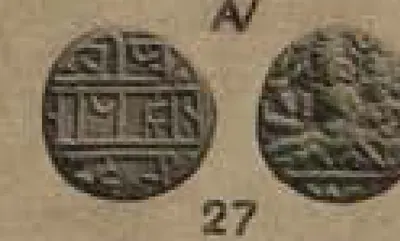 Gold half-pagoda of Krishnadeva Raya: god and goddess seated (V. A. Smith, Catalogue of the Coins in the Indian Museum, Vol. I, 1906, plate XXX, 27 (PDF p. 427))Coin · 1906
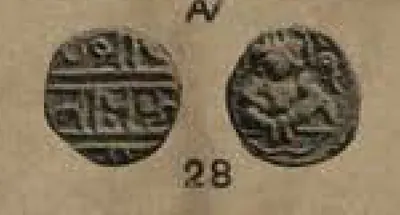 Gold half-pagoda of Krishnadeva Raya: seated Vishnu with shell (V. A. Smith, Catalogue of the Coins in the Indian Museum, Vol. I, 1906, plate XXX, 28 (PDF p. 427))Coin · 1906
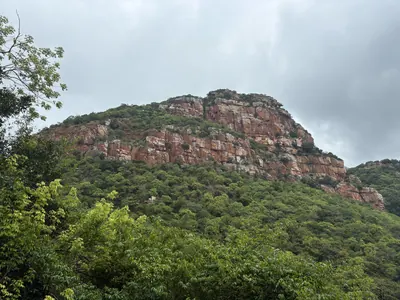 The Udayagiri hill (Udayagiri Droog), Nellore districtPhotograph · 2025
Related
Dynasties
Vijayanagara Empire
c. 1336–1646 CE
The South Indian empire founded about 1336 by the brothers Harihara and Bukka on the Tungabhadra. The Sangama, Saluva, Tuluva and Aravidu dynasties ruled it in turn. It held Rayalaseema and the Nellore country from the fourteenth century. It fought the Reddis, the Velamas, the Bahmanis and the Gajapatis of Orissa for the Telugu coast, and under Krishnadeva Raya it took Udayagiri, Kondavidu and Kondapalli and marched to Simhachalam. Its court made Telugu a language of high poetry. After the defeat of 1565 its kings ruled from Penukonda and Chandragiri, until Golconda took the last of the Telugu districts in the 1640s.
Gajapatis of Orissa
c. 1434–1541 CE
The Suryavamsi kings of Orissa, 'lords of elephants', who ruled from Cuttack from 1434–35 to about 1541. Kapilendra (Kapilesvara) took the throne of the last Eastern Ganga king. He conquered the Reddi kingdoms of Rajahmundry and Kondavidu, and sent his son Hamvira and his nephew Raghudeva into Telangana, where they took Warangal in 1460. He carried his arms down the coast towards the Kaveri. His son Purushottama lost the Godavari–Krishna country to the Bahmanis and won it back. Prataparudra lost everything south of the Godavari or the Krishna to Krishnadeva Raya of Vijayanagara in 1513–19, and the coastal districts fell to Golconda in the following decades.
References
Notes (0)
Sources (6)
Spotted an error on this page? Tell us
Last updated: