Ibrahim Adil Shah I
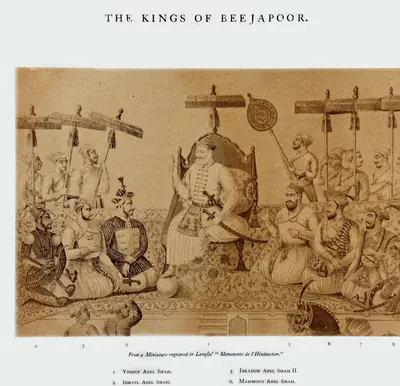
Fourth Adil Shahi sultan of Bijapur (r. 1535–1558), a younger son of Ismail Adil Shah. Invited by Bhoj Tirmal of Vijayanagara, he entered the Vijayanagara capital in 1535. His general Asad Khan then besieged Adoni, the first Bijapur attack on the fortress, which Ferishta says ended in a negotiated peace. In 1551–52 he lost Raichur and Mudgal to Aliya Rama Raya.
Ibrahim was a younger son of Ismail Adil Shah.1 He was raised to the throne of Bijapur when his elder brother Mallu was deposed and blinded in 1534–35.1 Ferishta says that he died in AH 965 (1557–58; AH is the Islamic way of counting years) “after a reign of twenty-four years and some months”.2 See the Adil Shahis of Bijapur.
A change of language
Ibrahim reversed his father’s preference for Persians and Shias. Ferishta says that he restored the Sunni faith, dismissed most of the foreign troops and took Deccanis into his service.3 He adds that “the public accounts, formerly kept in Persian, were now written in Hindvy, under the management of bramins”.3 These Brahmans “soon acquired great influence in his government”.3
Cousens, writing in 1916, agreed that “the Hindu element in the public offices was considerably strengthened”.1 But he wrote that under Ibrahim “Persian was made the official language of the court”, the opposite of Ferishta’s statement.1
Vijayanagara and Adoni
In AH 942 (1535), according to Ferishta, Bhoj Tirmal Ray offered Ibrahim a large subsidy (payment) to march to his help.4 Bhoj Tirmal had seized the throne of Vijayanagara, and he wanted help against the nobles led by Ramraj (Aliya Rama Raya).4 Ibrahim arrived at Vijayanagara “without opposition, when he was conducted into the city by Bhoj Tirmul Ray”.4 Bhoj Tirmal “seated him on the royal musnud” (throne) “and made rejoicings for seven days”.4
Bhoj Tirmal soon paid him to leave.56 Before the Bijapur army had recrossed the Krishna, the nobles broke into the palace and Bhoj Tirmal killed himself.56
Ibrahim heard of this at Raichur.6 He sent his minister Asad Khan “with the greatest part of his army to reduce the important fortress of Adony”.6 The fort “was on the point of surrendering” when Ramraj’s younger brother Venkatadri marched to relieve it.6 Asad Khan raised the siege and was beaten in a pitched battle.6 Then he surprised Venkatadri’s camp by night and captured his treasure and family.6
Ramraj suspected that the local zamindars (landholders) had invited the attack, and that Venkatadri’s officers were disloyal.7 So he advised his brother to make peace and recover his family, and the war ended in a treaty.7
The Bellary gazetteer dates the siege to 1537.8 It says Ibrahim “invested it” (laid siege to it) “but retreated on the approach of a relieving army from Vijayanagar”.8 Cousens, on the other hand, says the expedition to capture “the much coveted fort of Adoni” was “brought to a very successful issue”.9 See Adoni and Asad Khan Lari.
Raichur lost
Later in the reign Bijapur was attacked from three sides at once. Ferishta describes a league of Burhan Nizam Shah of Ahmadnagar with Ramraj and the king of Golconda.1011 In AH 959 (1551–52), he says, Ramraj met Burhan near Raichur.1011 The allies agreed that “the forts of Moodkul and Rachore” (Mudgal and Raichur) “should be conquered for Ramraj”.1011 Raichur was taken, “and on its falling into their hands the garrison of Moodkul also surrendered without opposition”.1011 The two forts stayed with Vijayanagara until 1565. See Raichur.
Family
Ferishta says that in AH 950 (1543) Ibrahim married Rabia Sultana, the daughter of Ala-ud-din Imad Shah of Berar.12 Cousens says that after Adoni he also honoured Asad Khan by marrying his daughter.9 Ferishta says that Ibrahim left two sons and two daughters at his death.2
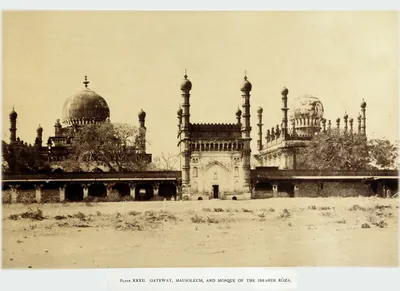
Cousens counts four sons, Ismail, Ali, Ahmad and Tahmasp, and two daughters.1314 The daughters married into the royal houses of Ahmadnagar and Bidar.1314 He says that Ibrahim kept Ali, the abler of the elder sons, a prisoner in the fort of Miraj for nine years.1314 Ibrahim was buried in the family vault at Gogi.13 See Ali Adil Shah I.
Footnotes
-
Henry Cousens, Bijapur and its Architectural Remains (Archaeological Survey of India, Imperial Series, Vol. XXXVII, 1916), p. 5 (archive.org (opens in a new tab)). ↩ ↩2 ↩3 ↩4
-
Muhammad Qasim Ferishta, tr. John Briggs, History of the Rise of the Mahomedan Power in India, Vol. III (1829), p. 112 (archive.org (opens in a new tab)). ↩ ↩2
-
Ferishta, tr. Briggs, Vol. III (1829), p. 80 (archive.org (opens in a new tab)). ↩ ↩2 ↩3
-
Ferishta, tr. Briggs, Vol. III (1829), p. 83 (archive.org (opens in a new tab)). ↩ ↩2 ↩3 ↩4
-
Ferishta, tr. Briggs, Vol. III (1829), p. 84 (archive.org (opens in a new tab)). ↩ ↩2
-
Ferishta, tr. Briggs, Vol. III (1829), p. 85 (archive.org (opens in a new tab)). ↩ ↩2 ↩3 ↩4 ↩5 ↩6 ↩7
-
Ferishta, tr. Briggs, Vol. III (1829), p. 86 (archive.org (opens in a new tab)). ↩ ↩2
-
W. Francis, Madras District Gazetteers: Bellary (1904), p. 195 (archive.org (opens in a new tab)). ↩ ↩2
-
Cousens, Bijapur and its Architectural Remains (1916), p. 6 (archive.org (opens in a new tab)). ↩ ↩2
-
Ferishta, tr. Briggs, Vol. III (1829), p. 104 (archive.org (opens in a new tab)). ↩ ↩2 ↩3 ↩4
-
Ferishta, tr. Briggs, Vol. III (1829), p. 105 (archive.org (opens in a new tab)). ↩ ↩2 ↩3 ↩4
-
Ferishta, tr. Briggs, Vol. III (1829), p. 92 (archive.org (opens in a new tab)). ↩
-
Cousens, Bijapur and its Architectural Remains (1916), p. 7 (archive.org (opens in a new tab)). ↩ ↩2 ↩3 ↩4
-
Cousens, Bijapur and its Architectural Remains (1916), p. 8 (archive.org (opens in a new tab)). ↩ ↩2 ↩3
Photos
Related
Dynasties
References
Notes (0)
Sources (3)
Spotted an error on this page? Tell us
Last updated: