Skandavarman II (Pallava)
Pallava king of the Nellore–Guntur country, known from the first Omgodu grant, issued from Tambrapa in the 33rd year of his reign. The grant gives his ancestors back to a Kumaravishnu, who performed the horse sacrifice. He was the father of the crown prince Vishnugopa and the grandfather of Simhavarman, whose grants come from the same region.
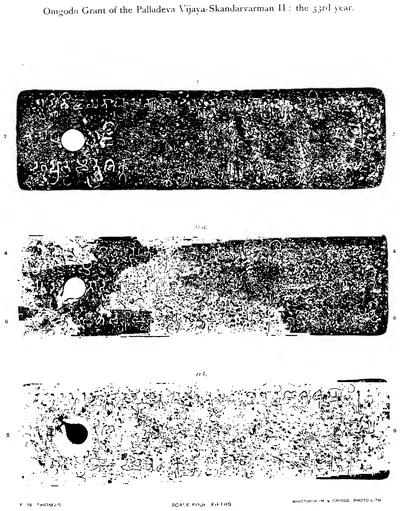
Skandavarman II is one of the Pallava kings who granted villages in the Guntur and Nellore country without, so far as their charters show, ruling from Kanchi. His only grant, the first Omgodu grant, was issued from “the victorious Tambrapa-sthana” in the 33rd year of his reign.12
H. Krishna Sastri, who edited the grant, numbered him Skandavarman II.34 The grants of his son and grandson name a Skandavarman I as his grandfather.34
Family
The Omgodu grant names four generations.1 They are:1
- the Maharaja Kumaravishnu, a performer of the horse sacrifice1
- his son Skandavarman, “who acquired the kingdom by his own prowess”1
- his son Viravarman1
- his son the Maharaja Vijaya-Skandavarman, the donor1
Skandavarman I was the son of Kumaravishnu, according to the Omgodu grant.1 Viravarman was the son of Skandavarman I.15 Skandavarman II was the son of Viravarman.16
His son, the crown prince Vishnugopa, issued the Uruvupalli grant.56 It gives the same three names, Skandavarman, Viravarman and Skandavarman.56 The grants of his grandson Simhavarman begin with Viravarman.56
Krishna Sastri identified Viravarman with the Virakorchavarman of the Darsi plate and with the Virakurcha of the Velurpalayam plates, a 9th-century Pallava genealogy.42 He took Skandavarman II to be the Skandasishya whom those plates make the son of Virakurcha.42
Kumaravishnu was the first king of the Omgodu grant.2 Krishna Sastri thought him “probably” the Kalabhartri of the Velurpalayam plates, “though there may be very little that is common to the two names”.2 R. Gopalan followed these identifications in his table of the Pallava kings, but called them tentative.78
The grant
The grant was made by the order of Vijaya-Skandavarman.1 The officers and ayuktakas (local officials) of Karmarashtra and the people of Omgodu were told of the gift.1 The village of Omgodu had been given to the Brahman Golasarman, a student of two Vedas.1 The gift came with the eighteen kinds of exemptions (freedom from taxes and dues), except for the fields already ploughed as temple land.1
Krishna Sastri identified Karmarashtra with the Kamma-nadu of later inscriptions.19 This was the northern part of the Nellore district and part of the Guntur district.19 He suggested that Omgodu might be the town of Ongole.19
Date
The grant is dated in the old way, in the third fortnight of winter of the king’s 33rd year, as in the earlier Prakrit charters.2 Krishna Sastri saw in this, in its numerals and in the spaces between words, a sign that it was close to the Andhra (Satavahana) period.2
Gopalan concluded from the year of reign that Skandavarman’s reign lasted at least 33 years, and he took the grant to be the oldest of the Sanskrit charters.1011 D. C. Sircar placed it, with the Darsi fragment, between about the middle of the 4th century and the beginning of the 5th.12
G. Jouveau-Dubreuil counted back from Mahendravarman I at 25 years a generation, and dated him 450–475.1314 He thought that Skandavarman, who issued his grant from Tambrapa, probably never reigned at Kanchi.1314
Footnotes
-
Krishna Sastri, “Two Pallava Copper-plate Grants” (1920), p. 250 (archive.org (opens in a new tab)). ↩ ↩2 ↩3 ↩4 ↩5 ↩6 ↩7 ↩8 ↩9 ↩10 ↩11 ↩12 ↩13 ↩14 ↩15 ↩16 ↩17
-
Krishna Sastri, “Two Pallava Copper-plate Grants” (1920), p. 251 (archive.org (opens in a new tab)). ↩ ↩2 ↩3 ↩4 ↩5 ↩6 ↩7
-
H. Krishna Sastri, “Two Pallava Copper-plate Grants”, Epigraphia Indica XV (1919–20), p. 248 (archive.org (opens in a new tab)). ↩ ↩2
-
Krishna Sastri, “Two Pallava Copper-plate Grants” (1920), p. 249 (archive.org (opens in a new tab)). ↩ ↩2 ↩3 ↩4
-
J. F. Fleet, “Sanskrit and Old-Canarese Inscriptions, No. XII”, Indian Antiquary V (1876), pp. 52–53, translation (archive.org (opens in a new tab)). ↩ ↩2 ↩3 ↩4
-
E. Hultzsch, “Pikira Grant of Simhavarman”, Epigraphia Indica VIII (1905–06), p. 160 (archive.org (opens in a new tab)). ↩ ↩2 ↩3 ↩4
-
Gopalan, History of the Pallavas of Kanchi (1928), p. 57 (archive.org (opens in a new tab)). ↩
-
Gopalan, History of the Pallavas (1928), pp. 59–60 (archive.org (opens in a new tab)). ↩
-
Krishna Sastri, “Two Pallava Copper-plate Grants” (1920), p. 254 (archive.org (opens in a new tab)). ↩ ↩2 ↩3
-
R. Gopalan, History of the Pallavas of Kanchi (1928), p. 56 (archive.org (opens in a new tab)). ↩
-
Gopalan, History of the Pallavas (1928), p. 61 (archive.org (opens in a new tab)). ↩
-
D. C. Sircar, The Successors of the Satavahanas in Lower Deccan (1939), p. 171 (archive.org (opens in a new tab)). ↩
-
G. Jouveau-Dubreuil, Ancient History of the Deccan (1920), p. 67 (archive.org (opens in a new tab)). ↩ ↩2
-
Jouveau-Dubreuil, Ancient History of the Deccan (1920), p. 68 (archive.org (opens in a new tab)). ↩ ↩2
Photos
Related
Dynasties

References
Notes (0)
Sources (7)
Spotted an error on this page? Tell us
Last updated: