Madhavavarman (Vishnukundin)
The most famous Vishnukundin king. His own and his descendants' grants credit him with eleven horse sacrifices and a thousand agnishtoma rites. He married into the Vakataka royal family. Whether he was also Madhavavarman Janashraya, the son of Govindavarman and donor of the first Ipur and the Polamuru plates, is disputed: D. C. Sircar and V. V. Mirashi thought so, while other scholars made Janashraya a later king, Madhavavarman III. His date is also disputed: Sircar placed him about 535–585, Mirashi about 510–560.
Which Madhavavarman?
Several kings of the Vishnukundin family were called Madhavavarman, and historians number them differently. This page is about the king whom every Vishnukundin grant credits with eleven ashvamedhas (horse sacrifices) and a thousand agnishtomas (soma sacrifices).12 He is the great-grandfather named at the head of the Chikkulla plates.231 He is the grandfather in the Ramatirtham plates, and the grandfather of Madhavavarman II in the second set of Ipur plates.231
The difficulty is a second Madhavavarman, the son of Govindavarman, who issued the first set of Ipur plates and the Polamuru plates.45 In the Polamuru plates he bears the surname Janashraya.45 Scholars disagree about whether he was the same man.
- The same king. D. C. Sircar argued in 1939 that all the references must be to one man.678 He thought it very unlikely that two kings of the same family and period performed exactly the same numbers of sacrifices.678 Both grants of Govindavarman’s son claim the eleven horse sacrifices and the thousand agnishtomas.678 So Sircar called that king Madhavavarman I, son of Govindavarman.7 V. V. Mirashi followed Sircar’s family tree.910 E. Hultzsch, editing the first Ipur plates in 1924, had also been tempted by this identification because of their early script.4
- Two kings. In the epigraphical report for 1913–14, H. Krishna Sastri called the Janashraya of the Polamuru plates “a new and a later member of the family”, because of the late style of the letters.1112 The report for 1919–20 placed the Polamuru kings after Vikramendravarman II of the Chikkulla plates.13 K. V. Lakshman Rao made a tentative family tree, which Robert Sewell and S. Krishnaswami Aiyangar printed in 1932.14 In it the king of the Polamuru grant is Madhava III Janashraya, the last king of the line.14 An earlier Madhava II is the one who married a Vakataka princess.14 M. Somasekhara Sarma and R. S. Panchamukhi also made Janashraya a later king, Madhavavarman III.1516 K. R. Subramanian counted him as Madhavavarman IV.17
The editor of Epigraphia Indica added a note to Panchamukhi’s article in 1936.16 It pointed out that the sacrifices claimed in the two grants suggested that their king might not be different from Madhava I.16 It also noted that Hultzsch had judged the script of the first Ipur plates earlier than that of the Ramatirtham and Chikkulla plates.16 This page follows Sircar’s identification, as the reign chart on the dynasty page does, but it describes the grants of Govindavarman’s son below with that caution.
Grants
Three copper-plate grants have been credited to the king himself, two of them only if Sircar is right.
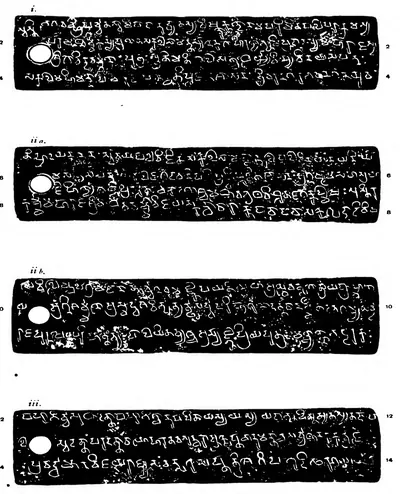
- Ipur plates (set I), from the Tenali taluk of Guntur district. The Maharaja Madhavavarman, son of the Maharaja Govindavarman, issued them in the 37th year of his reign, from his camp at Kudavada.48 They grant the village of Vilembali in the Guddadi district to a Brahmin, Agnisharman.48 The executor of the grant was the king’s “dear son” Manchyanna-bhattaraka.48
- Polamuru plates, from Godavari district. They were first noticed in the epigraphical report for 1913–14.12 According to Sircar they call the king Janashraya, his father Govindavarman Vikramashraya, and his grandfather Vikramahendra.181920 The grant was made on a lunar eclipse, when the king was crossing the Godavari to conquer the east.12181920 Lakshman Rao read the year of reign as 48, and Sircar read it as 40.1421
- Khanapur plates, from Satara district in Maharashtra. Their first plate, which would have named the family, is lost.1022 Mirashi credited them to this king because of the sacrifices listed and the king’s title of sarvabhauma (emperor).1022
The first Ipur grant praises the king in the usual terms.8 It calls him one “who delights the hearts of the young women standing on (the top of) the palaces of Trivaranagara”.8 It also calls him one “who has removed the stains of the world by bathing at the end of eleven Aśvamedhas”.8
Hultzsch could not identify Trivaranagara, and thought it could hardly be the distant Tripuri.4 The report for 1919–20 took it to be Tripuri after all.13 Mirashi and Panchamukhi read it as “the city of Trivara”, that is, Tivaradeva, a king of Mahakosala (Chhattisgarh).923 Mirashi took the phrase to boast of a victory over Tivaradeva.9 Panchamukhi used it to date Janashraya to the early 7th century.23 Sircar also thought the phrase pointed to hostile relations with that city rather than to a marriage there.24
Sacrifices
The grant of his great-grandson Vikramendravarman II, the Chikkulla plates, gives the fullest list.2 In F. Kielhorn’s translation, Madhavavarman “washed off the stains of the world by his ablutions after eleven aśvamēdha sacrifices”.2 He also celebrated thousands of sacrifices, and performed rites including the purushamedha, vajapeya and rajasuya.2 Kielhorn noted that the purushamedha is a human sacrifice.25
Sircar observed that no other Vishnukundin king was then known to have performed a sacrifice of any kind.6 He remarked that, if the claim to a purushamedha was true, the king must have been an extreme fanatic.26 He counted him among the most orthodox Hindu kings of ancient India.26 Sircar also read a phrase of the Polamuru plates as a reference to trial by ordeal (divya).27 But he was unsure whether it praised the king for using ordeals or for abolishing them.27
Family
Govindavarman was the son of Vikramahendra, according to the Polamuru plates.1218 The first Ipur grant praises Govindavarman as a giver of cows, gold and land.84 It also calls him a worshipper of the lord of Sriparvata (taken to be the Shiva of Srisailam).84 Sircar concluded that the great Madhavavarman was the son of Govindavarman and the grandson of Vikramahendra.7 Others made Govindavarman’s son a later king, Madhavavarman III, as described above.1416
Madhavavarman married a princess of the Vakataka family, according to the usual reading of the Chikkulla plates.228 Vikramendravarman I was the son of Madhavavarman, and the Chikkulla plates say that his birth was “embellished by the two families of the Vishnukundins and Vakatas”.2
Hultzsch took this to mean that Vikramendra’s mother was a Vakataka princess.28 Krishna Sastri, in the report for 1908–09, had already concluded that Vikramendravarman I was the son of Madhavavarman and of an unnamed Vakataka princess.29 Who she was is unknown. Jouveau-Dubreuil thought she was a daughter or granddaughter of Prabhavati, the Gupta princess who married the Vakataka Rudrasena II.30
Vincent Smith, as reported by Sewell and Aiyangar, made her a daughter of the Vakataka king Harishena.31 Mirashi thought she was probably a daughter or near relative of Harishena, the last known Vakataka emperor (about 475–500).3233
Sircar listed three sons of Madhavavarman: Devavarman, Manchyanna-bhattaraka and Vikramendravarman I.34 Two grandsons issued grants of their own.353 Madhavavarman, son of Devavarman, issued the second set of Ipur plates.35 Indravarman, son of Vikramendravarman I, issued the Ramatirtham plates.3 See Indravarman.
The extent of his power
The grants of Madhavavarman and his line come from the Krishna–Godavari country. Sewell and Aiyangar took the Polamuru expedition across the Godavari to be an attack on Kalinga.20 Panchamukhi thought it an attempt to win back the Plaki district from the Eastern Gangas.36 Sircar suggested that he was the ruler of the Andhra country whom the Maukhari king Ishanavarman defeated, according to the Haraha inscription.19
Mirashi claimed a much wider empire.3235 In his view Madhavavarman overran Dakshina Kosala (Chhattisgarh) and for a time held its capital, Sripura.3235 Mirashi also took the Khanapur plates, which grant a village on the Krishna in Satara district, to show that Maharashtra was part of his empire.3235
In the second Ipur grant the grandson claims to be lord of the Trikuta and Malaya mountains.3235 Hultzsch had dismissed this claim, since those mountains were far from Vishnukundin land.3235 To Mirashi, therefore, the claim seemed to rest on fact.3235 Mirashi believed the empire was divided after Madhavavarman’s death between a western and an eastern branch.37
Date
No Vishnukundin grant is dated in an era, so all dates for this king are reconstructions.38 Much rests on the village of Polamuru. Madhavavarman Janashraya granted it to a Brahmin named Shivasharman.3940 The Eastern Chalukya king Jayasimha I later granted the same village to Shivasharman’s son Rudrasharman, called its “former holder”.3940 The schemes in the library disagree:
- Sircar (1939): about 535–585. He allowed about half a century between the two Polamuru grants and put Jayasimha’s grant about 637.404121 He concluded that the king began to reign between 516 and 535.404121
- Mirashi: in 1938 he dated the Polamuru plates, of the 40th year, to the Phalguna eclipse of 565 and the reign to about 525–568.424310 He repeated this date in 1942, and in 1956 he gave Madhavavarman I the dates about 510–560.424310 The editor of Epigraphia Indica found his argument unconvincing.42
- Lakshman Rao, followed by Sewell and Aiyangar (1932): as “Madhava III”, accession in the year after 10 February 546.1415 This came from the reading of year 48 in the Polamuru grant and an eclipse of 10 February 594.1415 In this scheme the Chalukya kings Mangalesha, Kubja Vishnuvardhana and Pulakeshin II defeated him about 610.1415 Madhava I, the ancestor, is put about 357–382.14
- Panchamukhi (1936): Madhavavarman I about 500. He dated Janashraya’s Polamuru grant to the eclipse of 12 February 621.1644 He put the Chalukya conquest between 621 and 631.1644
The reign chart shown on the dynasty page uses the dates given by Sircar.
Footnotes
-
E. Hultzsch, “Ipur Plates of Madhavavarman II”, Epigraphia Indica XVII (1924), p. 339 (archive.org (opens in a new tab)). ↩ ↩2 ↩3
-
F. Kielhorn, “Chikkulla Plates of Vikramendravarman II”, Epigraphia Indica IV (1897), p. 197 (archive.org (opens in a new tab)). ↩ ↩2 ↩3 ↩4 ↩5 ↩6 ↩7 ↩8
-
Hultzsch, “Ramatirtham Plates” (1914), p. 133 (archive.org (opens in a new tab)). ↩ ↩2 ↩3 ↩4
-
E. Hultzsch, “Ipur Plates of Govindavarman’s Son Madhavavarman”, Epigraphia Indica XVII (1924), pp. 334–335 (archive.org (opens in a new tab)). ↩ ↩2 ↩3 ↩4 ↩5 ↩6 ↩7 ↩8 ↩9
-
Sircar, Successors of the Satavahanas (1939), p. 101 (archive.org (opens in a new tab)). ↩ ↩2
-
D. C. Sircar, The Successors of the Satavahanas in Lower Deccan (1939), pp. 99–100 (archive.org (opens in a new tab)). ↩ ↩2 ↩3 ↩4
-
Sircar, Successors of the Satavahanas (1939), pp. 103–104 (archive.org (opens in a new tab)). ↩ ↩2 ↩3 ↩4 ↩5
-
Hultzsch, “Ipur Plates of Govindavarman’s Son Madhavavarman” (1924), p. 337, translation (archive.org (opens in a new tab)). ↩ ↩2 ↩3 ↩4 ↩5 ↩6 ↩7 ↩8 ↩9 ↩10 ↩11
-
V. V. Mirashi, “Thakurdiya Plates of Maha-Pravararaja”, Epigraphia Indica XXII (1938), pp. 19–20 (archive.org (opens in a new tab)). ↩ ↩2 ↩3
-
V. V. Mirashi and Y. R. Gupte, “Khanapur Plates of Madhavavarman”, Epigraphia Indica XXVII (1956), p. 314 (archive.org (opens in a new tab)). ↩ ↩2 ↩3 ↩4 ↩5
-
Annual Report on Epigraphy, Madras, for 1913–14 (1914), Part I, p. 6 (archive.org (opens in a new tab)). ↩
-
Annual Report on Epigraphy, Madras, for 1913–14 (1914), Part II, para. 35, p. 102 (archive.org (opens in a new tab)). ↩ ↩2 ↩3 ↩4
-
Annual Report on Epigraphy, Madras, for 1919–20 (1920), Part II, para. 10, pp. 98–99 (archive.org (opens in a new tab)). ↩ ↩2
-
Robert Sewell and S. Krishnaswami Aiyangar, The Historical Inscriptions of Southern India (1932), p. 404 (archive.org (opens in a new tab)). ↩ ↩2 ↩3 ↩4 ↩5 ↩6 ↩7 ↩8 ↩9
-
M. Somasekhara Sarma, “Indrabhattaraka and the Ganga Era”, Journal of the Andhra Historical Research Society V, pt. 3 (1930–31), pp. 184–185 (archive.org (opens in a new tab)). ↩ ↩2 ↩3 ↩4
-
R. S. Panchamukhi, “Tandivada Grant of Prithivi-Maharaja: 46th Year”, Epigraphia Indica XXIII (1936), pp. 91–92 and editor’s note (archive.org (opens in a new tab)). ↩ ↩2 ↩3 ↩4 ↩5 ↩6 ↩7
-
K. R. Subramanian, Buddhist Remains in Andhra and the History of Andhra between 225 and 610 A.D. (1932), pp. 113–114 (archive.org (opens in a new tab)). ↩
-
Sircar, Successors of the Satavahanas (1939), pp. 100–101 (archive.org (opens in a new tab)). ↩ ↩2 ↩3
-
Sircar, Successors of the Satavahanas (1939), p. 111 (archive.org (opens in a new tab)). ↩ ↩2 ↩3
-
Sewell and Aiyangar, Historical Inscriptions of Southern India (1932), p. 21 (archive.org (opens in a new tab)). ↩ ↩2 ↩3
-
Sircar, Successors of the Satavahanas (1939), p. 104, note 1, and p. 106 (archive.org (opens in a new tab)). ↩ ↩2 ↩3
-
Mirashi and Gupte, “Khanapur Plates” (1956), p. 313 (archive.org (opens in a new tab)). ↩ ↩2
-
Panchamukhi, “Tandivada Grant” (1936), pp. 90–92 (archive.org (opens in a new tab)). ↩ ↩2
-
Sircar, Successors of the Satavahanas (1939), p. 129 and note 1 (archive.org (opens in a new tab)). ↩
-
Kielhorn, “Chikkulla Plates” (1897), p. 194, note 5 (archive.org (opens in a new tab)). ↩
-
Sircar, Successors of the Satavahanas (1939), p. 128 and note 1 (archive.org (opens in a new tab)). ↩ ↩2
-
Sircar, Successors of the Satavahanas (1939), pp. 127–128 (archive.org (opens in a new tab)). ↩ ↩2
-
E. Hultzsch, “Ramatirtham Plates of Indravarman”, Epigraphia Indica XII (1914), p. 134 (archive.org (opens in a new tab)). ↩ ↩2
-
H. Krishna Sastri, Annual Report on Epigraphy, Southern Circle, for 1908–09 (1909), Part II, para. 62, p. 109 (archive.org (opens in a new tab)). ↩
-
G. Jouveau-Dubreuil, Ancient History of the Deccan (1920), pp. 73–74 (archive.org (opens in a new tab)). ↩
-
Sewell and Aiyangar, Historical Inscriptions of Southern India (1932), p. 20 (archive.org (opens in a new tab)). ↩
-
Mirashi and Gupte, “Khanapur Plates” (1956), p. 315 (archive.org (opens in a new tab)). ↩ ↩2 ↩3 ↩4 ↩5 ↩6 ↩7
-
V. V. Mirashi, “Epoch of the Ganga Era”, Epigraphia Indica XXVI (1942), p. 336 (archive.org (opens in a new tab)). ↩
-
Sircar, Successors of the Satavahanas (1939), p. 105 (archive.org (opens in a new tab)). ↩
-
Hultzsch, “Ipur Plates of Madhavavarman II” (1924), p. 338 (archive.org (opens in a new tab)). ↩ ↩2 ↩3 ↩4 ↩5 ↩6 ↩7 ↩8
-
Panchamukhi, “Tandivada Grant” (1936), p. 94 (archive.org (opens in a new tab)). ↩
-
Mirashi and Gupte, “Khanapur Plates” (1956), p. 316 (archive.org (opens in a new tab)). ↩
-
Kielhorn, “Chikkulla Plates” (1897), p. 198; Hultzsch, “Ramatirtham Plates” (1914), p. 134 (archive.org (opens in a new tab)). ↩
-
V. Rangacharya, “The Pulibumra Plates of the Eastern Chalukya King Jayasimha I”, Epigraphia Indica XIX (1928), p. 255 (archive.org (opens in a new tab)). ↩ ↩2
-
Sircar, Successors of the Satavahanas (1939), pp. 107–110 (archive.org (opens in a new tab)). ↩ ↩2 ↩3 ↩4
-
Sircar, Successors of the Satavahanas (1939), p. 112 (archive.org (opens in a new tab)). ↩ ↩2
-
V. V. Mirashi, “Thakurdiya Plates of Maha-Pravararaja”, Epigraphia Indica XXII (1938), p. 21 and editor’s note (archive.org (opens in a new tab)). ↩ ↩2 ↩3
-
V. V. Mirashi, “A Note on the Date of the Somavamsi Kings of Southern Kosala”, Epigraphia Indica XXVI (1942), p. 229 (archive.org (opens in a new tab)). ↩ ↩2
-
Panchamukhi, “Tandivada Grant” (1936), pp. 90, 95 (archive.org (opens in a new tab)). ↩ ↩2
Photos
Related
Dynasties
References
Notes (0)
Sources (16)
Spotted an error on this page? Tell us
Last updated: