Muhammad Ali Khan Walajah
Nawab of the Carnatic (Arcot) from 1749 to 1795, the son of Anwar-ud-din Khan. His father was killed at Ambur in 1749. He held out at Trichinopoly and, with English help, won the Nawabship from Chanda Sahib and the French. The treaty of Paris of 1763 recognised him, and the Mughal emperor gave him the title Walajah. His Telugu districts were Nellore, held under his brother Najib-ullah, who rebelled in 1757, Ongole and the Palnad. He owed large debts to the Company and to private lenders. He handed the revenues of the Carnatic to the Company in 1781, saw it take over their management in 1790–92, and agreed by the treaty of 1792 to pay nine lakhs of pagodas a year for its troops. He died in October 1795.
Muhammad Ali Khan was Nawab of the Carnatic for nearly half a century.1 He ruled from his father’s death in 1749 to his own in 1795, and he is known as Walajah, from the title the emperor gave him.1 The Nellore manual lists him among the Nawabs “of the Carnatic”.1 Their province, “from its capital … also received the name of Arcot, and included the district of Nellore”.1 See the Nawabs of the Carnatic (Arcot).
Ambur and Trichinopoly
Wilks writes that two sons of Anwar-ud-din fought in the battle of Ambur, where their father was killed on 23 July 1749.2 The elder son, Mahfuz Khan, was taken prisoner.2 The younger, Muhammad Ali, fled to Tiruchirappalli (then Trichinopoly), where he had been governor under his father.2
There, Wilks says, “he proclaimed himself the lawful Nabob, and for a time solicited in vain the assistance of the English”.234 He made this claim “to the prejudice of his elder brother Maphuz Khan (the only legitimate son of Anwar u Deen)”.234 He claimed “a patrimony which had been in his family just five years”.234
The Nellore manual calls him the second son of Anwar-ud-din.5 It says he received “the confirmation of the Nawabship from Nazir Jung, whom he recognized as the real Subahdar of the Deccan”.5 See Anwar-ud-din Khan and Nasir Jang.
The war that followed was fought mostly in the Tamil country, at Tiruchirappalli, Arcot and Srirangam.67 It ended with the death of Chanda Sahib and, after years of fighting between the English and the French, with the treaty of Paris of 1763.67 The eleventh article of that treaty “recognized Mahomed Ali as Nawab of the Carnatic and Salabat Jung as Subahdar of the Deccan”.67
In 1763 he gave the Company the jagir (land grant) round Madras in return for its help.78 It was worth about four and a half lakhs of pagodas a year.78 The Nellore manual says that the emperor “also conferred upon Mahomed Ali, Nawab of the Carnatic, the title of Wallajah Umer-ul-hind, which he ever after used”.910 Walter Elliot dates the title to 1766.910
Nellore and the northern poligars
His family and the great poligars (local chiefs) held his northern districts.1112 His brother Najib-ullah governed Nellore.1112 In 1753 the adventurer Muhammad Kamal took the town by surprise and drove Najib-ullah to Arcot.1112 Muhammad Kamal was defeated near Tirupati and beheaded by Najib-ullah’s order.1112
In 1756 the Nawab went north with an English force to collect the tribute of the “Northern Polygars”.12 The poligar of Venkatagiri agreed to pay 1,40,000 rupees.12 The poligar of Kalahasti agreed to pay 1,00,000 rupees “and to acknowledge the Nawab”.12 See Nellore, Tirupati and Srikalahasti.
In 1757 the Nawab demanded from Najib-ullah an extra payment of a lakh of rupees above the usual tribute.13 Najib-ullah refused. The Nawab then sent an army against Nellore, with an English force under Colonel Forde.13 The Nellore manual, following Orme, says that the Nawab’s army before Nellore in 1757 was led by his brother Abdul Wahab.14
The town held out, and Najib-ullah made peace with the English in 1759.1516 Abdul Wahab was rewarded with “a confirmation of the districts of Chandragiri and Chittoor”.1516 See Chandragiri.
The Imperial Gazetteer says that Pondicherry fell in 1761.1718 The Nawab had not forgiven his brother, and he got English help again.1718 Colonel Caillaud “took the Nellore fort in February” 1762, “and soon after made over the District to the Nawab”.1718
The Palnad, at the northern edge of his country, also came under his direct rule.1920 Erskine was the Company’s Collector there in 1790.1920 He wrote about the time “when the Nawab Mahomed Ali Khan was enabled to put himself in full possession of the Carnatic”.1920 Then “this province was a Zemindary dependent on Virabadra Rao, who was dispossessed”.1920 Its revenue had fallen ever since, “but more rapidly since His Highness was put in possession of his country in 1785”.1920
For a time the Nawab also held the Guntur Circar.21 The Company leased it from the Nizam’s brother Basalat Jang and passed it on to him for ten years.21 See Guntur.
Debts and treaties
The Nawab’s debts to the Company and to private lenders shaped the rest of his reign.822 The official record of the treaties says that by an agreement with the Bengal government in 1781 he had been “recognised as hereditary sovereign of the Carnatic”.822 He was also freed from money demands beyond the cost of ten battalions.822
But after long talks, an agreement was made on 2 December 1781.822 It said “that the revenues of the Carnatic should be transferred to the British Government for five years, the Nawab receiving one-sixth for his private expenses”.822
His revenues were given back to him in 1785.22 He then agreed to pay twelve lakhs of pagodas a year towards his debts and four for current costs.22 By the treaty of 1787 he agreed to pay nine lakhs a year for the defence of the Carnatic.22 He also gave up “direct political relations with other Native States”.22 See Ongole.
War with Tipu Sultan broke out in 1790, and the Company took the running of his country into its own hands.2324 The Court of Directors complained that “His Highness’ Fouzdar and Amildar at Nellore absolutely refused to submit to the Company’s authority”.2324 The Board of Revenue thought they were obeying the Nawab’s circular orders.2324 Collectors were appointed for Nellore and for “Ongole and the Palnaud”.2324
The treaty of 12 July 1792 ended this arrangement.2526 The Company was to keep a force in the Carnatic, and the Nawab paid nine lakhs of pagodas a year for it.2526 In war the Company was to take over the whole country and pay him a fifth of the revenues.2526 The Company was to collect the tribute of the great poligars, among them Venkatagiri and Kalahasti, in his name.2526 By the end of August 1792 Nellore “had been transferred to the Nawab’s officers”.25
Coins and public works
Elliot got extracts of the Nawab’s mint accounts in 1858.10 He says that Walajah “struck coins at other places besides Arcot, viz. Porto-Novo, Trichinopoli and Tiruvamur”.10 Among them were the Walajahi, the Kuruki, the Star and the Feringhipet pagodas.10 The word Wala “was always used by Walajah” on the grained back of the coin.10
Dighton, the first Collector of Nellore, reported in January 1791 on the district’s tanks and water-courses.27 The Nawab used to allow 5,000 pagodas a year for their repair.27 For some years this money had been “honestly expended on them”, but since then they had been neglected.27
Death
The official record says that Muhammad Ali was succeeded by his son Umdat-ul-Umara on 16 October 1795.26 It adds that after the fall of Srirangapatna (then Seringapatam) in 1799, papers were found showing “a treasonable correspondence”.2628 This, it says, “had been begun by Muhammad Ali and his son with Tipu Sultan shortly after the conclusion of the treaty of 1792”.2628 On that ground the Company declared itself free of the treaty, and in 1801 it took over the government of the Carnatic.2628
The Nellore manual’s list of the Nawabs gives him the years 1750 to 1794.1
Footnotes
-
John A. C. Boswell, A Manual of the Nellore District (1873), p. 444 (archive.org (opens in a new tab)). ↩ ↩2 ↩3 ↩4 ↩5
-
Mark Wilks, Historical Sketches of the South of India, Vol. I (1810), p. 259 (archive.org (opens in a new tab)). ↩ ↩2 ↩3 ↩4 ↩5 ↩6
-
Wilks, Historical Sketches, Vol. I (1810), p. 260 (archive.org (opens in a new tab)). ↩ ↩2 ↩3
-
Wilks, Historical Sketches, Vol. I (1810), p. 261 (archive.org (opens in a new tab)). ↩ ↩2 ↩3
-
Boswell, Nellore District (1873), p. 447 (archive.org (opens in a new tab)). ↩ ↩2
-
Boswell, Nellore District (1873), p. 448 (archive.org (opens in a new tab)). ↩ ↩2 ↩3
-
Boswell, Nellore District (1873), p. 459 (archive.org (opens in a new tab)). ↩ ↩2 ↩3 ↩4 ↩5
-
C. U. Aitchison, A Collection of Treaties, Engagements and Sanads, Vol. VIII (1892), p. 2 (archive.org (opens in a new tab)). ↩ ↩2 ↩3 ↩4 ↩5 ↩6 ↩7
-
Boswell, Nellore District (1873), p. 460 (archive.org (opens in a new tab)). ↩ ↩2
-
Walter Elliot, Coins of Southern India (1886), p. 144 and note 2 (archive.org (opens in a new tab)). ↩ ↩2 ↩3 ↩4 ↩5 ↩6
-
Boswell, Nellore District (1873), p. 449 (archive.org (opens in a new tab)). ↩ ↩2 ↩3 ↩4
-
Boswell, Nellore District (1873), p. 450 (archive.org (opens in a new tab)). ↩ ↩2 ↩3 ↩4 ↩5 ↩6 ↩7
-
Boswell, Nellore District (1873), p. 451 (archive.org (opens in a new tab)). ↩ ↩2
-
Boswell, Nellore District (1873), p. 452 (archive.org (opens in a new tab)). ↩
-
Boswell, Nellore District (1873), p. 456 (archive.org (opens in a new tab)). ↩ ↩2
-
Boswell, Nellore District (1873), p. 457 (archive.org (opens in a new tab)). ↩ ↩2
-
Imperial Gazetteer of India, Provincial Series: Madras, Vol. I (1908), p. 344 (archive.org (opens in a new tab)). ↩ ↩2 ↩3
-
Imperial Gazetteer: Madras, Vol. I (1908), p. 345 (archive.org (opens in a new tab)). ↩ ↩2 ↩3
-
Boswell, Nellore District (1873), p. 467, quoting Erskine’s report for fasli 1200 (archive.org (opens in a new tab)). ↩ ↩2 ↩3 ↩4 ↩5
-
Boswell, Nellore District (1873), p. 468 (archive.org (opens in a new tab)). ↩ ↩2 ↩3 ↩4 ↩5
-
Boswell, Nellore District (1873), p. 461 (archive.org (opens in a new tab)). ↩ ↩2
-
Aitchison, Treaties, Vol. VIII (1892), p. 3 (archive.org (opens in a new tab)). ↩ ↩2 ↩3 ↩4 ↩5 ↩6 ↩7 ↩8 ↩9
-
Boswell, Nellore District (1873), p. 463, quoting the Court of Directors (archive.org (opens in a new tab)). ↩ ↩2 ↩3 ↩4
-
Boswell, Nellore District (1873), p. 464 (archive.org (opens in a new tab)). ↩ ↩2 ↩3 ↩4
-
Boswell, Nellore District (1873), p. 472 (archive.org (opens in a new tab)). ↩ ↩2 ↩3 ↩4 ↩5
-
Aitchison, Treaties, Vol. VIII (1892), p. 4 (archive.org (opens in a new tab)). ↩ ↩2 ↩3 ↩4 ↩5 ↩6 ↩7 ↩8
-
Boswell, Nellore District (1873), p. 470, quoting Dighton’s description of the district, January 1791 (archive.org (opens in a new tab)). ↩ ↩2 ↩3
-
Aitchison, Treaties, Vol. VIII (1892), p. 5 (archive.org (opens in a new tab)). ↩ ↩2 ↩3
Photos
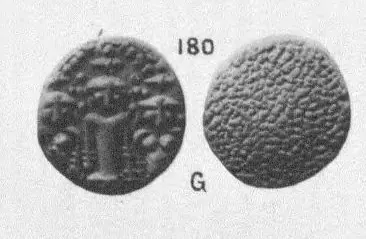 "Known as the Kuruki pagoda, struck by the Nawabs of Arcot": gold pagoda with three standing figures (Elliot 1886, Pl. IV, No. 180)Coin · 1886
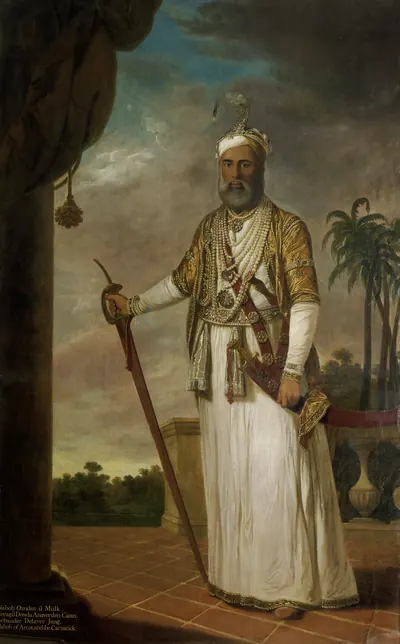 Muhammad Ali Khan Walajah, Nawab of Arcot: full-length portrait by Tilly Kettle, 1770s (Norfolk Museums)Other · c. 1772–76
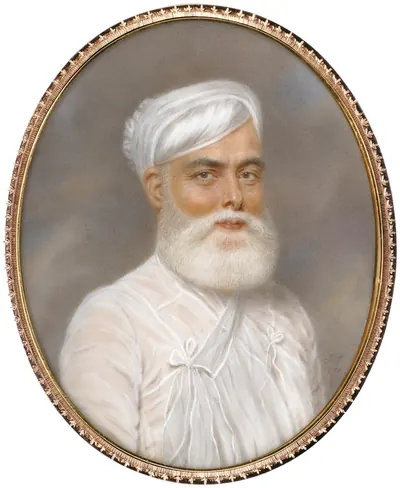 Muhammad Ali Khan Walajah, Nawab of Arcot: portrait miniature by John Smart, 1791Other · 1791
Related
Dynasties
References
Notes (0)
Sources (5)
Spotted an error on this page? Tell us
Last updated: