Guntur (Murtazanagar)
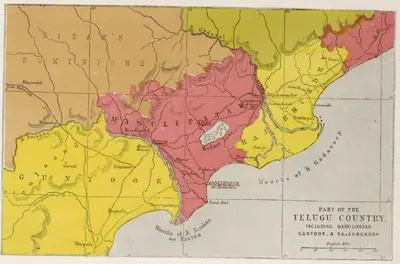
Town south of the Krishna that gave its name to the Guntur or Murtazanagar sarkar (district), the southernmost of the five Northern Circars of the Qutb Shahi and Mughal coast. Its standard assessment of about 11.7 lakhs of rupees, more than half of it crown land, was entered on the Mughal records after 1687. The Mughals counted the coast south of it as the Haidarabadi Karnatak. It passed to the East India Company only in 1788.
Guntur was the chief place of the southernmost of the five coastal sarkars (districts): Guntur, Kondapalli, Eluru (then Ellore), Rajahmundry and Srikakulam (then Chicacole).1 The Imperial Gazetteer of Madras says that they dated “from the Musalman occupation of that part of the country”.1 The English called them the Northern Circars, and their chief town was Machilipatnam (then Masulipatam).1 See the Mughals in the Telugu country, Machilipatnam and Kondaveedu.
The Murtazanagar sarkar
James Grant wrote a Political Survey of the Northern Circars, printed with the Fifth Report of 1812. He calls the sarkar “Guntoor, or Moortezanagur”. He gives its standard assessment as Rs 11,67,709, as entered on Aurangzeb’s records after the conquest of Golconda.2 Of this, “the havillee, or household portion, was” Rs 6,79,945.2 So more than half the sarkar was crown land, managed directly by the government.2
Grant explains that a large part of the revenue in Guntur was set aside for the household cavalry stationed there.3 The same was done in Srikakulam on the northern frontier.3 This was “before the conquest of the Carnatic, in the year 1652”.3
Gateway to the Karnatak
Grant describes Guntur, “as lying on the south side of the Kistna”, as “the master-key of the Carnatic towards the north”.4 The Mughals treated the coast south of it as part of the Karnatak. Sarkar says that the lowland of the Haidarabadi Karnatak “embraced the sea-coast from Gantur to Sadras”.56 Grant Duff says that the Hyderabad Carnatic “extended from Guntoor along the Coromandel coast”.7
Later history
The Nizam ceded the Northern Circars to the East India Company in 1766.8 At that time Guntur was held for life by his brother Basalat Jang, and it came under British administration only in 1788.8
Footnotes
-
Imperial Gazetteer of India: Madras, Vol. I (1908), p. 185 (archive.org (opens in a new tab)). ↩ ↩2 ↩3
-
James Grant, “Political Survey of the Northern Circars”, in W. K. Firminger (ed.), The Fifth Report from the Select Committee … on the Affairs of the East India Company, Vol. III (1918), p. 47 (archive.org (opens in a new tab)). ↩ ↩2 ↩3
-
Grant, “Political Survey”, in Firminger, Fifth Report, Vol. III (1918), p. 48 (archive.org (opens in a new tab)). ↩ ↩2 ↩3
-
James Grant, “Political Survey of the Northern Circars”, in W. K. Firminger (ed.), The Fifth Report from the Select Committee … on the Affairs of the East India Company, Vol. III (1918), p. 10 (archive.org (opens in a new tab)). ↩
-
Jadunath Sarkar, History of Aurangzib, Vol. V (1924), p. 50 (archive.org (opens in a new tab)). ↩
-
Sarkar, Aurangzib V (1924), p. 51 (archive.org (opens in a new tab)). ↩
-
James Grant Duff, A History of the Mahrattas, Vol. I (1826), p. 346 (archive.org (opens in a new tab)). ↩
-
Imperial Gazetteer: Madras, Vol. I (1908), p. 186 (archive.org (opens in a new tab)). ↩ ↩2
Photos
References
Notes (0)
Sources (4)
Spotted an error on this page? Tell us
Last updated: