Tirupati and Tirumala
Pilgrim town at the foot of the Tirumala hills in the old North Arcot (later Chittoor) district, and the hill town of Tirumala above it. Tirumala has the temple of Venkatesvara, which James Fergusson's revisers called the most sacred in the Madras Presidency. Krishnadeva Raya visited it after his eastern wars, gave it jewels and set up copper statues of himself and his queens. The later Aravidu kings made their grants before its god and lived at Chandragiri, in sight of the hill.
The North Arcot manual of 1894 describes “Tirupati: Sometimes called Lower Tirupati to distinguish it from Upper Tirupati or Tirumala, the sacred hill of pilgrimage”.12 It says that the lower town “is irregularly built, with narrow and dirty streets”.12 The manual adds that “were it not for the sanctity of the temple on the hills, the place would soon sink into insignificance”.12 This is because “it is from the pilgrims that the residents derive their livelihood”.12
The town has fifteen temples.12 The chief are those of Govindarajasvami and Ramasvami, and of these “the former has an imposing gopuram” (gateway tower).12
Tirumala, “or the holy hill”, stands on top of the range 6 miles away.34 The manual found the town “a most disappointing sight”.34 It said that “the only structure really deserving notice is the thousand-pillared mantapam on the skirts of the town”.34 It judged this hall later than the temple.34 See the Tirumala temple and Chandragiri.
The hill temple
James Fergusson’s revisers wrote in 1910 that the hill temple “was reputed to be the richest, the most magnificent, as it was certainly the most sacred of all those in the Presidency”.56 It was so sacred “that no unbelieving foreigner had ever been allowed to climb the holy hill”.56
J. D. B. Gribble entered it in 1870 with a party pursuing a murderer.56 He exclaimed, “Another of the illusions of my youth destroyed”.56 The revisers judged it “a fair specimen of a Dravidian temple of the second class, but in a sad state of dilapidation and disrepair”.56
Vijayanagara at Tirumala
The Tirumala temple keeps records of Krishnadeva Raya of 1514 in Telugu, Kannada and Tamil.78 In V. Rangacharya’s summary, one of them mentions “Krishnaraya’s attack on Prataparudra Gajapati”.78 Two records of 1512–13 record gifts by his queens.78
The Telugu Rayavachakamu says that at Tirupati the king performed the sixteen great gifts and presented jewels and gold.9 It says that he set up copper statues of himself and his queens Tirumala Devi and Chinna Devi before the god.9 H. Krishna Sastri published a photograph of the statues in 1915.10
The Kondavidu pillar inscription of 1520 levies customs for the god Raghunayaka.11 They were collected “at roads frequented (by people), such as (those to) the Tirumala hills”.11 See the Tirumala inscriptions and Krishnadeva Raya.
Krishna Sastri noted that the copper-plate grants of Venkatapati all bear the signature sri Venkatesa.10 They were made “in the presence of the god Venkatesa on the hill at Tirumala”.10 From this, a move of the capital from Penukonda to Chandragiri, “a town close to Tirupati”, has been inferred.10 A labelled copper statue of Venkatapatiraya stands at the entrance of the temple.10 See Venkatapati II.
Footnotes
-
Arthur F. Cox, rev. Harold A. Stuart, Madras District Manuals: North Arcot, Vol. II (1894), p. 326 (archive.org (opens in a new tab)). ↩ ↩2 ↩3 ↩4 ↩5 ↩6
-
Cox and Stuart, North Arcot Manual, Vol. II (1894), p. 327 (archive.org (opens in a new tab)). ↩ ↩2 ↩3 ↩4 ↩5 ↩6
-
Cox and Stuart, North Arcot Manual, Vol. II (1894), p. 328 (archive.org (opens in a new tab)). ↩ ↩2 ↩3 ↩4
-
Cox and Stuart, North Arcot Manual, Vol. II (1894), p. 331 (archive.org (opens in a new tab)). ↩ ↩2 ↩3 ↩4
-
James Fergusson, History of Indian and Eastern Architecture, Vol. I, revised by James Burgess (1910), p. 404, note 2 (archive.org (opens in a new tab)). ↩ ↩2 ↩3 ↩4 ↩5
-
Fergusson, Indian and Eastern Architecture, Vol. I (1910), p. 407, note continued (archive.org (opens in a new tab)). ↩ ↩2 ↩3 ↩4 ↩5
-
V. Rangacharya, A Topographical List of the Inscriptions of the Madras Presidency, Vol. I (1919), p. 472, Chittoor No. 9-A (archive.org (opens in a new tab)). ↩ ↩2 ↩3
-
Rangacharya, Topographical List, Vol. I (1919), p. 473, Chittoor Nos. 9-M and 9-N (archive.org (opens in a new tab)). ↩ ↩2 ↩3
-
S. Krishnaswami Aiyangar (ed.), Sources of Vijayanagar History (1919), p. 117, extract from the Rayavachakamu (archive.org (opens in a new tab)). ↩ ↩2
-
H. Krishna Sastri, “The Third Vijayanagara Dynasty; its Viceroys and Ministers”, Archaeological Survey of India, Annual Report 1911–12 (1915), p. 189 and note 3 (archive.org (opens in a new tab)). ↩ ↩2 ↩3 ↩4 ↩5
-
H. Luders and H. Krishna Sastri, “Kondavidu Inscription of Krishnaraya”, Epigraphia Indica VI (1900–01), p. 232 (archive.org (opens in a new tab)). ↩ ↩2
Photos
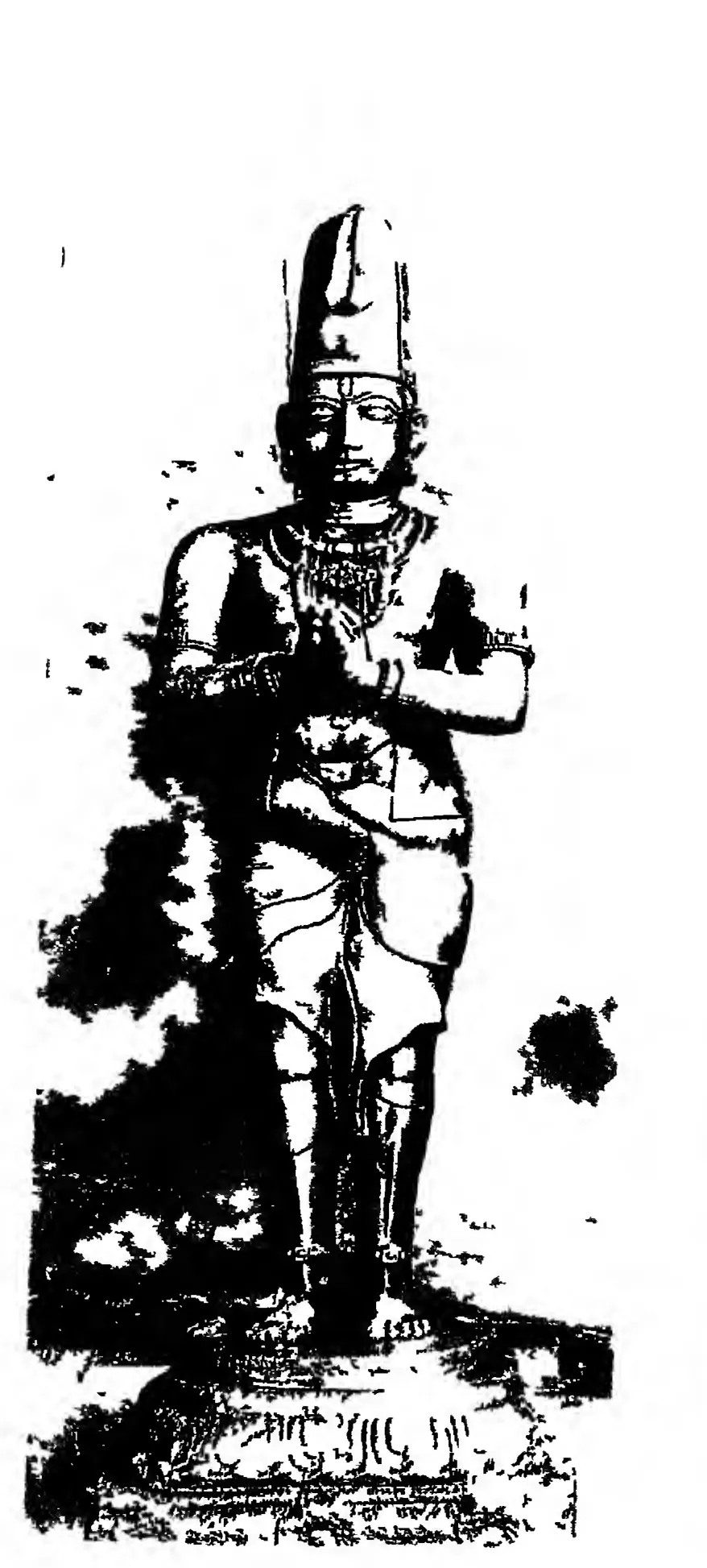
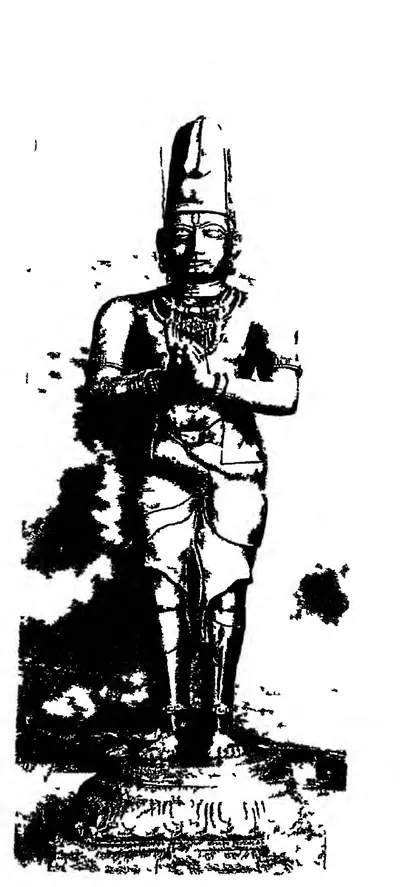 "A king, perhaps Tirumala", unlabelled stone image in the Tirumala temple (ASI Annual Report 1911-12, plate LXXVI, fig. 5 (PDF p. 354))Historic photograph · 1915
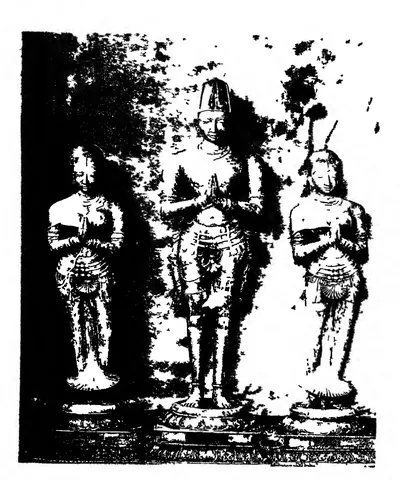 "Chinnadevi", "Krishnaraya-Maharaya" and "Tirumaladevi", copper statues in the Tirumala temple (ASI Annual Report 1911-12, plate LXXVI, figs. 1-3 (PDF p. 354))Historic photograph · 1915
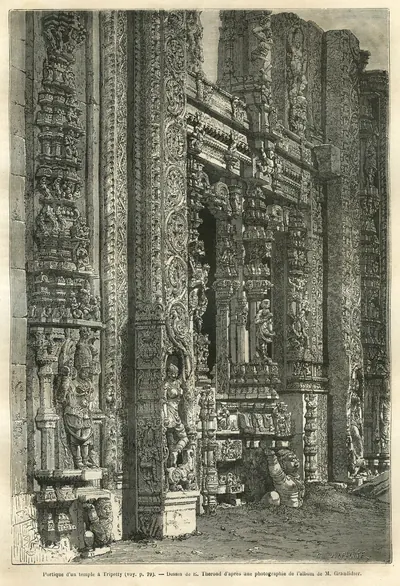 "Gate of the temple at Tripetty", wood engraving by E. Therond, about 1878Drawing · 1878
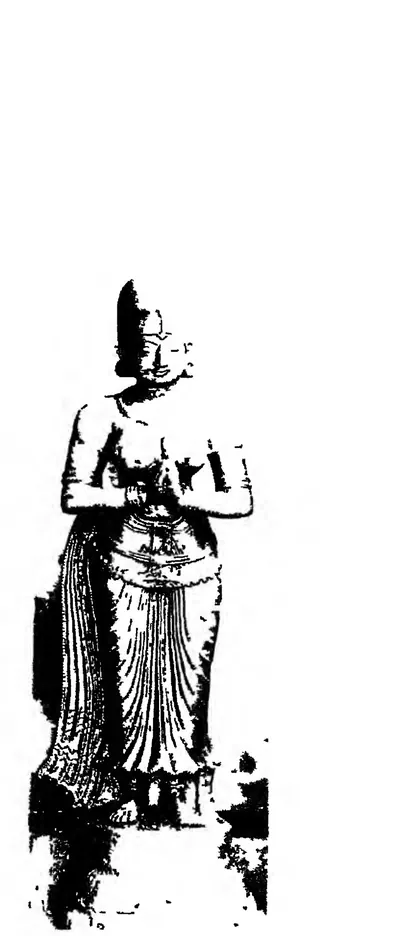 "His queen, perhaps Vengalamba", unlabelled stone image in the Tirumala temple (ASI Annual Report 1911-12, plate LXXVI, fig. 6 (PDF p. 354))Historic photograph · 1915
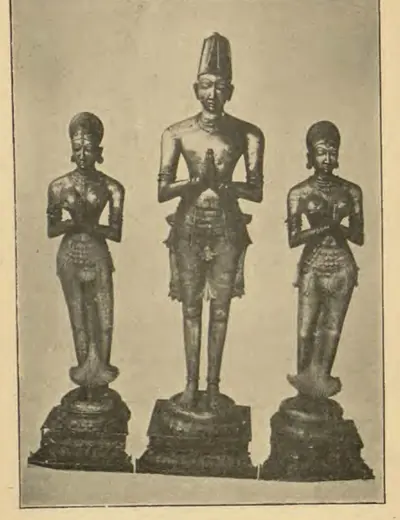 "Metal images of Krishna Raya and his two queens, Tirupati Temple, Chittoor District" (Longhurst, Hampi Ruins, 3rd ed. 1933, fig. 14, p. 42 (PDF p. 56))Historic photograph · 1933
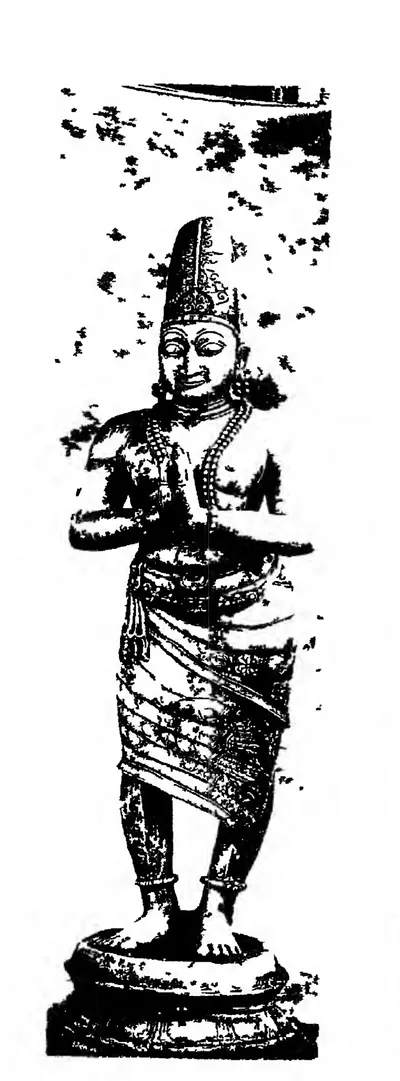 "Venkatapatiraya", labelled copper statue at the entrance of the Tirumala temple (ASI Annual Report 1911-12, plate LXXVI, fig. 4 (PDF p. 354))Historic photograph · 1915
Related
People
Shivaji
c. 1627–1680 CE
Founder of the Maratha kingdom (died 1680), crowned at Raigarh in 1674. In the Telugu country he is remembered for his Karnatak expedition of 1677. He made an alliance with Abul Hasan Qutb Shah of Golconda, and the king and his ministers Madanna and Akkanna received him at Hyderabad with great ceremony. He made a pilgrimage to Srisailam, crossed the Krishna near Kurnool and sent his army south through the Cuddapah country to Jinji. On the way home he took the fort of Bellary. In 1680 Bijapur gave him its rights over the Bellary and Anantapur country.
Muhammad Ali Khan Walajah
1749–1795 CE
Nawab of the Carnatic (Arcot) from 1749 to 1795, the son of Anwar-ud-din Khan. His father was killed at Ambur in 1749. He held out at Trichinopoly and, with English help, won the Nawabship from Chanda Sahib and the French. The treaty of Paris of 1763 recognised him, and the Mughal emperor gave him the title Walajah. His Telugu districts were Nellore, held under his brother Najib-ullah, who rebelled in 1757, Ongole and the Palnad. He owed large debts to the Company and to private lenders. He handed the revenues of the Carnatic to the Company in 1781, saw it take over their management in 1790–92, and agreed by the treaty of 1792 to pay nine lakhs of pagodas a year for its troops. He died in October 1795.
Najib-ullah Khan
Brother of the Nawab Muhammad Ali Walajah and governor of Nellore in the 1750s. In 1753 the adventurer Muhammad Kamal drove him out of Nellore, but he won it back and had Kamal beheaded. In 1757 he refused his brother's demand for an extra payment and rebelled. His garrison beat off the attack of the Nawab's army and an English force under Colonel Forde. He went over to the French, received Bussy at Nellore in 1758 and joined Moracin against Tirupati. When the French siege of Madras failed in 1759, he killed the Frenchmen with him and was confirmed in Nellore for a tribute of 30,000 pagodas. In 1762 an English force under Caillaud took the Nellore fort from him for the Nawab.
Tallapaka Annamacharya
Telugu composer of devotional songs (sankirtanas) to the god Venkatesvara of Tirupati, the first of the Tallapaka family of temple poets. The Tirupati temple dated him 1408–1503 when it printed his songs in 1941. Temple records of 1530–1558, studied by S. Krishnaswami Aiyangar, show his son Tirumalai Aiyangar as the temple's appointed singer, and his grandson setting up his image as a teacher.
Monuments
Inscriptions
References
Notes (0)
Sources (6)
Spotted an error on this page? Tell us
Last updated: