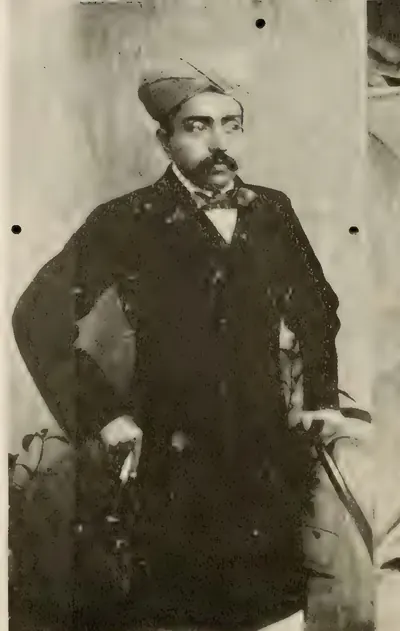
Muhammad Beg Khan of Banganapalle
Muhammad Beg Khan was the Mughal killedar (fort commander) of Banganapalle who, according to the Kurnool manual, became a petty Nawab when the first Nizam made himself independent. The Nizam confirmed the territory to him as a jagir (land grant), and he died at Banganapalle about 1758. The manual and Vadivelu call him a relative of Aurangzeb's minister Mubariz Khan. The Imperial Gazetteer and the 1961 Census handbook, using the family's own papers, speak of two men of this name: a first killedar and his adopted son. A document of 1718–19 at Banganapalle bears the seal of a Muhammad Beg Khan.
Download
Muhammad Beg Khan was the first ruler of Banganapalle in the Kurnool manual’s history of the State.12 He began as a Mughal fort commander and ended as a petty Nawab under the first Nizam.12 In the manual’s account, the later rulers descend from his granddaughter, the sister of Gulli Nawab.2 See the Banganapalle State.
Killedar of Banganapalle
The Kurnool manual (1886) says that “towards the close of the seventeenth century” Muhammad Beg Khan was made killadar (fort commander) of Banganapalle.1 It calls him “a relative of Mubaraz Khan (a Vazier of Aurangzebe)”.1 His brother, Fazl Ali Khan, was made commander of the nearby fort of Chenchelimala.1 The brother soon died without children, so Chenchelimala was added to Muhammad Beg’s charge.1
A. Vadivelu’s family history (1903) tells the same story.3 In his account Aurangzeb appointed “Mahomed Beg Khan, a relation of his Minister, Mubaraz Khan”, as jagirdar (holder of the land grant).3 Before that, Vadivelu says, Bijapur had given Banganapalle in 1643 to a general named Siddu Simbul.4 Aitchison’s collection of treaties (1892) calls Muhammad Beg the “son of Aurangzeb’s Grand Wazir”.5 See the Mughals in the Telugu country.
A petty Nawab under the Nizam
Muhammad Beg held his joint charge until the Mughal empire broke up.2 Then Asaf Jah, the first Nizam, “assumed sovereign powers”, and Muhammad Beg “became a petty chieftain or nabob”.2 The manual goes on: “In the course of his southern tour, it is said, Asaf Ja recognised Muhammad Beg’s title and granted the territory in jaghire.”2 Vadivelu says much the same, and adds that Muhammad Beg Khan “declared his independence”.3 See Nizam-ul-Mulk Asaf Jah I.
The jagir was settled by the middle of the century.6 In 1750 Nasir Jang promised a village to his envoy Saif-ud-din, who asked for Banganapalle.6 But Nasir Jang was “unwilling to oust the Jaghiredar of Banganapalle” and asked him to choose another village.6 The manual does not name this jagirdar.6 By its own dates, Muhammad Beg Khan was still alive in 1750.2 See Nasir Jang.
Death and heirs
Muhammad Beg Khan died at Banganapalle about 1172 of the Hijra (1758).2 His son, also called Fazl Ali Khan, had died before him.2 So his grandson, Fazl Ali Khan, known as Gulli Nawab, followed him as a boy of ten.2 Vadivelu says that “Mahomed Beg Khan and his descendants held the Jaghir till 1758”.3 See Fazl Ali Khan (Gulli Nawab).
The family’s own account
The Imperial Gazetteer (1908) used the family’s papers.7 The oldest title-deed the family could show was dated 1761.7 It records the Nizam appointing Husain Ali Khan as killadar and faujdar (magistrate) of Banganapalle, and it mentions “the removal of one Muhammad Beg Khan”.7
The gazetteer adds that, according to the family’s manuscripts, Muhammad Beg Khan “was the great-grandfather of Husain Ali Khan”.7 He was also “the adopted son of a person of the same name appointed Kiladar of Banganapalle by the Sultan of Bijapur in the last half of the seventeenth century”.7 A document still kept at Banganapalle “bears the seal of Muhammad Beg Khan and the date 1131 Hijra (A.D. 1718–19)”.7
The District Census Handbook of Kurnool (1961, printed 1964) gives a fuller family history.8 It says that a Muhammad Beg Khan Rosebhani became killadar of Banganapalle through his nephew Mubariz Khan, then governor of the Deccan.8 His adopted son, Muhammad Beg Khan-e-lung, followed him in 1686 and was killadar until 1725.8 Late in his rule this second Muhammad Beg asked Delhi for a sanad (deed of grant) for the jagir.8 The handbook says that the minister Qutb-ul-Mulk granted it under the seal of Rafi-ud-Darajat, a grandson of Aurangzeb.8 When he died in 1725, his son-in-law Ata Khan followed him.8
Where the sources disagree
- One man or two. The Kurnool manual and Vadivelu tell of one Muhammad Beg Khan, appointed by the Mughals and confirmed by the first Nizam.123 The Imperial Gazetteer and the Census handbook tell of a first killadar and his adopted son of the same name.78
- Who appointed the first Muhammad Beg. The manual and Vadivelu say the Mughals.13 The Imperial Gazetteer says the Sultan of Bijapur.7
- His relationship to Mubariz Khan. The manual and Vadivelu call him a relative of Mubariz Khan.13 Aitchison calls him the son of Aurangzeb’s chief minister.5 The Census handbook makes Mubariz Khan his nephew.8
- When he died. The manual dates his death to about 1758.2 The Census handbook dates the death of the second Muhammad Beg Khan to 1725.8 The 1761 deed in the Imperial Gazetteer mentions the removal of a Muhammad Beg Khan in that year.7
Footnotes
-
Narahari Gopalakristnamah Chetty, A Manual of the Kurnool District (1886), p. 246 (archive.org (opens in a new tab)). ↩ ↩2 ↩3 ↩4 ↩5 ↩6 ↩7 ↩8 ↩9
-
Chetty, Kurnool District (1886), p. 247 (archive.org (opens in a new tab)). ↩ ↩2 ↩3 ↩4 ↩5 ↩6 ↩7 ↩8 ↩9 ↩10 ↩11 ↩12
-
A. Vadivelu, The Aristocracy of Southern India (1903), p. 6 (archive.org (opens in a new tab)). ↩ ↩2 ↩3 ↩4 ↩5 ↩6 ↩7
-
Vadivelu, Aristocracy of Southern India (1903), p. 5 (archive.org (opens in a new tab)). ↩
-
C. U. Aitchison, A Collection of Treaties, Engagements and Sanads, Vol. VIII (1892), Part I, p. 97, “Banganapalle” (archive.org (opens in a new tab)). ↩ ↩2
-
Chetty, Kurnool District (1886), p. 32 (archive.org (opens in a new tab)). ↩ ↩2 ↩3 ↩4
-
Imperial Gazetteer of India, Provincial Series: Madras, Vol. II (1908), p. 472, “Banganapalle State” (archive.org (opens in a new tab)). ↩ ↩2 ↩3 ↩4 ↩5 ↩6 ↩7 ↩8 ↩9
-
A. Chandra Sekhar, Census of India 1961, Andhra Pradesh: District Census Handbook, Kurnool District (1964), p. xxx (PDF p. 49) (censusindia.gov.in (opens in a new tab)). Paraphrased (Public domain in India). ↩ ↩2 ↩3 ↩4 ↩5 ↩6 ↩7 ↩8 ↩9
Related
Dynasties
References
Notes (0)
Sources (5)
Spotted an error on this page? Tell us
Last updated: