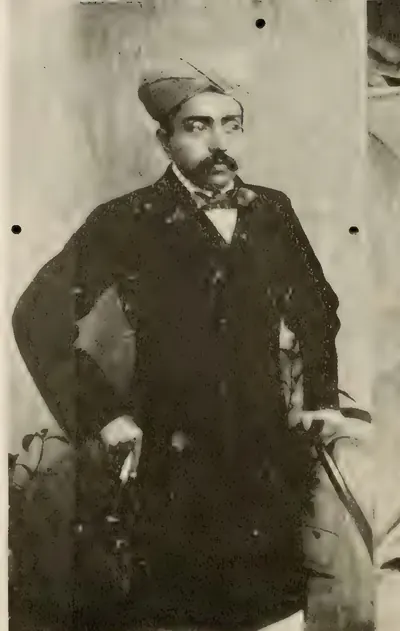
Fazl Ali Khan (Gulli Nawab) of Banganapalle
Fazl Ali Khan, called Gulli Nawab, was the grandson of Muhammad Beg Khan and, in the Kurnool manual, the second ruler of Banganapalle. He came to the throne as a boy of ten, lost power for eight years to a relative, Muhammad Beg Khan Laug, and then drove him out. Haidar Ali forced him to submit, and his old tribute to the Nawab of Kurnool ended. He had no children. He married his sister to a Persian, Saiyid Muhammad Khan Nagadi, and gave Banganapalle and Chenchelimala to her sons, Husain Ali Khan and Asad Ali Khan. He died in 1782 after a reign of sixteen years. The 1961 Census handbook calls him Fazl Ali Khan II and dates his rule 1737–1769.
Download
Fazl Ali Khan, better known as Gulli Nawab, ruled Banganapalle in the second half of the eighteenth century.1 In the Kurnool manual he is the link between the first ruler, Muhammad Beg Khan, and the family of his sister, which held the State after him.1 Almost all that is known of him comes from one page of that manual.1 See the Banganapalle State.
A boy ruler
The manual says that Muhammad Beg Khan’s son, Fazl Ali Khan, died before his father.1 So when Muhammad Beg died about 1758, his grandson succeeded him.1 This was “Fassal Ali Khan, alias Gulli Nabob, a boy of ten years of age”.1 See Muhammad Beg Khan.
While he was a child, power was seized by a relative, Muhammad Beg Khan Laug.1 He was the husband of the young Nawab’s maternal aunt, and he “ruled for eight years”.1 Then Gulli Nawab drove him out.1
Haidar Ali
In Gulli Nawab’s lifetime, the manual says, Haidar Ali of Mysore “invaded the country and reduced the Nabob to submission”.1 Until then Banganapalle had paid tribute to the Nawab of Kurnool.1 That tribute “was now abolished”.1 The manual does not date the invasion.1 See Haidar Ali and the Nawabs of Kurnool.
His sister’s sons
Gulli Nawab had a sister, Avautul Batul Khanum.1 He married her to Saiyid Muhammad Khan Nagadi, a Persian nobleman who had served Saadatullah Khan, the Nawab of Arcot.1 They had two sons, Saiyid Husain Ali Khan and Saiyid Asad Ali Khan.1 See Saadatullah Khan.
Gulli Nawab had no children of his own, so he “looked upon them as his own children”.1 He gave Banganapalle to Husain Ali Khan and the fort of Chenchelimala to Asad Ali Khan.1 He died at Banganapalle in 1197 of the Hijra (1782), “after a reign of sixteen years”.1 See Husain Ali Khan and Asad Ali Khan.
The Census handbook’s account
The District Census Handbook of Kurnool (1961, printed 1964) tells the family’s story with other names and dates.2 It does not use the name Gulli Nawab.2 But its Fazl Ali Khan II, like the manual’s Gulli Nawab, is the son of a Fazl Ali Khan, has no children and is followed by his sister’s son, Husain Ali Khan.21
In the handbook’s account, Fazl Ali Khan I ruled for nine years and died in 1737.2 His son, Fazl Ali Khan II, then held the jagir (land grant) for thirty-two years and died in 1769.2 The handbook says it was believed that he stayed unmarried because he wanted his beloved sister’s son to rule after him.2 He adopted his nephew Husain Ali Khan as his son.23
Where the sources disagree
- His grandfather. The manual makes him the grandson of Muhammad Beg Khan.1 The Census handbook makes his father, Fazl Ali Khan I, the brother-in-law of Ata Khan, who was the son-in-law of the second Muhammad Beg Khan.2
- His dates. The manual’s dates give him about 1766 to 1782, after his grandfather’s death about 1758 and the regent’s eight years.1 The Census handbook dates his rule from 1737 to 1769.2
- Husain Ali Khan’s grant. The manual says that Gulli Nawab gave Banganapalle to Husain Ali Khan.1 The Imperial Gazetteer found that the family’s oldest deed records the Nizam appointing Husain Ali Khan in 1761.4
- The family line. A. Vadivelu’s family history (1903) says that Saiyid Muhammad Khan Nagadi married the granddaughter of the jagirdar Fazle Ali Khan.5 It says that a relative named Ghulam Ali Khan succeeded Fazle Ali Khan about 1732, and that Husain Ali Khan came after him.5
Footnotes
-
Narahari Gopalakristnamah Chetty, A Manual of the Kurnool District (1886), p. 247 and note (archive.org (opens in a new tab)). ↩ ↩2 ↩3 ↩4 ↩5 ↩6 ↩7 ↩8 ↩9 ↩10 ↩11 ↩12 ↩13 ↩14 ↩15 ↩16 ↩17 ↩18 ↩19 ↩20 ↩21 ↩22 ↩23
-
A. Chandra Sekhar, Census of India 1961, Andhra Pradesh: District Census Handbook, Kurnool District (1964), p. xxx (PDF p. 49) (censusindia.gov.in (opens in a new tab)). Paraphrased (Public domain in India). ↩ ↩2 ↩3 ↩4 ↩5 ↩6 ↩7 ↩8 ↩9
-
Chandra Sekhar, District Census Handbook, Kurnool (1964), p. xxxi (PDF p. 52) (censusindia.gov.in (opens in a new tab)). Paraphrased (Public domain in India). ↩
-
Imperial Gazetteer of India, Provincial Series: Madras, Vol. II (1908), p. 472, “Banganapalle State” (archive.org (opens in a new tab)). ↩
-
A. Vadivelu, The Aristocracy of Southern India (1903), p. 6 (archive.org (opens in a new tab)). ↩ ↩2
Related
Dynasties
References
Notes (0)
Sources (4)
Spotted an error on this page? Tell us
Last updated: