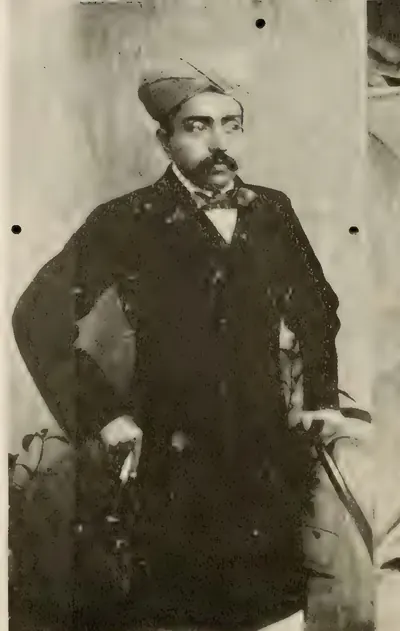
Husain Ali Khan of Banganapalle
Saiyid Husain Ali Khan was the first ruler of Banganapalle from the family that held it until 1948. He was the son of a Persian, Saiyid Muhammad Khan Nagadi, and of the sister of Gulli Nawab, who gave him Banganapalle. The family's oldest deed records the Nizam appointing him killedar and faujdar of Banganapalle in 1761. He served Haidar Ali of Mysore as a soldier. After Haidar's death he set out for home but died on the way, about 1783. Tipu Sultan confirmed the jagir to his son Ghulam Ali Khan but soon took it back.
Download
Saiyid Husain Ali Khan was the first ruler of Banganapalle from the family that held it until 1948.12 He came to power through his mother, the sister of Gulli Nawab.3 He spent much of his life as a soldier of Haidar Ali, and his early death left Banganapalle open to Tipu Sultan.45 See the Banganapalle State.
Family
The Kurnool manual (1886) says that his father was Saiyid Muhammad Khan Nagadi, a Persian nobleman.3 Nagadi had served Saadatullah Khan, the Nawab of Arcot.3 His mother was Avautul Batul Khanum, the sister of Gulli Nawab.3 Husain Ali Khan was the elder of their two sons, and Asad Ali Khan the younger.3
A note in the manual traces the father’s family to Persia.3 Nagadi’s father, Tahar Ali Khan, had fled from Persia to the court of Sikandar Adil Shah of Bijapur.3 The District Census Handbook of Kurnool (1961, printed 1964) tells the same story.1 It adds that Tahar Ali was a younger son of Syed Muhammad Razvi, chief minister to Shah Abbas II of Persia.1 So, the handbook says, the Nawabs descended from Mubariz Khan on one side and from Razvi on the other.6 See Saadatullah Khan.
Ruler of Banganapalle
Gulli Nawab had no children and “looked upon them as his own children”.3 He gave Banganapalle to Husain Ali Khan and the fort of Chenchelimala to his brother Asad Ali Khan.3 The Census handbook says that its Fazl Ali Khan II adopted Husain Ali Khan as his son.6 Husain Ali Khan became ruler, it says, when Fazl Ali died in 1769.6 See Fazl Ali Khan (Gulli Nawab).
The Imperial Gazetteer (1908) found an earlier date in the family’s papers.7 Their oldest title-deed is dated 1761.7 It records “that the Nizam in that year appointed one Husain Ali Khan as Kiladar (commandant) and Faujdar (magistrate) of Banganapalle”.7 It also mentions “the removal of one Muhammad Beg Khan”, apparently from the same post.7 The gazetteer adds that “within a few years the country fell under the dominion of Mysore”.7 See Muhammad Beg Khan.
A soldier of Haidar Ali
A. Vadivelu’s family history (1903) says that Husain Ali Khan wanted to win a name as a soldier.4 So he asked Haidar Ali, then at the height of his power, for a post in his army.4 He served in Mysore until Haidar’s death, “with benefit to the State and credit to himself”.4 The Census handbook also calls him a general of great distinction under Haidar.6 See Haidar Ali.
Death
When Tipu Sultan came to the throne, Vadivelu says, Husain Ali Khan was ill and took leave to go home.4 But he died on the way and never saw Banganapalle again.4 The Census handbook says that his body was brought to Banganapalle on the 27th day of Ramzan in 1783.6
He left four young sons:3
- Ghulam Ali Khan
- Mustafa Ali Khan
- Ahmad Ali Khan
- Fateh Ali Khan3
Because they were minors, their uncle Asad Ali Khan managed the territory for them.3
The Imperial Gazetteer describes a letter of 1783 from Tipu in the Madras records.7 It praised “the assiduity of the recently deceased Husain Ali Khan in the Sarkar affairs” and gave the jagir (land grant) to his son Ghulam Ali Khan.7 But Tipu soon took it back and drove Ghulam Ali Khan out.7 Vadivelu says that Tipu summoned the widow and her sons, and that he seized the jagir when she delayed.45 See Ghulam Ali Khan (Mansur-ud-daula) and Tipu Sultan.
Where the sources disagree
- How he came to Banganapalle. The manual says that Gulli Nawab gave it to him.3 The Imperial Gazetteer says that a deed of 1761 records the Nizam appointing him.7 Vadivelu says that he followed a relative named Ghulam Ali Khan.4 The Census handbook says that his uncle Fazl Ali Khan II adopted him, and that he became ruler in 1769.6
- His dates. The manual’s dates leave him a short time as head of the family, between Gulli Nawab’s death in 1782 and Tipu’s summons of 1783.3 The deed of 1761 and the Census handbook give him much longer.76
- His mother’s family. The manual makes his mother the sister of Gulli Nawab.3 The Census handbook calls her the daughter of Fazl Ali Khan I.1 Vadivelu calls her a granddaughter of Fazle Ali Khan.4
Footnotes
-
A. Chandra Sekhar, Census of India 1961, Andhra Pradesh: District Census Handbook, Kurnool District (1964), p. xxx (PDF p. 49) (censusindia.gov.in (opens in a new tab)). Paraphrased (Public domain in India). ↩ ↩2 ↩3 ↩4
-
Chandra Sekhar, District Census Handbook, Kurnool (1964), p. xxxii (PDF p. 53) (censusindia.gov.in (opens in a new tab)). Paraphrased (Public domain in India). ↩
-
Narahari Gopalakristnamah Chetty, A Manual of the Kurnool District (1886), p. 247 and note (archive.org (opens in a new tab)). ↩ ↩2 ↩3 ↩4 ↩5 ↩6 ↩7 ↩8 ↩9 ↩10 ↩11 ↩12 ↩13 ↩14 ↩15
-
A. Vadivelu, The Aristocracy of Southern India (1903), p. 6 (archive.org (opens in a new tab)). ↩ ↩2 ↩3 ↩4 ↩5 ↩6 ↩7 ↩8 ↩9
-
Vadivelu, Aristocracy of Southern India (1903), p. 7 (archive.org (opens in a new tab)). ↩ ↩2
-
Chandra Sekhar, District Census Handbook, Kurnool (1964), p. xxxi (PDF p. 52) (censusindia.gov.in (opens in a new tab)). Paraphrased (Public domain in India). ↩ ↩2 ↩3 ↩4 ↩5 ↩6 ↩7
-
Imperial Gazetteer of India, Provincial Series: Madras, Vol. II (1908), p. 472, “Banganapalle State” (archive.org (opens in a new tab)). ↩ ↩2 ↩3 ↩4 ↩5 ↩6 ↩7 ↩8 ↩9 ↩10
Related
Dynasties
References
Notes (0)
Sources (4)
Spotted an error on this page? Tell us
Last updated: