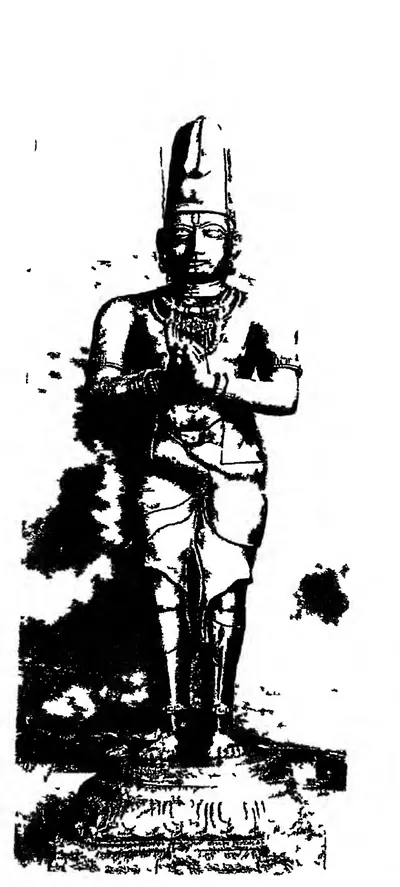
Pedda Venkata (Vijayanagara)
Pedda Venkata, a grandson of Aliya Rama Raya, was king of Vijayanagara from 1630 until his death in October 1642. His inscriptions run from Anantapur and Nellore to the Tamil country, but the Nayaka of Madurai and the ruler of Mysore were by then almost independent, and Bijapur and Golconda pressed on his lands. In 1639 his Naik, Damarla Venkatappa, gave the English the site of Madras. His nephew Sriranga III followed him.
Download
Pedda Venkata was king of Vijayanagara from 1630 until his death in October 1642.12 He was a grandson of Aliya Rama Raya, the regent who fell in the battle of 1565.13 By his time the empire was much smaller. The great Nayakas of the south obeyed it only in name, and the sultans of Bijapur and Golconda pressed on it from the north.45 See Vijayanagara and Aliya Rama Raya.
Family
The Telugu poem Ramarajiyamu, as S. Krishnaswami Aiyangar summarised it, says that Sriranga, a son of Aliya Rama Raya, had two sons: Pedda Venkata and Chinna Venkata.3 The poem says that Pedda Venkata married Bangaramma, daughter of the chief Gobburi Oba.3 Sewell’s later family tree also names his wife Bangara.6
His younger brother Chinna Venkata had three sons, Tirumala, Venkatapati and Sriranga.7 This Sriranga later followed his uncle on the throne as Sriranga III.76
King
Sewell’s later work says that King Rama II seems to have died in 1630, and that Pedda Venkata succeeded him.1 The Ramarajiyamu claims that he ruled the whole empire in peace, from the Krishna to Rameswaram.3 His inscriptions show where he was still recognised as king:148
- the Anantapur, Chingleput and North Arcot districts in 16331
- the Tirunelveli (then Tinnevelly) district in 1634, by the Kuniyur plates4
- Mysore in 1636, where he is said to rule from Penukonda, and the Nellore and North Arcot districts in the same year4
- the Anantapur district in 1638, 1639 and 164048
One record of 1636 calls him “Anegondi Venkatapati”, after the fort just across the Tungabhadra from the old capital.4 But in the far south the Nayaka of Madurai had by then thrown off his loyalty.4 In southern Mysore, Sewell notes, he was king in name, while Kanthirava Narasa of Mysore was the real ruler.8
In Krishnaswami Aiyangar’s view, the king’s lands were hemmed in. On one side was the Bijapur territory held by the Maratha Shahji, and on the other the conquests of Mir Jumla for Golconda.5 In 1640, Sewell says, the king sent Prince Sriranga to bring the Nayakas of Madurai and Thanjavur (then Tanjore) back to obedience.8 Tirumala Nayaka of Madurai called in help from Golconda and drove off the royal troops.8 The Thanjavur Nayaka submitted.8
The grant of Madras
In 1639 the English trader Francis Day obtained land at “Medraspatam”, three miles north of San Thome.9 He got it from Damarla Venkatappa, the Naik (governor) who ruled the coast from Pulicat to San Thome.109 The Naik gave him a grant of land and privileges, and leave to build a fort.9 This was the beginning of Fort St. George and the city of Madras.8
Henry Davison Love, the historian of old Madras, notes that Dutch records of 1642 call the Naik’s brother Aiyappa a brother-in-law of Venkatapati, Rajah of Vijayanagar.9 The English later spoke of the cowles (grants) “of the former King and our Naik”.11 Love concluded that Rajah Venkatapati had confirmed the Naik’s grant before October 1642, though no copy of his confirmation survives.11
Death
Love says that Rajah Venkatapati of Vijayanagar died in October 1642, and that his nephew Sri Ranga Rayal succeeded him.2 Sewell’s later work also dates his death to October 1642.8 Some local chiefs would not accept the new king. Damarla Venkatappa refused, and was imprisoned.2 See Sriranga III.
Where the sources disagree
- Who granted Madras. Sewell (1900) wrote that the site of Fort St. George was granted to Francis Day by “Sri Ranga Raya VI” in March 1639, the king then living at Chandragiri.12 Love and Sewell’s later work say that the grant of 1639 was made by the Naik Damarla Venkatappa.98 Love adds that Rajah Venkatapati confirmed it.11
- His number. Sewell’s later work calls him Pedda Venkata II.1 Krishnaswami Aiyangar calls him Venkata II.5 Sewell (1900) listed him as “Pedda Venkata II”, with inscriptions of 1634 and 1636.13
Footnotes
-
Robert Sewell, ed. S. Krishnaswami Aiyangar, The Historical Inscriptions of Southern India (1932), p. 275 (archive.org (opens in a new tab)). ↩ ↩2 ↩3 ↩4 ↩5 ↩6
-
Love, Vestiges of Old Madras, Vol. I (1913), p. 53 (archive.org (opens in a new tab)). ↩ ↩2 ↩3
-
S. Krishnaswami Aiyangar (ed.), Sources of Vijayanagar History (1919), p. 310, the Ramarajiyamu of Venkayya (archive.org (opens in a new tab)). ↩ ↩2 ↩3 ↩4
-
Sewell, Historical Inscriptions (1932), p. 276 (archive.org (opens in a new tab)). ↩ ↩2 ↩3 ↩4 ↩5 ↩6 ↩7
-
S. Krishnaswami Aiyangar, introduction to R. Sathyanatha Aiyar, History of the Nayaks of Madura (1924), p. 16 (archive.org (opens in a new tab)). ↩ ↩2 ↩3
-
Sewell, Historical Inscriptions (1932), p. 402, pedigree of the Aravidu dynasty (archive.org (opens in a new tab)). ↩ ↩2
-
Krishnaswami Aiyangar, Sources of Vijayanagar History (1919), p. 311, the Ramarajiyamu (archive.org (opens in a new tab)). ↩ ↩2
-
Sewell, Historical Inscriptions (1932), p. 277 (archive.org (opens in a new tab)). ↩ ↩2 ↩3 ↩4 ↩5 ↩6 ↩7 ↩8 ↩9
-
Love, Vestiges of Old Madras, Vol. I (1913), p. 14 and note (archive.org (opens in a new tab)). ↩ ↩2 ↩3 ↩4 ↩5
-
Henry Davison Love, Vestiges of Old Madras, 1640–1800, Vol. I (1913), p. 13 and note (archive.org (opens in a new tab)). ↩
-
Love, Vestiges of Old Madras, Vol. I (1913), p. 60 and note (archive.org (opens in a new tab)). ↩ ↩2 ↩3
-
Sewell, A Forgotten Empire (1900), p. 221 (archive.org (opens in a new tab)). ↩
-
Robert Sewell, A Forgotten Empire (Vijayanagar) (1900), p. 214, genealogy of the third dynasty (archive.org (opens in a new tab)). ↩
Related
Dynasties
References
Notes (0)
Sources (5)
Spotted an error on this page? Tell us
Last updated: