Penukonda
Town at the foot of a fortified hill over 3,000 feet high in the Anantapur district. It was the seat of a Vijayanagara prince from 1354, the refuge of the court after the defeat of 1565, and the capital of the Aravidu kings until they moved to Chandragiri. An inscription says its fort was built in 1354, and Channappa Nayudu repaired it for Tirumala. The Gagan Mahal palace, the Rama and Isvara temples and the Sher Khan mosque stand within it. Bijapur took it about 1652.
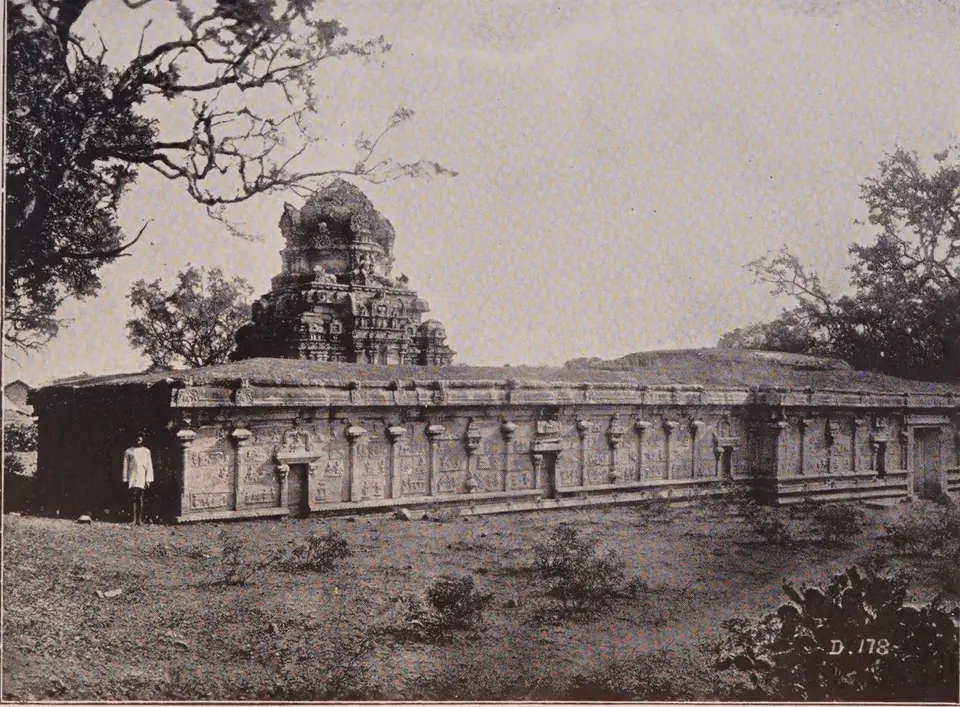
Penukonda is a town in the Anantapur district, at the foot of a fortified hill.1 An inscription dates its fort to 1354, and the Anantapur gazetteer concluded that a Vijayanagara prince lived there from the start of that dynasty’s rule.21 After the defeat of 1565 it became the headquarters of what was left of the Vijayanagara empire.3
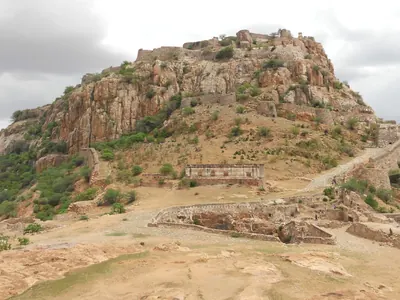
The Anantapur gazetteer of 1905 called Penukonda “the most interesting town in the district” from a historical point of view.1 It stands in a very picturesque spot, at the foot of a steep, rugged and strongly fortified hill “over three thousand feet in height”.1 From the hill, “a semi-circular line of massive fortifications stretches out for some distance into the plain”.1 A large tank (reservoir) lies along its southern side, and ruins and carved stones lie about on every side.1
An inscription of Saka 1778 (1856; Saka is an Indian way of counting years) in the hill temple calls Penukonda “the throne of the kingdom of Ghanagiri, i.e., Penukonda”.4 See the Penukonda fort.
Under the first dynasties
The earliest record of the town is the Kannada (Kanarese) inscription of 1354 at the north gate.2 It says that the fort was built while Bukka I’s son Virupanna governed the province of Penugonde.2
The gazetteer concluded that “at the very beginning of the rule of the Vijayanagar dynasty Penukonda was the residence of one of its princes”.13 It added that the town “evidently continued for many years to be one of the chief strongholds of the Vijayanagar kings”.13 According to Nuniz, Narasa Nayak kept the heir of the Saluva usurper prisoner in this fort, and had him murdered.13
A letter of 1510 to Albuquerque says that a rebel vassal (subordinate chief) seized a city called “Pergunda”.56 H. Luders took this city to be Penukonda, held by the chiefs of Ummattur until Krishnadeva Raya recovered it.56 The gazetteer says that Krishnadeva “is widely believed to have made the town his residence at one time”.3 The best of its stone-lined wells is popularly credited to him.3 See the Penukonda fort inscription and Krishnadeva Raya.
Capital of the Aravidus
After the defeat of 1565, Tirumala and the puppet king Sadasiva “hurried with all their treasure to the Penukonda fort”.3 They tried to reoccupy the old capital, but failed.3 Then “Penukonda became the head-quarters of what remained of the empire”.3
H. Krishna Sastri read an inscription of 1577 at the north gate.7 He took it to show that Tirumala already held Penukonda before the battle.7 In his reading, Tirumala’s officer Channappa Nayudu defended it against Muslim armies in 1566–67, 1568–69 and 1576–77.7
The gazetteer says that Tirumala’s son Ranga fled to Chandragiri, “in terror at the constant successes of the Musalmans”.38 After that, governors ruled Penukonda.38 It withstood a Bijapur blockade in 1577 and a Golconda siege in 1589.38
Krishna Sastri, on the other hand, noted that Venkatapati’s inscriptions “mention his capital Penugonda”.9 He said that Venkatapati’s move to Chandragiri is only inferred, since “no direct statement to that effect” had been found.9 Records at Ahobilam of 1584 and 1585 call Sriranga I and Venkatapati “ruling at Penugonda”.10 See Tirumala, Venkatapati II, Chandragiri and the Penukonda inscription of 1577.
After Vijayanagara
A Mackenzie manuscript says that the place fell to Bijapur in 1652.8 Its governor, Konati Nayudu, had been bribed with a large jagir (land grant).8 The gazetteer says that the Muslim conquerors pulled down many temples and built mosques from their materials.8
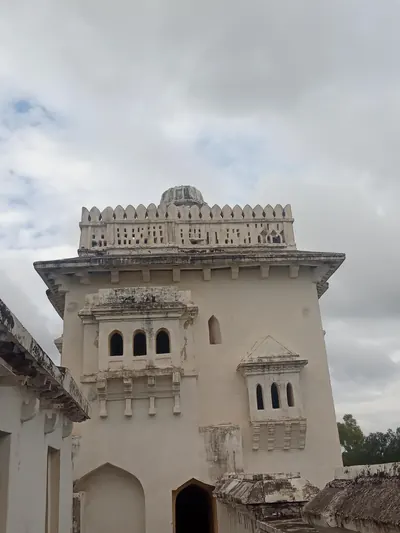
About a century later, the town belonged to the Maratha Morari Rao of Gooty.8 Haidar Ali took it from him in 1762.8 The gazetteer singled out these buildings:811
- the Sher Khan mosque, in whose courtyard pavement lies a Telugu inscription of Sadasiva dated 1564
- the Ramasvami and Isvara temples, whose carvings “are much after the style of those on the Hazara Ramasvami temple at Vijayanagar”
- the Gagana Mahal palace
- the darga (shrine of a saint) of Babayya, which, its legend says, took over a temple of “Harihara of Vijayanagar”811
See the Gagan Mahal and Vijayanagara.
Footnotes
-
W. Francis, Madras District Gazetteers: Anantapur (1905), p. 190 (archive.org (opens in a new tab)). ↩ ↩2 ↩3 ↩4 ↩5 ↩6 ↩7 ↩8 ↩9
-
E. Hultzsch, “Ranganatha Inscription of Goppana; Saka-Samvat 1293”, Epigraphia Indica VI (1900–01), p. 327 (archive.org (opens in a new tab)). ↩ ↩2 ↩3
-
Francis, Anantapur Gazetteer (1905), p. 191 (archive.org (opens in a new tab)). ↩ ↩2 ↩3 ↩4 ↩5 ↩6 ↩7 ↩8 ↩9 ↩10 ↩11 ↩12
-
V. Rangacharya, A Topographical List of the Inscriptions of the Madras Presidency, Vol. I (1919), p. 24, Anantapur No. 153 (archive.org (opens in a new tab)). ↩
-
H. Luders, “Amaravati Inscription of Krishnaraya of Vijayanagara; Saka-Samvat 1437”, Epigraphia Indica VII (1902–03), p. 18 (archive.org (opens in a new tab)). ↩ ↩2
-
Luders, “Amaravati Inscription of Krishnaraya”, Epigraphia Indica VII (1902–03), p. 19 (archive.org (opens in a new tab)). ↩ ↩2
-
H. Krishna Sastri, “The Third Vijayanagara Dynasty; its Viceroys and Ministers”, Archaeological Survey of India, Annual Report 1911–12 (1915), p. 184 (archive.org (opens in a new tab)). ↩ ↩2 ↩3
-
Francis, Anantapur Gazetteer (1905), p. 192 (archive.org (opens in a new tab)). ↩ ↩2 ↩3 ↩4 ↩5 ↩6 ↩7 ↩8 ↩9 ↩10
-
Krishna Sastri, “The Third Vijayanagara Dynasty”, ASI Annual Report 1911–12 (1915), p. 189 and note 2 (archive.org (opens in a new tab)). ↩ ↩2
-
Rangacharya, Topographical List, Vol. II (1919), p. 973, Kurnool Nos. 584 and 585 (archive.org (opens in a new tab)). ↩
-
Francis, Anantapur Gazetteer (1905), p. 193 (archive.org (opens in a new tab)). ↩ ↩2
Photos
Related
People
Ballala III (Hoysala)
1292–1342 CE
The last great Hoysala king, crowned on 31 January 1292, who united the two halves of the kingdom. Malik Kafur took his capital Dorasamudra in 1311; the city was rebuilt by 1316 and destroyed again by a Tughluq army, after which he lived at Tiruvannamalai. His inscriptions in the Anantapur district run from 1317 to 1340, and in 1328 his minister ruled at Penukonda. A Kakatiya general defeated him at Kanchi. He was killed fighting the Sultan of Madurai on 8 September 1342.
Ali Adil Shah I
c. 1558–1580 CE
Fifth Adil Shahi sultan of Bijapur (r. 1558–1580). He was first an ally of Aliya Rama Raya, but then joined the league of Deccan sultans that defeated and killed Rama Raya in January 1565. Afterwards he won back Raichur and Mudgal, took Adoni in 1568 and turned south against the Aravidu kings, besieging Penukonda. The date and details of that siege are disputed. He was the husband of Chand Bibi.
Muhammad Quli Qutb Shah
1566–1612 CE
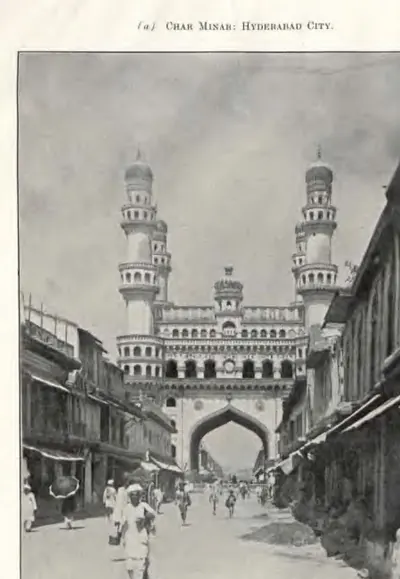
Fifth Qutb Shahi sultan of Golconda (1580–1612), third son of Ibrahim Qutb Shah. He founded the city of Bhagnagar, later Hyderabad, on the Musi river around 1589–91, and built the Charminar, the Jami Masjid and the Dar-ush-Shifa hospital there. Ferishta says he named the city after a singer, Bhagmati. The sources differ on who she was and on how the city got its later name. He wrote poetry in Persian and the old Urdu of the Deccan.
Ibrahim Adil Shah II
1580–1627 CE
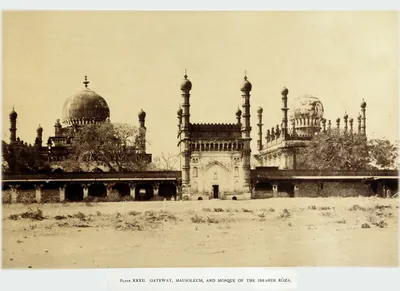
Sixth Adil Shahi sultan of Bijapur (r. 1580–1627), nephew and successor of Ali Adil Shah I, called Jagat Guru. He was the patron of the historian Ferishta and the builder of the Ibrahim Rauza. In his reign Bijapur held Adoni against a siege of 1595–96. Early in the seventeenth century it took Kurnool from the last Hindu chief of the town. Heras places Ferishta's account of a failed Bijapur siege of Penukonda in these years.
Muhammad Adil Shah
1627–1656 CE
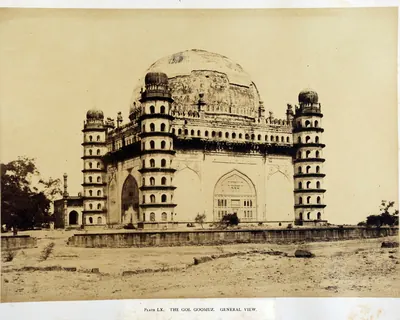
Seventh Adil Shahi sultan of Bijapur (r. 1627–1656), called Mahmud in some histories, and the builder of the Gol Gumbaz. He made peace with Shah Jahan in 1636 and then sent his armies into the Karnatak, with Shahji Bhonsle among the commanders. Bijapur took Jinji and Vellore, Penukonda (1652, by a Mackenzie manuscript) and the uplands of the Bellary and Anantapur country. It divided the Karnatak with Golconda's minister Mir Jumla.
Morari Rao Ghorpade
c. 1741–1776 CE
A Maratha soldier who fought for pay, of the Ghorpade family. He was lord of Gooty from the 1740s until Haidar Ali took the fortress in 1776. The Marathas left him as governor of Trichinopoly in 1741. He gave it up to the first Nizam in the mid-1740s and was accepted as chief of Gooty under the subahdar of the Deccan. His horsemen, whom Orme thought the best Indian soldiers of the day, fought in the Carnatic wars for Muhammad Ali and the English, for Mysore and for the French. Later they fought with the English against Haidar. He held Penukonda and Madakasira and took tribute from the Anantapur poligars. After a long siege of Gooty he surrendered to Haidar and died a prisoner at Kabbaldurga.
Haidar Ali
1761–1782 CE
A soldier who made himself master of Mysore in 1761 and ruled it until he died in December 1782. In the Telugu country he took Penukonda and Madakasira from the Maratha Morari Rao in 1762. He won back Gurramkonda through his brother-in-law Mir Sahib in 1768, took Bellary in 1775 and took Gooty from Morari Rao in 1776. In 1779 he conquered the Nawab of Cuddapah, and the Nawab of Kurnool and the poligars of the Bellary and Anantapur country paid him tribute. His invasion of the Carnatic in 1780 began the Second Mysore War.
Tipu Sultan
1782–1799 CE
Son of Haidar Ali and ruler of Mysore from December 1782 until he was killed at the fall of Seringapatam on 4 May 1799. As a young commander he took Gurramkonda back from the Marathas in 1773–74. As Sultan he held Gooty, Gurramkonda, Cuddapah, Bellary and the Anantapur country. He gave Gooty and Gurramkonda the new names Faiz Hisar and Zafarabad and struck copper coins at both. He besieged Adoni in 1786 and seized the poligars of Rayadurg and Harpanahalli. By the treaty of 1792 he gave up Cuddapah, Gurramkonda, Bellary and Tadpatri to the Nizam. The rest of his Telugu districts went to the Nizam after his death and were ceded to the East India Company in 1800.
Monuments
Inscriptions
Penukonda fort inscription (1354)
1354 CE
A Kanarese (Kannada) inscription on a bastion of the north gate of Penukonda fort. It is dated Saka 1276, Jaya, which E. Hultzsch equated with 25 March 1354. It records that the minister Anantarasa built the fort while Bukka I ruled and his son Virupanna governed the province of Penugonde. It is the earliest dated record of the town, and it shows that a prince of the first Vijayanagara dynasty lived there.
Penukonda inscription of Channappa Nayudu (1577)
c. 1577 CE
An inscription on the south wall of the Anjaneya temple at the north gate of Penukonda fort. It is dated Saka 1499, Dhatri (1576–77), in the reign of Sriranga I. It records that Channappa Nayudu, an officer of Tirumala, built an inner fort, gates, bastions and trenches at Penukonda for Tirumala. He beat off Muslim generals in 1566–67, 1568–69 and 1576–77. The record ends by calling Penukonda a city built by a god, whose walls no man could boast of conquering. H. Krishna Sastri read it as proof that Tirumala held Penukonda before the battle of 1565.
References
Notes (0)
Sources (6)
Spotted an error on this page? Tell us
Last updated: